
White Rhinoceros Profile
In the Pleistocene, our species began a process of destruction that we are only now beginning to understand. Our people wiped out all mammoths, sabre-toothed cats, and various other charismatic megafauna entirely, and substantially reduced what was left. By the time of the Romans, this entitlement saw lions driven to extinction in Europe and Elephants eradicated from North Africa.
Back then, there was no concept of a global ecosystem, and ecologists were thin on the ground. So, it could be argued that they didn’t know any better. Today, though, we do. Yet, we’re still at it, and the White Rhinoceros is one of the largest victims of our nature.

White Rhinoceros Facts Overview
| Habitat: | Dense forests, savannas, and woodlands with grassy openings |
| Location: | Sub-Saharan Africa, south of the DRC |
| Lifespan: | 50 years |
| Size: | Up to 3.8 metres 12.5 ft |
| Weight: | Up to 3,600 kg (7,900 lb) |
| Colour: | Grey |
| Diet: | Grasses |
| Predators: | Hyenas, lions, humans |
| Top Speed: | Probably less than 32 km/h (20 mph) |
| No. of Species: | 1 |
| Conservation Status: | Near Threatened |
White rhinos are true prehistoric monsters. But they don’t carry much of an attitude for it; these are relatively non-aggressive rhinos who just want to be left alone.
They are one of the biggest animals on the planet, and can really do some harm when threatened, unless, of course, you’re an elephant. But the majority of rhino-related harm is directed towards them, and by us. Following in the footsteps of the extinct Pleistocene megafauna and the white rhino’s Critically Endangered cousin, the black rhino, this species is in rapid decline for very stupid reasons. And its eradication would mean far more than simply the loss of a charismatic animal.
Interesting White Rhinoceros Facts
1. They’re ancient
Rhinos once stomped about all over the shop. They would have migrated with the mammoth herds in the Steppe, welcomed our species into North America, and could even handle the frigid winters of the Pleistocene Arctic.
Now, there are only 3 species in Asia, and two in Africa. The African species are 14 million years old, and 5 million years separated, and are the Critically Endangered black rhino, and the more common, but also struggling, white rhino.
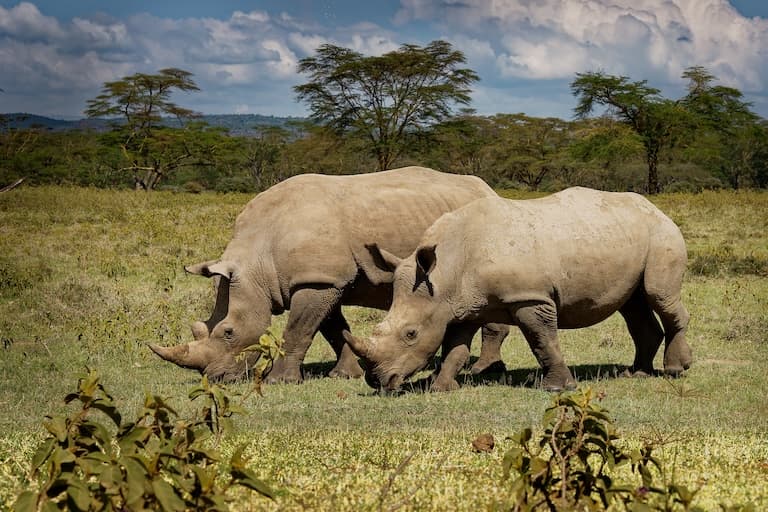
The two can be told apart from their faces: the black rhino is a browser of shrubs and herbs, and so has a prehensile pointed upper lip to select specific foods with; the white rhino is a lawnmower, and grazes with a wide mouth. From the side, the white rhino also has a much longer head.
Both of these animals are huge, but the white rhino is the largest rhinoceros species1.
2. They’re enormous
There aren’t many animals on land that are bigger than a white rhino. These are Miocene monsters, and represent the old guard of mammalian orders from a time when it wasn’t the even-toed ungulates that reigned, but the odd-toed ones.
Today, those odd-toed mammals have been reduced to the horses, tapirs and rhinos, and the 250 to 300 species of even-toed ungulates have taken over.
So, rhinos are truly walking museums, and pack a serious prehistoric punch. White rhinos can grow to over 3,600 kg, and carry with them their characteristic piercing weaponry that’s used for digging, competition, and stabbing into other enormous animals.
3. They’re quite stupid
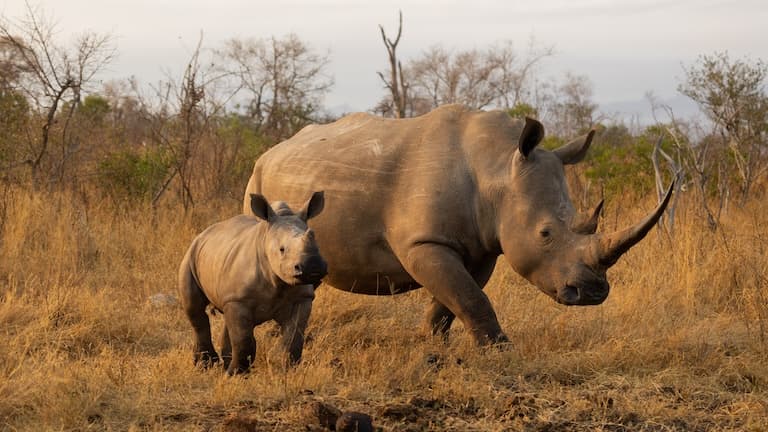
Rhinos are notoriously crotchety animals in the wild, but in captivity can be very charming. A tame rhino is as friendly as a monstrous puppy, and the babies are at least as adorable.
But being cute takes no more brain power than being a marauding tank of a machine, and so rhinos are very limited in their cognitive abilities.
They eat, they play, they defend their young and themselves, but they aren’t too bright. And sometimes, their ego can get the better of them.
Despite being the third-heaviest animal on land, they share their range with the first heaviest: the African elephant. And sometimes, the rhino’s small brains persuade it that it’s a good idea to go up against one. But if the white rhino is a tank, the African elephant is… whatever is three times stronger than a tank. And the rhino is easily bulldozed, pierced, and sent packing.
4. They’re a keystone species
Like all mega herbivores, white rhinos have a significant impact on the world around them. They control the very primary producers that support every other tier of the ecosystem. They do this by grazing, but also by simply being heavy and trampling the ground beneath them.
The repercussions on the climate of our removal of all these animals are only just becoming apparent, but science is starting to hint towards mammalian (non-human) biomass being a substantial supporter of climate stability.
After a meal, their dung also supports smaller ecosystems like the beetles that breed in it, and the birds that eat them, as well as fertilising the very ground that they feed from.
So, all of this makes it very important that we keep them around – rhino conservation is not just about the very human bias to save animals we like, it’s also about saving a species we really need. Unfortunately, we’re not doing a good job of it2.

5. They’re in trouble
Most of the world’s landmasses were once riddled with giant herbivores like the white rhino. There were even members like the European Elsasmotherium that grew to over twice the mass, or some that had thick coats of woolly jackets. We are the reason these animals no longer exist.
There’s not much we can do about that now, and technically, we shouldn’t be held responsible for the mistakes of our ancestors, but we can learn from them. Yet, we are proving to be slow learners, and the white rhino is a good example of this.
Like all rhinos, they’re hunted for their horns. These horns are ground up to put in what some people erroneously call “Medicine”, and this is in spite of having plenty of actual medical therapies available. That’s because the rhino horn powder nowadays isn’t about treating an illness, and is instead a symbol of wealth and status.
This demand for expensive nonsense has driven the northern subspecies entirely to extinction, and the species as a whole is now Near Threatened with a declining population of around 10,000 remaining across Africa. And the rhino horn therapy itself is most likely useless.
6. Rhino horn is probably ineffective
There’s a grim irony in this animal’s most conspicuous tool of self-defence being the very driver of its extinction. Rhino horn is ground up to treat fevers, infections, and various other ailments, but research into its components has fallen short of finding anything worthwhile in this regard.
It’s made of keratin – the same protein that makes hair and fingernails, and there’s very little chemical difference about it than either of these. So, treating illnesses with rhino horn is about as sensible as eating your own toe clippings, but even if it did have medicinal value, this argument dangerously sidesteps the wider issue3.
7. But that’s not important
The arguments around whether or not alternative medicines are effective, at least in this context, have the same effect on discussions as arguing the semantics around human trafficking in US politics – they are a distraction.
The fundamental argument against wiping out a rare and ancient animal lies not in any justification for it, but in the fact that there is no justification for it. Our ecosystem is our life support system, and if we think it’s okay to remove components of that for short-term gain, then we’re behaving no differently than a bacterial infection or malignant melanoma. This approach to the natural world is unsustainable because, as much as we consider ourselves above nature, the truth is we are simply a component of it.
So, whether rhino horn has cultural, medical, or economic value in any form is not important. Nothing we need as individuals trumps the importance of a healthy ecosystem for our species and the millions of other species that all equally rely upon it.
White Rhinoceros Fact-File Summary
Scientific Classification
| Kingdom: | Animalia |
| Phylum: | Chordata |
| Class: | Mammalia |
| Order: | Perissodactyla |
| Family: | Rhinocerotidae |
| Genus: | Ceratotherium |
| Species Name: | simum |
Fact Sources & References
- Brindley (2016), “How to Tell the Difference Between Black and White Rhino”, Travel For Wildlife.
- Megan (2025), “Why Conserving Black and White Rhinos Matters: Facts, Threats, and How to Help”, Wildlife Act.
- Juliette (2024), “As a medicine, study finds rhino horn useless — and potentially toxic”, MONGABAY.