
Snapping Turtle Profile
Turtles are best known as the car-sized derpy shields that swim around with tranquillity in the oceans, but they originated in the presence of dinosaurs, and so their most basal members still have all the hardware they evolved in response to this.
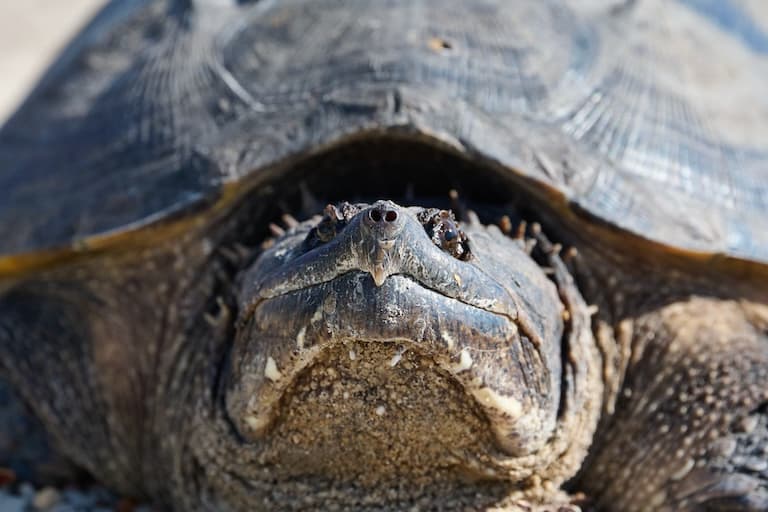
Snapping turtles are ancient and scary-looking predators with a fearsome bite. But they’re not a threat to humans and can even be kept as pets by more experienced exotic animal owners.
However, this isn’t a suggestion that you do – they are far better left in the wild, and in many cases, are heavily protected.
Snapping Turtle Facts Overview
| Habitat: | Freshwater, usually still or slow-moving, murky or obscured by plants |
| Location: | Southern and Eastern North America, |
| Lifespan: | Up to around 70 years |
| Size: | Around 1 metre (3 ft) long |
| Weight: | Up to 150 kg, perhaps more, in exceptional cases |
| Colour: | Usually covered in algae, with grey/green sometimes yellowish skin |
| Diet: | Fish, small mammals, birds, acorns! |
| Predators: | Otters, birds, humans |
| Top Speed: | Slow |
| No. of Species: | 5-6 |
| Conservation Status: | Vulnerable and Endangered |
Snapping turtles are outstanding, ancient and powerful ambush predators that shameless frauds like Coyote Peterson have misrepresented for money.
These are not monsters; they’re turtles. And they are mortal. They can bite off your finger! But they will leave your garden tools intact, and there’s no sensible reason to pretend otherwise.
Interesting Snapping Turtle Facts
1. They’re ancient
Snapping turtles as they are today might have been around, more or less unchanged, as far back as 100 million years ago.
Around that time, the Americas were not remotely conjoined, and North America had a great big shallow sea bisecting it vertically, full of mosasaurs and other scary monsters. And the shallows would have been the domain of monster crocodilians.
And this, as some people have hypothesised, is what made snapping turtles so freakish. With monster crocs on their heels, they needed to evolve spines, hard plates, immensely powerful jaws, and other such prehistoric defences suitable for the Cretaceous ecosystem.
And this served them well, too. Snappers today make up about five species, but in ye olde dinosaur times, they were plentiful and far more widespread1.
And some even go as far as to say that this family of snapping turtles is ancestral to all modern turtles, from scary to adorable.
2. They get huge
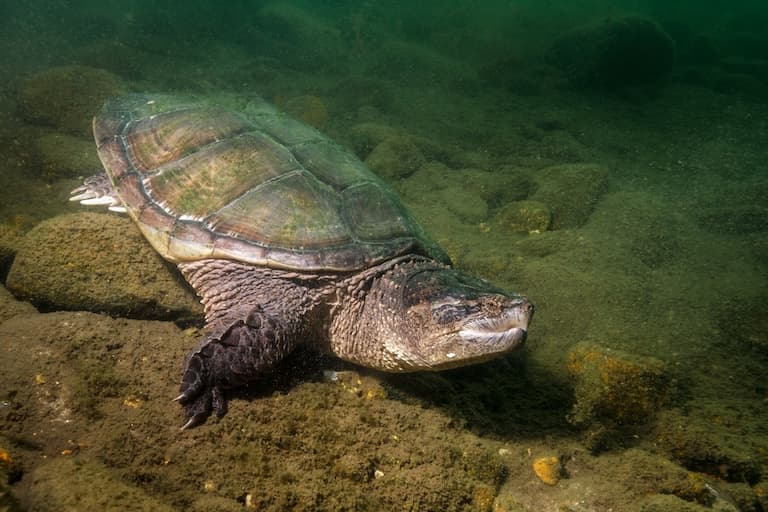
Of all freshwater turtles, the alligator snapper is the largest. This animal can grow to horrific proportions, and while they average somewhere between 20-50 kg when fully grown, some have been found that have reached way past 100 kg.
These exceptional hulks are usually, if not always, old adult males, suggesting that at least in the males, they never stop growing.
Snapping turtles this big are, understandably, intimidating, and they can be pretty aggressive, too.
3. They’re aggressive
There are two genera of snappers around today. The Alligator snapping turtle is in the Macrochelys genus, and the far more common common snapping turtle is in the Chelydra genus.
Both of these groups contain turtles known for biting, and they do this with gusto, as we’ll soon discuss, but as aggressive as they may be, this attitude isn’t aimed at humans, but at one another and their prey.
Snappers, it’s fair to generalise, do not enjoy the company of one another. These solitary reptiles are unfriendly at best, and dangerously defensive of their personal space at worst.
With very little variety in their defensive capabilities, they rely on their thick skins, leathery, protective shells, and the tool at the front end for which they are named.

4. They snap!
The feeding strategy of these turtles is to lie very still for a remarkably long time, growing algae on their shells, hiding silently amid the plant matter or mud in a pond or at the bottom of a river, and wait.
This doesn’t cost much energy at all, and so snapping turtles can save all their units for a single snap, which they do with alarming speed, once a hapless victim gets within range.
The precise bite speed is hard to nail down, but it’s quite clearly a rapid motion, and in the larger species, the force is also enough to sever a finger. In 2016, a 15-year-old boy had what’s medically referred to as a “Traumatic amputation”, using the clean, swift motion of an alligator snapping turtle’s mouth parts2.
Be warned, the attached reference has a photo of the stump for proof!
But even after all this, snappers aren’t monsters; they aren’t typically aggressive to things they don’t think are food, and don’t routinely go after fingers. And the legendary status of their bite has been entirely overblown3.
5. But not that much
In classic internet fashion, we’ve managed to take something that’s truly impressive and make it appear less so by over-representing it.
The remarkable snap of the snapping turtle has been exaggerated to the point of absurdity, with claims that it can snap clean through a broom handle. Remarkably, given the ease of access to both brooms and snapping turtles, this incredible feat doesn’t seem to have ever appeared on video. Mysterious!
Not really. As brilliant as they are, they can’t snap clean through thick wood, any more than a raw liver diet can make someone less of a loser. It’s another internet myth.
They can do some pretty mediocre damage to very soft bamboo, though! So, if you have any soft bamboo around, keep it out of the mouth of any snapping turtle you might have nearby.
6. They eat acorns
Perhaps the cutest thing about snapping turtles is that they don’t purely eat meat.
This may or may not be a product of stupidity, rather than dietary preference, as they are distinctly froglike in their concern for what’s in front of them, but it is well documented that even alligator snapping turtles will eat acorns, alongside the indiscriminate slaughter of anything else small enough to bite.
Seeds, tubers, stalks, nuts and fruits also end up in the gullet of alligator snappers, and in one survey, more than half the gut contents by volume of those sampled were acorns.
Whether these are ingested on purpose or not, they come out the other end able to germinate, and as a sign that this has been happening for millions of years, they might also be more viable after passing through the turtle, which suggests an evolutionary response to the act on behalf of the plant.
Unfortunately, the contents of the guts of these animals were determined by cutting them open, which was part of a commercial harvest, and points to some of the reasons why there’s a common snapping turtle and a much less common one4.
7. They’re in trouble
The common snapping turtle is doing fine, likely in part because it isn’t very tasty.
But alligator snappers are in trouble. Both species are on the list, with the Suwanee alligator snapper listed as vulnerable, and the Western alligator snapper endangered. Illegal harvest, bycatch, habitat destruction and water pollution are all to blame; essentially the same killers that affect all freshwater systems the world over, where humans are involved5.
Being rather ugly and scary-looking animals, conservation is hampered by a lack of public concern and is mostly limited to state and regional legislation. Fortunately, there are now many protected areas within the ranges of these turtles, but both are still considered in decline.
Snapping Turtle Fact-File Summary
Scientific Classification
| Kingdom: | Animalia |
| Phylum: | Chordata |
| Class: | Reptilia |
| Order: | Testudines |
| Family: | Chelydridae |
Fact Sources & References
- (2025), “Snapping Turtles: A Misunderstood Dinosaur! ⎹ Critter Corner”, Found an Animal.
- Johnson and Nielsen (2016), “Traumatic Amputation of Finger From an Alligator Snapping Turtle Bite”, Pubmed.
- Boojibs, “Snapping turtle makes half a hotdog absolutely disappear”, Reddit.
- Sloan et al (1996), “Stomach contents of commercially harvested alligator snapping turtles, Macroclemys temminckii”, ResearchGate.
- Carr et al (2023), “Western Alligator Snapping Turtle”, The IUCN Red List of Threatened Species in 2023.