
Shrike Profile
As any observer of the djent brand of heavy metal knows, it all starts with nine baritone strings, tuning a step and a half down, and making a face like you’re being forced to tolerate a brutal fart. Then, pop on the jazz metronome, hammer on the G-sus chord and you’re pretty much done. You just have to think of a name.
And if you happen to be a wildlife biologist as a side gig (between all the touring and volunteering your time with all the insatiable groupies), then not only have you picked two of the least lucrative pursuits in life, but you’re also in a unique position to call upon a sweet-looking songbird called a shrike for all your darkest inspiration.
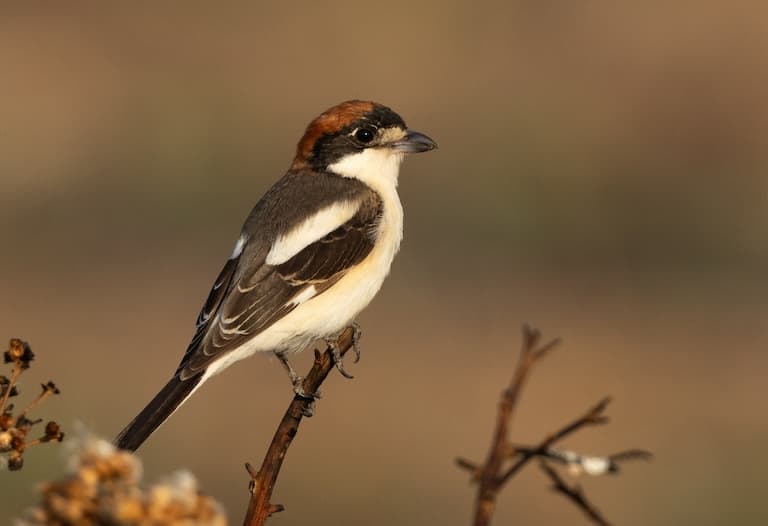
Shrike Facts Overview
| Habitat: | Mostly open plains, some tree cover specialists |
| Location: | Eurasia and North America |
| Lifespan: | Up to 10 years |
| Size: | Largest species around 23 cm long |
| Weight: | Not listed |
| Colour: | Mostly grey with a black mask and wing stripes |
| Diet: | Mostly insects, also small mammals, lizards, birds |
| Predators: | Corvids, cats |
| Top Speed: | Up to 55 km/h |
| No. of Species: | 34 |
| Conservation Status: | Mostly Least Concern, some Threatened or Vulnerable, one Critically Endangered |
Shrikes are small, relatively cute-looking birds, about the size of a sparrow. But with all the fury of a peregrine falcon. This is a rare case of a songbird who really does know the score – they keep tally of their kills on the thorns of an acacia.
As small as they are, shrikes are truly brutal, and for their size, are some of the most accomplished murders in the animal kingdom.
Interesting Shrike Facts
1. They’re Corvoids
It’s difficult to remember that Corvids are songbirds, since they’re large, indelicate and have a voice more like Yoko Ono than Stevie Nicks. But the crows, ravens, jackdaws and magpies – intelligent, mysterious and scary birds – are all part of a superfamily of songbirds called Corvoidea.
And alongside them in this dark menagerie are the shrikes, in the family Laniidae. These are fairly small birds, making up around 34 known species, almost all over the world. South America and Australia are yet to be invaded by this group of birds, and that’s probably for the best, since they are stone cold marauders.
2. They hunt
Shrikes share a lot of common traits with the raptor clade of avian hunters, specifically the mid-range raptors like the small eagles or true hawks. They will sit on a parch, up in a vantage point, and scan their domain for victims. Then, they can descend and capture, bringing it back up to eat.
But they also share features of other raptors, too, like the falcons and sparrowhawks, and are now known to attack on the wing. But they do this without the brute force of a piercing set of talons or a large wingspan to carry prey on – instead, they use a hooked beak, lots of speed and up to 6G of force.
With a precision strike, this little bird pierces the neck or spine of its victim on impact, driving its hook into the very nervous system and paralysing its prey.
But they don’t always have to go out of their way to find food, they can also get it to come to them1.

3. They mimic
This bird is sometimes called the French Mockingbird, due to their similar appearance. But mockery is in the shrike’s nature, too, and females have been recorded sitting on a tree, making the stress noises of their target prey. When the targets of this manipulation show up to see what’s going on, they’re massacred.
In the words of the 16th Century English poet who described this process, George Turberville: “ungrateful subtill fowle”!
4. They kill, a lot
In the Western US, there’s a bird called the Brewer’s sparrow. This is a feisty little thing, and when rearing its young will aggressively mob predatory birds to get them to leave. They’ll mob all sorts of hunters, many much larger than they are. But they won’t mob the shrike.
That’s because the shrike will be just as happy to eat the parents, and any attempt to attack them would be offering yourself up on a plate2.
Shrikes are natural born killers, and they kill so much, it’s often said they do it just for the thrill. They have a reputation for indiscriminate slaughter, and this is only part true – research suggests that while they do kill a lot, they perhaps don’t kill more than they need3.
What they do, though, is present their kills for all to witness.
5. They impale their foes
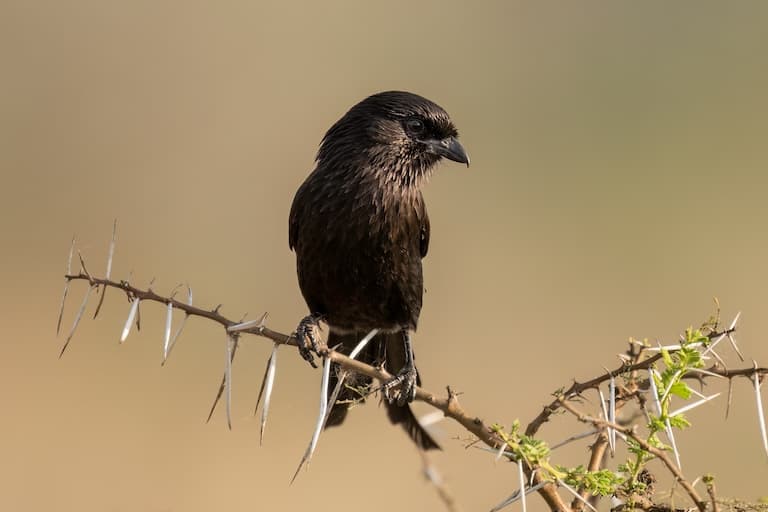
Shrikes get their reputation from their habit of hanging carcasses up in trees, or on fences. They pick something with a lot of spines and go all Vlad the Impaler on them. Birds, rodents, lizards, and the rest, all get arranged into a morbid death shrine, stabbed through and hung on the branches of an acacia or the barbs of a barbed-wire fence.
This serves at least three functions: First, they use the spike as a fork, from which they can pull their victims to pieces to ear. But also, this might be a way to store food for later , which they may return to when they’re getting weary of murder; finally, it works to show off to the ladies what remarkable perpetrators of destruction they are.
6. Chicks dig it
A full larder of corpses is the surest sign you’re going to be a good husband. This is also true for the shrike, whose collection is presented to females for their assessment.
Sometimes, inedible items are placed alongside the corpses, to jazz them up a bit, and the male will pluck pieces of the carnage to feed to her, as well as mimic the act of impaling corpses on the branch to show her his methods.
If that works, most species are monogamous, but family groups help in the rearing of young ones, which is uncharacteristically sweet.
7. They’re mostly doing ok
Many species of shrike have lost much of their ranges to agricultural lands, so habitat destruction is a serious issue for shrikes4. Further, much about them is still to be figured out, so information is a bit limited on how much they’re struggling, but it does appear that shrikes as a whole aren’t in much trouble.
Populations declines are reported, and in some locations they have disappeared entirely, so chances are many could receive a different conservation ranking during their next assessments.
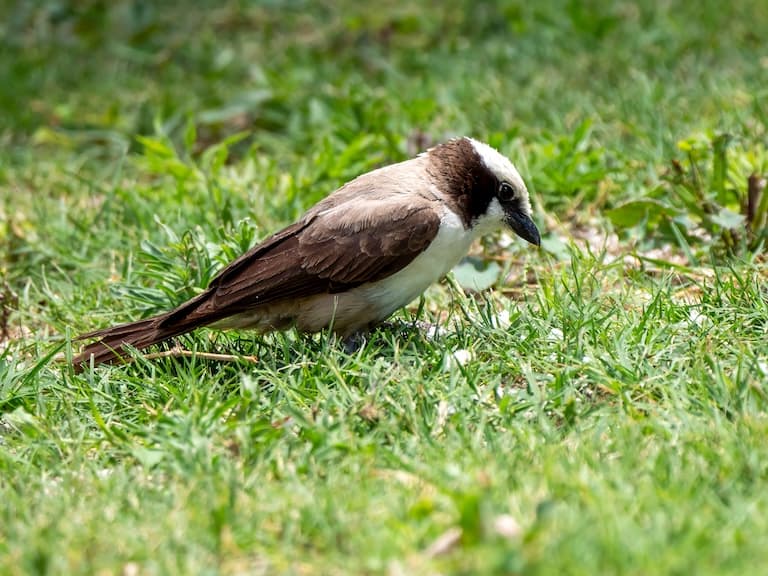
Shrike Fact-File Summary
Scientific Classification
| Kingdom: | Animalia |
| Phylum: | Chordata |
| Class: | Aves |
| Order: | Passeriformes |
| Family: | Laniidae |
| Genus: | 2 genera |
| Species Name: | 34 species |
Fact Sources & References
- Hannah (2018), “Shrikes Have an Absolutely Brutal Way of Killing Large Prey”, Audubon.
- Sustaita et al(2018), “Come on baby, let’s do the twist: the kinematics of killing in loggerhead shrikes”, National Library of Medicine.
- George (2014), “Nature Journal: Loggerhead shrike a fearsome bird”, Citizen Times.
- (2021), “Newton’s Fiscal”, The IUCN Red List of Threatened Species in 2020.