
Seahorse Profile
Many things can shrink your hippocampus. Stress, lack of exercise, online comments sections… But one thing that’s guaranteed to give them a good chance of recovery is spending time with a genus of fish named after two little organs in the brain. Or, is it the other way around?
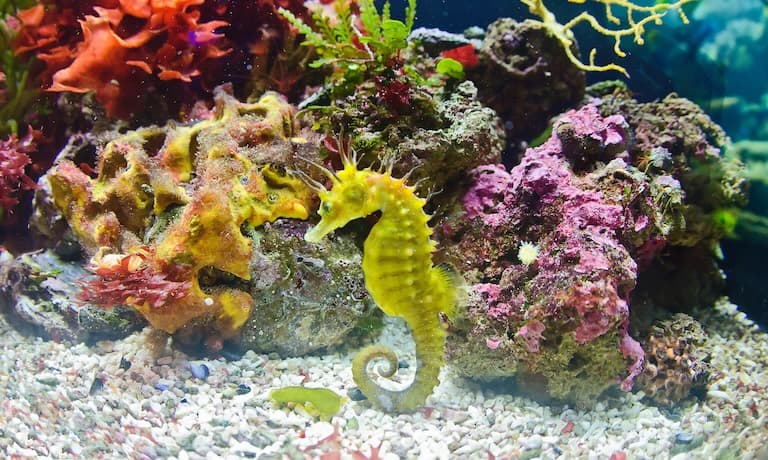
A Seahorse is a special little genus of bony fish that has no direct impact on your ability to control emotions, but certainly can trigger a wave of unrestricted awwwww in any remotely sane person.

Seahorse Facts Overview
| Habitat: | Marine, shallows with cover |
| Location: | Worldwide |
| Lifespan: | 1-5 years, depending on species |
| Size: | Up to 35 cm (14 inches); usually far smaller |
| Weight: | Not recorded |
| Colour: | Varied, cryptic in relation to their habitats |
| Diet: | Tiny animals |
| Predators: | Almost everything larger |
| Top Speed: | Very slow |
| No. of Species: | 46+ |
| Conservation Status: | Many are vulnerable, some are endangered |
Interesting Seahorse Facts
Seahorses are all backwards. They swim backwards, breed backwards, and, unlike their terrestrial namesakes, don’t eat grass, but instead hold onto it and eat small animals. This weirdness, combined with their pretty colours, makes them irresistible to saltwater aquarists, and sadly, many captive specimens die after being brought in from the wild.
But on the flipside, this popularity also makes them a good flagship species for the conservation of their habitats, and many protected seahorse areas are also home to lots of less popular but equally vulnerable species.
1. They’re fish
Seahorses are not horses. But, as bony fish, they are more closely related to horses than they are, say, to sharks. Regardless, this proximity to their equine brethren is not a cause of their horse-shapedness but only coincidence to it, and this goes doubly for the two seahorse-shaped organs in your head.
The genus is Hippocampus, and actually translates to sea monster, but these little cuties are about as far from a monster as you can get, unless you’re a minuscule crustacean, then, yeah, they would be pretty frightening.
Their next-closest relatives are the other pipefish, to whom, if you were to contort them like a balloon animal (but please don’t – this is both illegal and morally wrong), you can see the resemblance. Sea dragons look like seahorses in drag (another coincidence), and together, these three groups make up the family Syngnathinae.
All three are named for having a fused jaw, which gives them a sort of perpetual look of surprise.
But as cartoonish as seahorses are, they are insatiable predators!

2. They’re ambush predators
As sweet as they appear, these small and unusual fish are, like almost all fish in the ocean, predators. There’s not much in the way of broccoli or chia seeds in the ocean, so pretty much everything bigger than plankton has to eat other animals, and in the case of seahorses, these animals are the small crustaceans that swim about in the grasses and algae the horses hide among. These are almost entirely copepods.
Seahorses aren’t very good at swimming (in fact, they aren’t very good at much at all, as we’ll soon see), so they rely on hanging about and waiting for their food to come to them. Their tails are their most remarkable appendage, as they’re prehensile and used to wrap around stalks.
Their insatiable appetite for food keeps them eating almost non-stop, which is another product of their lack of specialism, this time in the gut.
3. They have no stomachs
Seahorse digestion is about as efficient as their swimming capabilities. They have no stomach, and so they must eat continuously, as food can only be processed in the intestines. To make matters worse, they have no teeth, either, and so they can’t prep their crunchy food for digestion by chewing it up1.
Their mouths are fused into a long tube, and they send their victims through a rapid passage through the gut, where it must be absorbed as quickly as possible. This is weird, but it’s not the weirdest thing about seahorses by far.
4. They breed weird
Disregarding some brutal and unnecessary experiments on Chinese rodents and some cheat codes for Sims 2, seahorses are the only known animal in which males can become pregnant.
The male has a brood pouch, and the female uses her ovipositor, much like a penis, to insert her eggs into this. This is the culmination of a lengthy courtship process that takes many days, as you’d expect, too, if a female wanted to inject you with her eggs.
Courtship involves colour changes, synchronised swimming, gazing into one another’s eyes, and the eventual opening of the brood pouch of the male when he’s ready to be penetrated. After dumping her load, she just swims off.
For the male, though, the weird things have yet to crescendo.
5. They squirt them out like noodles
Males giving birth is already unusual, and they will do this sometime between 9 and 45 days later, depending on the species, but when the process itself involves pumping out thousands of little ones like a cloud of crushed-up instant noodles, that’s just icing on the cake.
Most species release 100 to 1000 babies in this process, but some reach up to 2,500 or more. Muscular contractions ejaculate a fog of these little seahorses into the water: almost identical to the adults, but tiny.
These large clusters are a product of how delicious seahorse babies appear to be, since pretty much everything eats them, and only a small fraction will make it to adulthood. Less than half a per cent, by some counts.
This might sound slim, but larger fish often release tens of thousands of eggs, some even millions, and a far lower percentage of those make it.
Anyway, this process is a sight to behold, and so far, no amount of stock glockenspiel music can distract from how unsettling it is.
7. Wild-caught seahorses are a bad idea
Seahorses are weird and cute, and so are the top targets of amateur aquarists. Unfortunately, many of these are victims of wild-caught populations, and don’t do well in captivity. Stress reduces their ability to fight off infections, and many die quickly after being caught.
Fortunately, captive breeding is on the rise, and these seahorses do fare better than their wild-caught counterparts.
They do need to be kept in tanks without competitively fast feeders, as seahorses like to take their time, and so competitors will take all the food before the seahorses have had their share. They’re also delicate, and require experienced care with specific water quality maintenance2.
8. Lots of them are in trouble
This whole wild-caught industry has done a number on the populations of many species. Habitat destruction is also a rampant and widespread threat, but their appeal can work in their favour, too.
Protection of their natural habitats can bring ecotourism money into their homes, funding itself in the process.
They can also be used as an umbrella species for conservation, as their delicate habitats are home to a plethora of other plant and animal communities that are in equal need of looking after3.

Seahorse Fact-File Summary
Scientific Classification
| Kingdom: | Animalia |
| Phylum: | Chordata |
| Class: | Actinopterygii |
| Order: | Syngnathiformes |
| Family: | Syngnathidae |
| Genus: | Hippocampus |
| Species Name: | 46 species |
Fact Sources & References
- Palma et al (2013), “The effect of diet on ontogenic development of the digestive tract in juvenile reared long snout seahorse Hippocampus guttulatus”, ResearchGate.
- Gili et al (2025), “Ethics, Laws, and Research: The Case of Mediterranean Seahorses (Hippocampus hippocampus and Hippocampus guttulatus)”, Wiley Online Library.
- Vincent et al (2011), “Conservation and management of seahorses and other Syngnathidae”, Wiley Online Library.