
Sea Dragon Profile
The remake of How to Train Your Dragon is the perfect opportunity to bash the industry for such a dearth of originality that an idea only needs to be 15 years old before it qualifies for a money-grabbing rehash.
But look to the world of animal nomenclature for a similar lack of originality – here, you’ll find the need for an instructional called How to Name Your Dragon, because so far, Weedy, Leafy and Ruby are all we’ve come up with for the rare and elusive Sea Dragons, and these, too, sound like they came out of a Dean DeBlois fever dream.
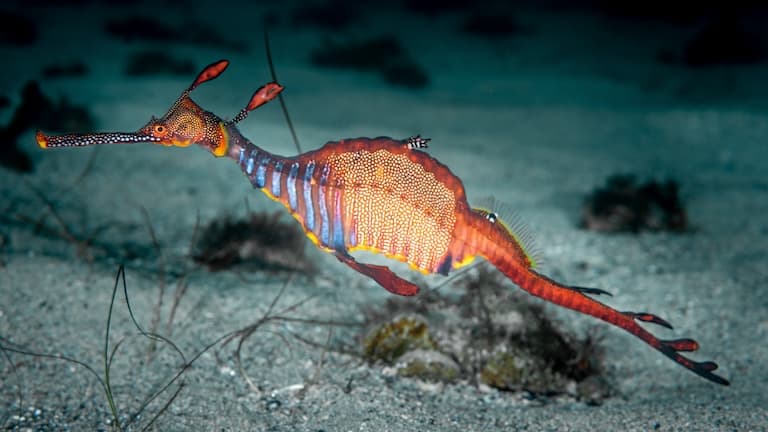
Sea Dragon Facts Overview
| Habitat: | Shallow marine, seagrass and kelp growth, usually above 50 metres depth |
| Location: | Australia |
| Lifespan: | Likely around 3 years |
| Size: | Up to 45cm (17.7 inches) in length |
| Weight: | Unknown |
| Colour: | Algae coloured |
| Diet: | Mysids and other crustaceans |
| Predators: | Larger fish, otters, |
| Top Speed: | Very slow: up to 17 metres per hour |
| No. of Species: | 3 |
| Conservation Status: | Least Concern, Vulnerable and Data Deficient (Leafy, weedy, ruby, respectively) |
Interesting Sea Dragon Facts
Sea dragons are the lesser-known group of the seahorse family. They make up three species so far, in two genera, and given that there are so few of them found, there’s still a good chance there will be more popping up in the near future, if we don’t kill them all from pollution. Unfortunately, discovering these species doesn’t put them in the clear, either, as greedy people suddenly show an interest in keeping them in tanks and crushing them into fake medicine.
1. They’re in the sea horse family
Sea dragons may sound mysterious, but much like the fabled unicorn, when you look closely, they’re just horses with extra bits. Sea horses, in this instance. But sea horses are already pretty awesome, so this doesn’t really detract from the allure of sea dragons at all, and these “extra bits” are really quite impressive.
As members of the tube-mouthed Syngnathidae family, they’re grouped with the seahorses and pipefish, and if pipefish are at one end of the opulence spectrum for this family, the sea dragons are well over at the other end. They have incredible fronds and are the most ornate of the family. Able to mimic the algae or grass they surround themselves in to such a degree that at least one of them remained hidden from science until 2015.
This most recent one, the ruby sea dragon, makes the third species known, along with its friends, the leafy sea dragon and the weedy sea dragon. The leafy is the best-known, as it has the most ornate decorations; the weedy is a sort of weedier younger brother, and the ruby is in a second genus all to itself, but not well known at all, yet.
2. They’re hard to spot
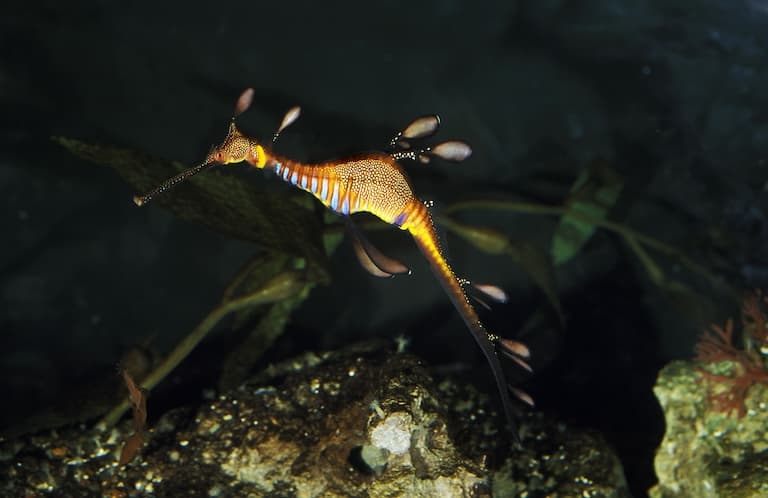
Sea dragons take the cryptic nature of the seahorse to the extreme, and are ornately decorated with camouflage.
They have no tail fin, and they truly suck at swimming, migrating over small territories with bursts of motion up to 17 metres per hour, but preferring to spend the vast majority of their time stationary. Well, not entirely stationary, as their leafy surroundings move with the waves, so they must too, if they want to fit in.
And so, being leafy, moving like a leaf and being surrounded by leaves have served them well. They can hide from most predators this way, and some, like the ruby sea dragon, hid so well that it was only discovered in 2015. Ironically, this is the least leafy of the three species, and it’s also bright red, so
3. They’re big
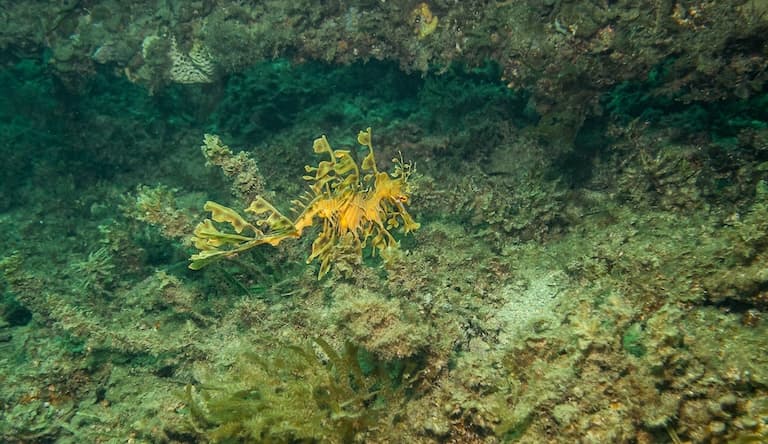
Of the three species known, the leafy sea dragon is the largest. This beast reaches up to 45 cm long, which is pretty incredible for an animal that hides so well.
The weedy sea dragon is a similar animal, especially when looking at the skeleton, but has a thicker body and far less adornment. It’s also slightly smaller, and the ruby sea dragon probably is the smallest, though with just a couple of specimens, there’s a lot left to understand about these animals!
As far as members of the seahorses go, though, these are large examples. They also have other features that set them slightly apart from their seahorse relatives, and this is most evident in their breeding strategies.
4. They’re a source of Trypophobia
Male seahorses give birth with a sort of sneeze of tiny seahorses spewed out from a hole in the abdomen. Male leafy sea dragons can get even more upsetting than that.
The weedy sea dragon carries rows of eggs along his abdomen, lined up like an infected leaf, and when they’re ready to hatch, he shakes his tail to release them, one by one. This miracle of birth shares similarities with the parasitic wasp eggs laid on the back of a caterpillar and leaves behind little holes where the eggs were once attached – something that Trypophobes will find deeply unsettling.
5. “Oriental herbalists” won’t leave them alone
In the West, people seem to have an attitude toward wildlife that comes from the internal idea that “This animal’s so cute, I want to keep it captive in my house”. In the East, there’s a similarly obnoxious approach, but with a twist. So-called Oriental herbalists seem to have the intrusive thought of, “That animal’s so cute, I bet I can grind it into a powder and eat it to gain its magical properties”.
Both of these approaches to nature are devastating to wildlife, and neither of them is a conscionable thought to act upon.
Sadly, the sea dragons being cool is exactly what leads these unrepentant charlatans to charge $200 a gram for dried sea dragon. And western aquarists often don’t do them any better, as live-caught individuals often die in captivity. Very few have ever bred in a fish tank, and none have ever granted their consumer special powers or even therapeutic solutions1.
6. Pollution is also a problem
Weedy sea dragons are now listed as Vulnerable by the IUCN2, in part because of the aforementioned threats but also because of their sensitivity to water pollution – something which we are still contributing to at an alarming rate. Bycatch and coastal habitat degradation are all mixed in there, too, which is also something affecting the Leafy species.
Data on the ruby sea dragon is still too slim to know how they’re doing, but considering the only known specimens were trawled up by the fishing industry in a reef habitat, chances are that they’re victims of all of this, too3.
Sea Dragon Fact-File Summary
Scientific Classification
| Kingdom: | Animalia |
| Phylum: | Chordata |
| Class: | Actinopterygii |
| Order: | Syngnathiformes |
| Family: | Syngnathidae |
| Genus: | Phyllopteryx and Phycodurus |
Fact Sources & References
- Frostic (2000), “Phyllopteryx taeniolatus”, Animal Diversity Web.
- Pollom (2017), “Leafy Seadragon”, he IUCN Red List of Threatened Species 2017.
- Aylesworth et al (2016), “Ruby Seadragon”, The IUCN Red List of Threatened Species 2016.