
Rusty-spotted Cat Profile
Nowadays, it’s very rare that a mammal slips by science unnoticed. But if any can, it’s the cats. These are animals whose entire existence relies on being stealthy and staying out of the way of people. The Rusty-spotted cat isn’t entirely unknown but is by no means understood, and this is a blessing and a curse, as conservationists discover more of them than they thought existed, but also have almost no idea how to protect what’s there.

Rusty-spotted Cat Facts Overview
| Habitat: | Dry temperate and tropical forest, human habitations |
| Location: | India and Sri Lanka |
| Lifespan: | 18 years in captivity |
| Size: | Up to around 40 cm (16 in) long |
| Weight: | Up to 1.7 kg (3.7 lb) |
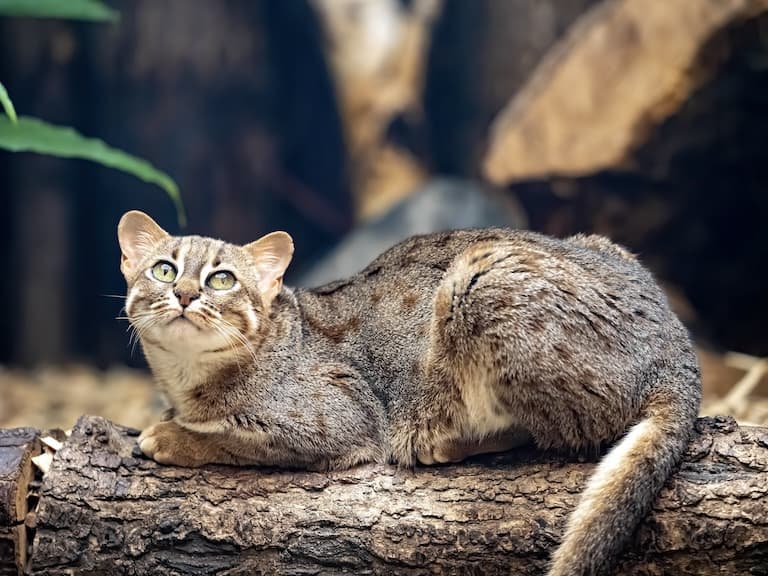
| Colour: | Grey-brown to golden brown, with black-to brown stripes and spots |
| Diet: | Small birds and mammals |
| Predators: | Unknown |
| Top Speed: | Unknown |
| No. of Species: | 1 |
| Conservation Status: | Near Threatened |
Interesting Rusty-spotted Cat Facts
Rusty spotted cats have traits that are both typical and atypical of cats, depending on where you look. They are not afraid of water or fruit, but they’re also agile little solitary hunters, just as you’d expect. They are very small, very elusive, and very in danger of losing much of their habitats to farming.
1. They’re little cats
Cats are a family of carnivorans, and are separated into two big and about 35 small genera, differentiated at the subfamily level. The big cats, in the Pantherinae subfamily, are made up of the Panthera and Neofelis genera, containing all the classic big cats as well as the snow leopards and clouded leopards.
The small cats are much more diverse. Cheetahs, while they are big cats, are not Big Cats, and are the tallest members of the Felinae subfamily. Cougars are up there, too, and while not as tall, are much heavier than cheetahs. This is also the subfamily that Caracals, ocelots, and house cats belong to, in descending order of size, and at the end of this spectrum are the little Asian cats in the Prionailurus genus.
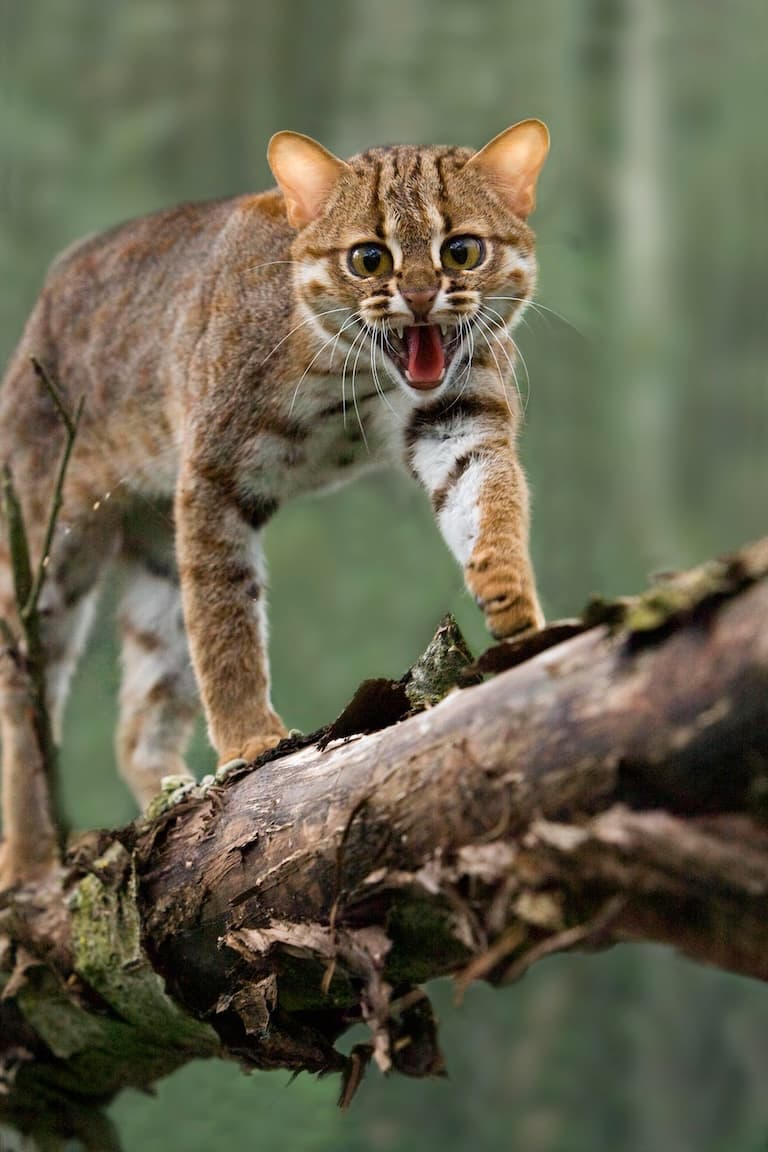
Of all of them, the rusty-spotted cat is the smallest, and indeed the smallest cat in the world. They are around half the size of a domestic cat and reach around 1.7 kg maximum1.

2. They can swim
These tiny cats are jungle specialists, and while they are primarily terrestrial, can traverse all sorts of terrain you’d expect to find in the forest.
They’re close relatives of the particularly unusual fishing cats, who, against all stereotypes, absolutely thrive in water.
Rusty-spotted cats aren’t as adept as their cousins in aquatic environments, but they are not remotely afraid of the water, and will swim across water bodies too large to jump across or too deep to paddle through.
And, as you’d expect, they are ok in the trees, too.
3. They can climb well
Rusty-spotted cats eat birds, eggs, and small mammals, and probably invertebrates, too, considering their tiny proportions.
Much of this food can be found on the ground, and this is primarily a terrestrial animal, but it is also adept at getting up and around trees.
4. They might eat fruit
This is a very elusive and poorly understood species, and most of the literature comes from captive animals in zoos.
And in zoos, they have been known to eat fruit, which suggests that wild populations may, as well. And if this is the case, not only could this species be a significant controller of small prey species, but it may also be a disperser of plant seeds
5. They’re sometimes around people
It’s commonly mentioned that this species is often found in and around human habitations. They’ve been found in gardens, on farms, even nesting in roofs, and so this is partially true, but their presence here is likely more out of necessity, rather than preference, and is most certainly not the norm.
In science, the term “selection bias” essentially describes the phenomenon of finding things where you look for them. If you only look in the corner of the room, you might get the impression that’s where people keep all their dust, but without checking on top of the cupboards, under the sofa and behind your ears, you’re not getting the full picture.
Likewise, research is a lot easier where there’s a power supply to charge your camera batteries, cell coverage to upload your data, and three hot meals a day, and so findings of these cats in and around human habitations are more a product of the disproportionate amount of time looking there, rather than the lengthy, expensive and malaria-filled jungle treks needed to get the full picture.
In reality, it’s likely they want nothing to do with people and are really only spending time where people are due to their preferred habitats being entirely destroyed. And this is a problem for the rusty-spotted cat.
6. They’re in decline
Currently, this species is listed as Near Threatened. There is a dearth of data on wild populations, so their condition is hard to assess accurately, but what’s easy to identify is the rapid decline of their preferred jungle habitats.
This is a mammal whose first wild photograph was taken as late as 2012, and its first recording in 2016, which really goes to show how hard it is to learn about, but there are estimated to be around 10,000 members making up the species, and this number is thought to be in steady decline due to the fragmentation and destruction of its habitats2.
7. But they might be more common than we knew
One upside to being so elusive is that this cat species may, in fact, be more common than was once thought.
Their discovery in Nepal in 2016 made them the 12th cat species known there, and it’s hopeful that this late discovery showed that they weren’t as rare as previously thought, and implies they could be found in other regions, too3.
With only tens of individuals in captivity – somewhere around 50 – and not discernible success in the handful of breeding programs attempted, the success of their wild populations is essential to the survival of the species.
Rusty-spotted Cat Fact-File Summary
Scientific Classification
| Kingdom: | Animalia |
| Phylum: | Chordata |
| Class: | Mammalia |
| Order: | Carnivora |
| Family: | Felidae |
| Genus: | Prionailurus |
| Species Name: | rubiginosus |
Fact Sources & References
- Miles (2013), “Prionailurus rubiginosus ”, Animal Diversity Web.
- Mukherjee et al (2016), “Rusty-spotted Cat”, The IUCN Red List of Threatened Species.
- Lamichhane et al (2016), “Rusty-spotted cat: 12th cat species discovered in Western Terai of Nepal”, ResearchGate.