
Russian Blue Cat Profile
Russia has a fair bit to be blue about. The long, dark winters, the lack of effective infrastructure, the entirely avoidable wartime economy forcing the price of vodka up to 350 Rubles a half litre… At least they have the metric system.
But there’s actually a wealth of wonders to be found, as well: The Lena pillars, the Kuri Islands, and Valentina Shevchenko are just a few examples.
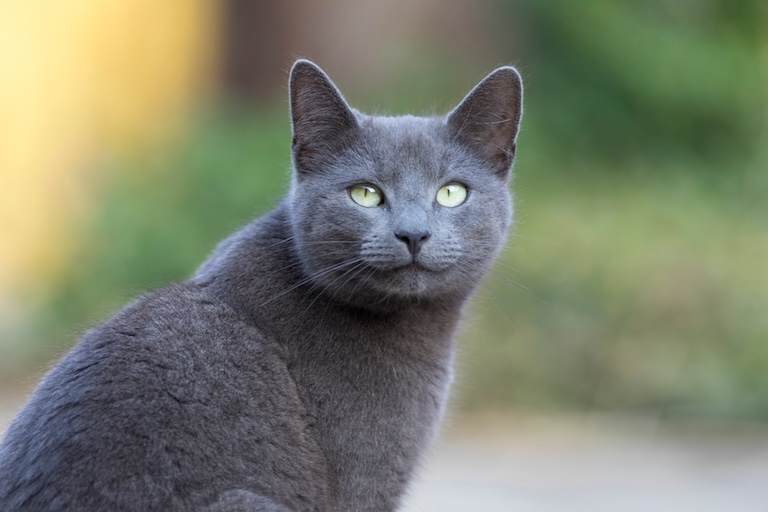
And much like Valentina, today’s subject is a Russian export with all the best features of a cat: smarts, athleticism and looks. The Russian Blue is a gorgeous little killer, and one that avoids many of the pitfalls of the artificially selected purebreds.
Russian Blue Cat Facts Overview
| Habitat: | Domestic |
| Location: | Worldwide |
| Lifespan: | Up to 15 years |
| Size: | Small-to-medium breed |
| Weight: | 3.6 to 6.8 kg (8 to 15 lb) |
| Colour: | Bluish-Grey |
| Diet: | Cat food |
| Predators: | None |
| Top Speed: | Catlike reflexes |
| No. of Species: | 1 |
| Conservation Status: | Not listed |
Russian blues are growing in popularity, on account of their remarkable prowess as pets, athletes, and companions. Unfortunately, this does risk the health of their genetic lines as breeders will try to find the cheapest route to supplying increasing demands, but they come from very healthy stock, so their decline may well be delayed for a lot longer than others. These grey-blue killers are as adorable as they are house-friendly, and for a purebred, are surprisingly low-maintenance.
Interesting Russian Blue Cat Facts
1. They’re Russian
These pretty little cats are not only Russian by name. Their origin as Felis catus seems to be somewhere in the old Soviet Union (just in case there’s a new one by the time you read this), likely within the 2020 Russian boundaries.
Another common name for this breed is the Archangel blues (which is also what Robert Harris is so good at depicting in his novels), and this location inside Russia is where it’s thought the breed left on boats to arrive in the rest of Europe and eventually the Americas.
2. They’re “blue”
Animal colouration is determined by a couple of things: diet and natural pigmentation. As humans, there’s not a lot we can do about our colour, as the pigment is pretty much hard-wired by genetics, though sun exposure can bring out more of it. And really, it’s just the one pigment: melanin. This (or the lack of it) gives us all the wonderful shades in our species from Nordic porcelain, through Latin Bronze to Sudanese ebony; even the sort of blotchy pink Englishman colour of us animal bloggers.
Melanin covers browns, oranges and yellows in mammals, and it’s pretty much the only one we can make ourselves. Other colours have to come from either dietary sources or be a sort of optical illusion based on the structure of the material scattering light in different frequencies.
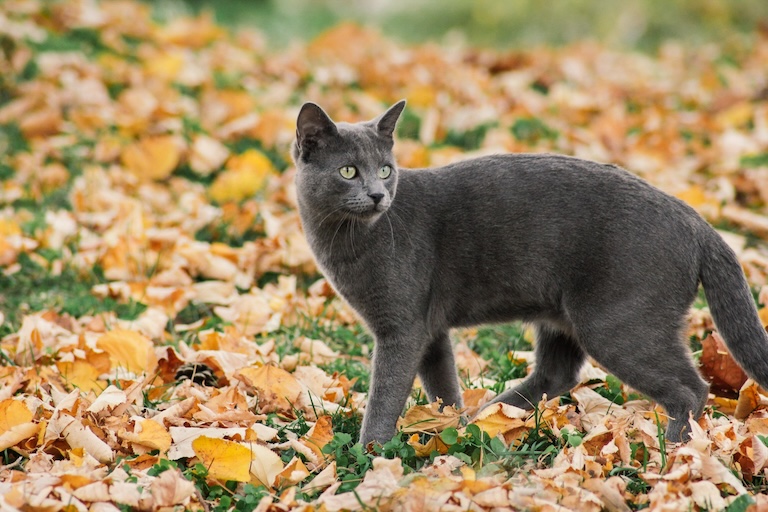
All this to say that there is no “blue” pigment in mammals, and in fact, blue is exceptionally rare in all animals, especially as pigment. So, when animals like this Russian cat are called blue, it’s a bit of a misnomer.
They’re clearly grey, but the subtle bluesish tint that shows up in certain lighting comes not from pigment, but from the way the fur scatters light. They have a gene called the “dilution” gene, which determines how far apart melanin pigment cells sit, and being spread out on the hair fibres, this creates a grey colouration, and a phenomenon called Rayleigh scattering.
This is often the focus of intolerable pedantry involving a single smartass and the line, “They’re not actually blue, they just look blue”, but since all colour is merely a manifestation in the brain of the observer, they’re exactly as blue as anything else.
How’s that for pedantry?
3. There are four types
The Russian blue cat is broken up into four registered phenotypes based on slight variations in the way they look.
There’s the English type, with a coat that matches the description of much of the population there: dense, short, and soft;
There’s the Scandinavian type, which, as you’d expect, is longer and more graceful;
There’s the Australian type, whose eyes are more oval than the other three;
And finally, the American type, which is lighter in colour than the rest, is often more silvery than blue. 1
4. They’re docile
This breed is generalised to be a very easy cat to live with, so as well as being beautiful and full of character, they make decent pets. They don’t shed any more than is reasonable and need little in the way of maintenance.
The only concerns to be aware of appear to be the need for a lot of stimulation – these are intelligent animals with plenty of energy, and this energy is what gives them their infamous killing capabilities. 2
5. They’re trained assassins
In the movie Cats and Dogs, another Shevchenko parallel occurs. The trained assassin who works hard to bring home the meow-mix and is also an expert with weapons is played by a CGI Russian blue and a real Danny Mann.
This is more than just a random coincidence. Real-life Russian blues (and, possibly, Valentina Shevchenko) are experts at killing and leaping. They are renowned as some of the most athletic of all domestic cat breeds, and are said to be able to climb and jump with monkey-like skill. 3
6. They don’t live as long
Domestic cats have seriously impressive longevity for such small mammals, and the Russian blue isn’t a short-lived animal by any measure, reaching somewhere between 10 and 15 years on average.
But considering that many cats push up and even sometimes surpass 20 years on the planet, this is a sort of low-to mid-range lifespan for the species.
Still, with all the character, athleticism and smarts this feline is packing, it’s likely to be a good 15 years for whoever is responsible enough to make their lives comfortable.
6. But they’re generally healthy
This is said to be a “Natural breed”, which refers to its rise as a wild community member, rather than a breed chosen by decades of selective breeding.
What this generally means is that Russian blues and other natural breeds don’t suffer from the decades of inbreeding that comes from breeders looking to make a buck, over making a cat that actually functions as a healthy organism.
Pugs, for example, struggle to even breathe, on account of their horrible evolutionary journey into what they now are. It’s hard to argue for any morally justifiable reason for their existence; Russian blues, on the other hand, are closer to what a cat would naturally be in the wild.
Though, this might be changing. As with any breed, as their popularity goes up, supply cuts corners to meet demand, and those corners are usually genetic; viable populations are expensive to acquire, so relatives are bred with relatives, and you end up with pug problems down the line.
These cats are considered generally healthy, though a common warning is to watch out for over-eating, as they can become obese if their feeding isn’t controlled and they don’t get enough exercise. 4
Russian Blue Cat Fact-File Summary
Scientific Classification
| Kingdom: | Animalia |
| Phylum: | Chordata |
| Class: | Mammalia |
| Order: | Carnivora |
| Family: | Felidae |
| Genus: | Felis |
| Species Name: | catus |
Fact Sources & References
- , “Russian Blue Types”, russianblues.org.uk.
- , “Russian Blue”, The Cat Fanciers’ Association.
- Dr Jack Ayerbe OAM (2024), “The Vet’s Guide to Russian Blue Cats: Facts, Care, and Training Tips”,Vets Love Pets.
- , “Russian Blue”, Purina.