
Rufous Hummingbird Profile
Hummingbirds are the smallest of all birds, known for their high metabolisms, significance as pollinators, and for adding splashes of dazzling colouration to the tropical scenescapes of South and Central America.
But there are species in North America, too, and not just the subtropical analogues of Florida, or the tropics of Mexico – all the way up into Canada. The Rufous Hummingbird is one such beast – able to tolerate a tremendous range of altitudes, climates and habitats, and its toughness has made it one of the most plentiful hummingbird species on the continent.
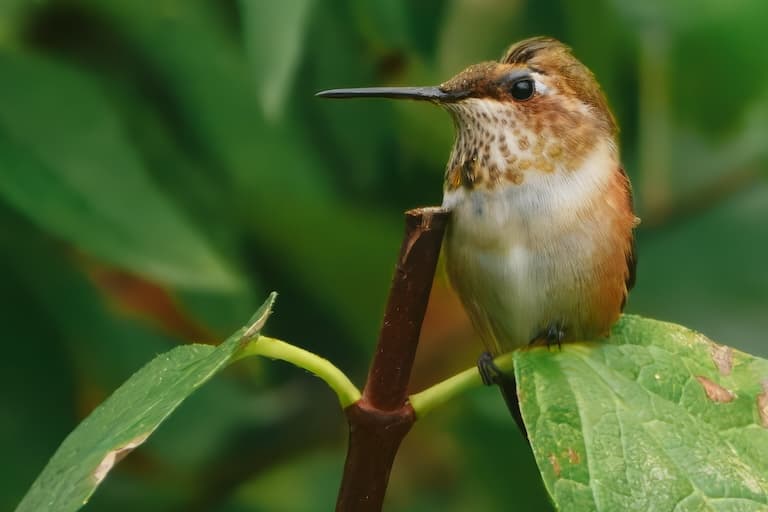
Rufous Hummingbird Facts Overview
| Habitat: | Varied, from mature forest to residential areas |
| Location: | Western North America, from Mexico to British Columbia |
| Lifespan: | Around 6 years, 9 years max |
| Size: | 9.5 cm (3.75 in) |
| Weight: | Around 3.4 g (0.1 oz) |
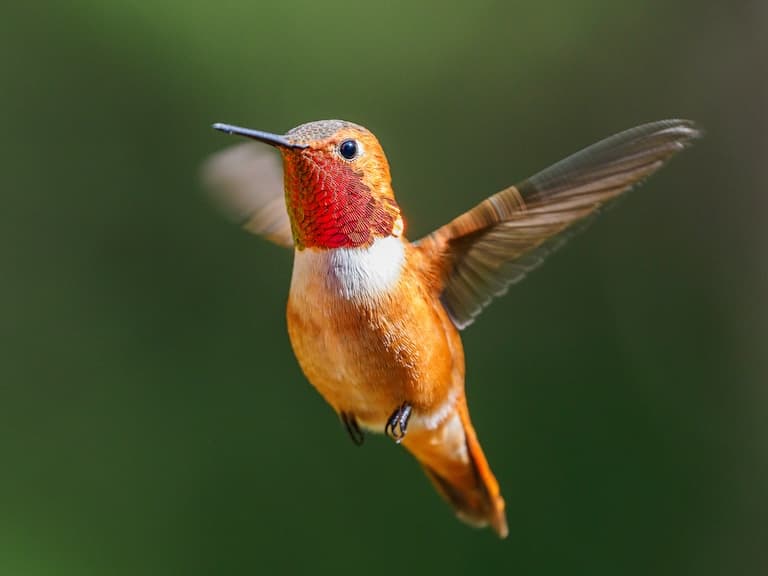
| Colour: | Males are rusty brown with a red throat, white collar and dark wingtips; females are much lighter brown with creamy bellies and iridescent green heads |
| Diet: | Nectar and small insects |
| Predators: | Unknown, probably cats, raptors, reptiles |
| Top Speed: | Not listed |
| No. of Species: | 1 |
| Conservation Status: | Near Threatened |
Rufous hummingbirds are loyal North Americans, whose epic migrations, feisty nature and pretty colouration make them one of the most common and popular hummingbird species on the continent. And they are tough as nails! Able to handle surprisingly low temperatures, high altitudes, and epic journeys from Mexico to Washington, these little troopers are truly worthy of respect.
Interesting Rufous Hummingbird Facts
1. They’re North American
Hummingbirds make up a family of almost 400 species of small, hovering, mostly nectar-feeders that are ubiquitous in well-manicured Colombian gardens or dense Ecuadorian forests. But they also span the entirety of Central America, and there are several species in North America, too. At least one species even makes it up to Alaska.
So, finding the rufous hummingbird in the Rocky Mountains on the West coast of North America isn’t entirely surprising. This species is exclusively found on the North American continent, and is one of around 18 or so species found there.
This species, along with the ruby-throated hummingbird, makes up the most common hummingbirds found
2. They’re hardy
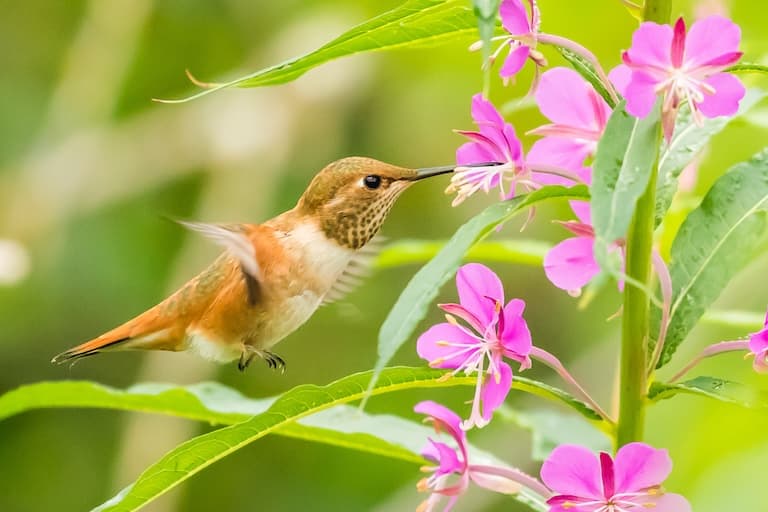
This species occupies a wide range both spatially and ecologically. They will thrive in various habitats from forest to meadow, to suburban back yard, and at a range of altitudes, to boot.
Being a Rocky Mountain native, they can be found as high as 3,000 metres above sea level, and will handle temperatures as low as -4 degrees C: something very unusual for such a small bird.
They will also eat arthropods alongside their primary nectar diets, which helps them hit their calories even during winters, when flowers are less abundant. Still, breeding requires plenty of energy and so coincides with the flowering season, when the sugar is flowing1.
Their adaptability and hardiness are only matched by their fighting spirit.
3. They’re feisty
These are fast and darty little birds, not unusual for hummingbirds, but where they shine is in their aggressive nature. They will compete with gusto over food sources, and are even known to chase predators away by rushing at them with fury.
They are not social at all, and so have no loyalty to one another outside of breeding, and will generally segregate by sex at all other times, with males feeding at higher altitudes than the females.
But their toughness doesn’t end there. When it’s time to move south for the winter, they really can move.
4. They migrate – a lot!
Rufous hummingbirds are capable of travelling remarkable distances when migrating. Up to 4,000 km, in a looping pattern from start to finish.
They are found as far North as British Columbia, and as far South as Mexico, being common at both ends of the spectrum.
Typically, Migration from the North begins in July, through to September, and will take them thousands of kilometres South, where they will stay until February or March, before returning. They generally follow the coast up the Western US, so are commonly spotted in California, and will make it back to Washington or farther North by the end of April2.
And all along this route, they’ll be looking out for hidden signals from their food sources.
5. They can see in UV
Our world is very much shaped by what we can see, and our vision, as profoundly vast as it appears to us, reflects a tiny sliver of the spectrum of light available. Ours cuts out at the purple high end, right before Ultraviolet, but not all animals are so limited.
Many birds, hummingbirds especially, see the world very differently on account of their ability to perceive more colours.
Flowers may look pretty to us, but that’s purely a coincidence – their beauty is designed for the eyes of the pollinators, and when seen with UV light, a hidden world of psychedelia emerges.
Hummingbirds see flowers with much more detail than we do, and it’s how they can spot a food source from a lot further away. Many flowers come with a bullseye pattern built in – only visible to those with the secret UV vision perk!
Being hummingbirds, these little animals have a very high metabolism, and so need to feed regularly and often, so being able to find food urgently is very important.
6. There are 22,000,000 of them
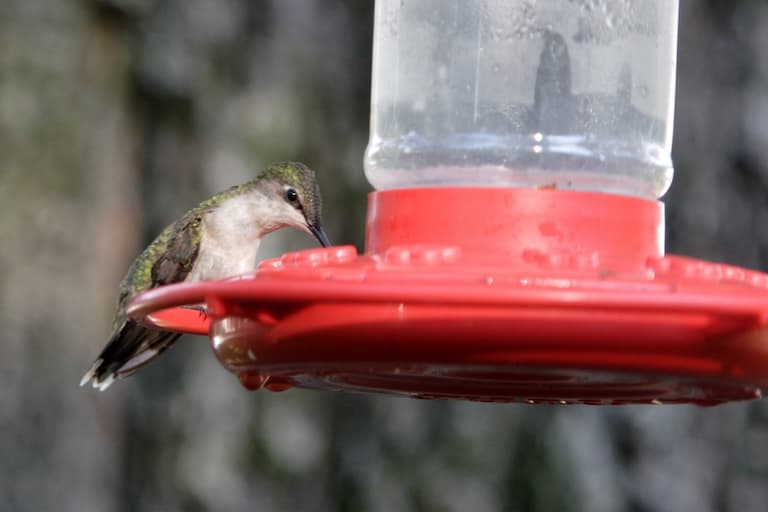
This is a tough little bird with a range of viable habitats at its disposal. It’s also thought to benefit from the development of its range by humans, at least when they bring gardens with flowering plants and bird feeders with them.
Habitat destruction is affecting them, though, and they are thought to be in decline and listed as Near Threatened by the IUCN3.
However, there are still estimated to be quite a few left. Over 22 million of them, so roughly the human population of Sri Lanka. Climate change is also considered a threat, but as for how they’re faring currently, their decline is thought to be slow.
However, their populations are acknowledged as poorly understood, which could sway things one way or another – something which remains to be seen.
Rufous Hummingbird Fact-File Summary
Scientific Classification
| Kingdom: | Animalia |
| Phylum: | Chordata |
| Class: | Aves |
| Order: | Caprimulgiformes |
| Family: | Trochilidae |
| Genus: | Selasphorus |
| Species Name: | rufus |
Fact Sources & References
- (2020), “Rufous Hummingbird”, The IUCN Red List of Threatened Species 2020.
- Anderson (2022), “Selasphorus rufus ”, Animal Diversity Web.
- (2020), “Rufous Hummingbird”, The IUCN Red List of Threatened Species 2020.