
Round Stingray Profile
Stingrays are cool. There are salt water ones, freshwater ones, deepwater, shallow water and marionette. But there are also tiny, almost circular ones that will simply not stop attacking innocent beach-goers.
These are the round stingrays, and they’re a reminder that any time spent in the water comes with the implicit permission of its rightful inhabitants.
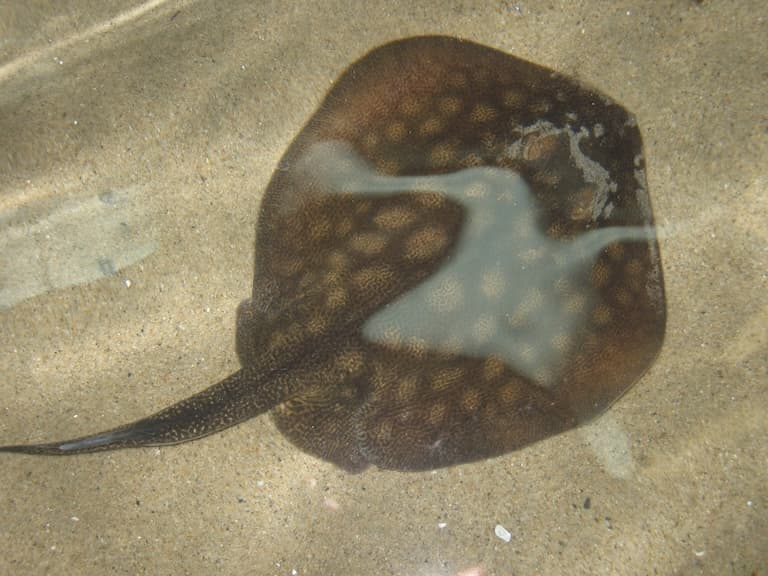
Round Stingray Facts Overview
| Habitat: | Tropical and subtropical: coastal shallow marine |
| Location: | Northeastern Pacific Ocean |
| Lifespan: | From 8-14 years |
| Size: | Usually around 25 cm (10 in) across – sometimes up to 50 cm (20 in) |
| Weight: | Not recorded |
| Colour: | Usually sandy brown to grey; sometimes spotted and dark grey |
| Diet: | Crustaceans, molluscs |
| Predators: | Seals, large fish |
| Top Speed: | Slow |
| No. of Species: | 1 |
| Conservation Status: | Least Concern |
Round stingrays are both a species and a family of stingrays, but today we’re going with the species that lends the family its name. These are from the West coasts of the Americas, and are small, docile sand-dwellers that get into trouble when they dare to occupy habitats people want to walk in or drag nets through.
Regardless of how inconsiderate these rays are, our efforts to diminish them have not been successful, and they can still be found in healthy numbers, sticking their middle stinger up at Californians.
Interesting Round Stingray Facts
1. They’re benthic rays
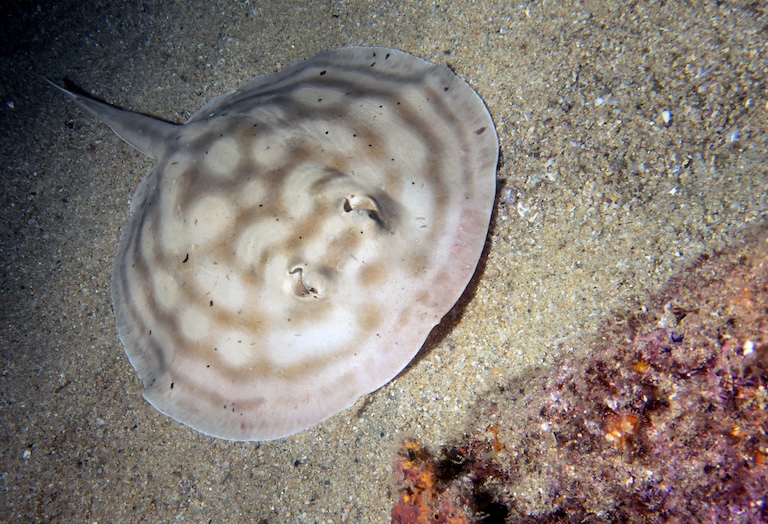
Round stingrays are true stingrays, and so are members of the Myliobatiformes order of cartilaginous fishes. They’re part of a family of American rays, making one of about 20 species of so-called “Round rays”. They are, indeed, round, and some of these are quite pretty, but the one that is commonly referred to as the round ray is a very demure, sandy-coloured animal with not much in the way of markings in most cases, though there are different colour morphs and some can be quite a lot darker and more blotched.
That’s because it spends most of its time hovering in and above sand, where it hunts for crustaceans.
They have been found as far down as 91 metres, but the vast majority of round rays are discovered just right there on the beach. Males in particular segregate from the females and occupy the shallower waters, while females spend more time beneath 14 metres.

2. They dig!
Whichever depth they are found at, their primary feeding strategy is to use their agile fins to shovel sand up in front of them and uncover prey items.
Doing so also uncovers animals that aren’t on the rays’ menu, but are very much prized by other species of fish in the vicinity, so these little rays offer ecosystem services to their community members, too1.
3. They sting!
As the name suggests, these are animals capable of injecting venom, and being relatively small, sand-dwelling beach-dwellers, they do it more than pretty much any other marine species in North America. Around 10,000 human cases are reported each year, but it’s mostly a painful inconvenience, and not something to be all that scared of.
As rays, they will naturally avoid conflict and are mostly gentle, but since they share the paddling area with clumsy apes, they are often stepped on, and this is how issues arise.
But of the two species, the ray is the one with more to complain about.
4. They’re considered a nuisance
It is a testament to how detached we can become from the suffering we cause when a species is declared to be a nuisance for the heinous crime of clogging up our trawlers with their inconsiderate corpses.
Yet, here we are. This species gets dragged up with the shrimp nets and entangled, slowing down the process of sanitising the shallows for seafood, and getting on people’s nerves. That the stingray gets nothing but a slow death from this interaction is besides the point.
Recreational fishing treats them with a similar lack of respect, often cutting off the dangerous tail before throwing them back in to die2.
5. They do well in captivity
This species has the nickname California stingray, since the majority of them interact with people on the beaches of California, and this is also where they’re collected for aquariums.
Being gentle by nature, and when placed in a habitat with no threats, there is no harm in snipping off the hardened cartilaginous spine from their tails, just in case a visitor’s kid gets too handsy, and the animal is considered pretty hardy and easy to look after.
So, they make an excellent addition to the marine aquaria found near the coasts
6. They reproduce fast
Another thing going for them is their rate of reproduction. Round stingrays give birth to live young and can litter up to 11 at a time, but usually closer to three. They can do this twice a year, though, meaning that they can survive a fair amount of disturbance before their populations begin to struggle.
And that’s good, on account of how all the aforementioned disturbances they do face.
The round stingray is still going strong, with a population considered stable and of least concern. Though, it’s important to note that this is, in part, because of Californian restrictions on shrimp trawling in protected areas3.
Round Stingray Fact-File Summary
Scientific Classification
| Kingdom: | Animalia |
| Phylum: | Chordata |
| Class: | Chondrichthyes |
| Order: | Myliobatiformes |
| Family: | Urotrigonidae |
| Genus: | Urobatis |
| Species Name: | halleri |
Fact Sources & References
- (2024), “Round Stingray”, Aquarium of The Pacific.
- Flem et al (2025), “Round Stingray”, The IUCN Red List of Threatened Species.
- Lyons et al (2015), “Round Stingray”, The IUCN Red List of Threatened Species 2014.