
Rockhopper Penguin Profile
For most of us in the Northern Hemisphere, Penguins are known to be large, waddling tuxedo birds from Antarctica, and are voiced by Elijah Wood in one of the worst examples of lazy, bell-curve writing in animation history.
But they’re much more than this! Some are small, live well away from Antarctica, and are voiced by the inimitable Robin Williams (but in the same abominable production). The Rockhopper Penguin is one, or possibly three, species of penguin that does not meet the stereotype.
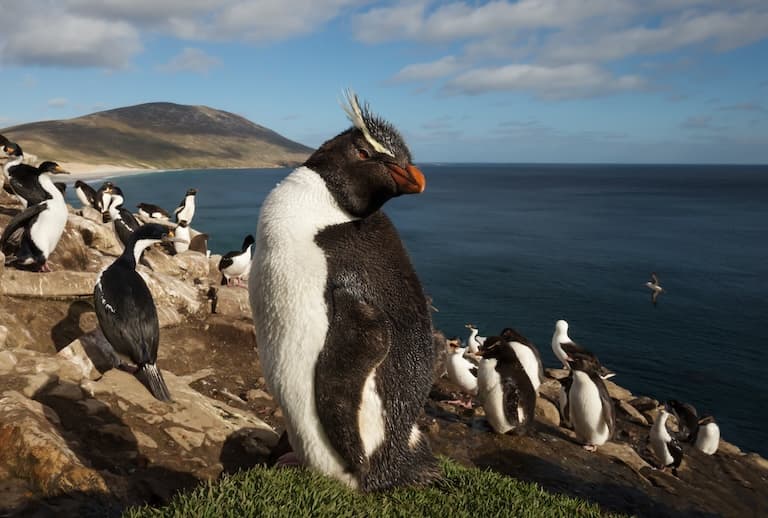
Rockhopper Penguin Facts Overview
| Habitat: | Coastal, rocky outcrops |
| Location: | South Atlantic and Indian Oceans |
| Lifespan: | 10 years |
| Size: | Up to 55 cm (21.6 inches) long |
| Weight: | Up to 4.3 kg ( |
| Colour: | Classic penguin coloured, with yellow eyebrows |
| Diet: | Krill, squid, octopus, lantern fish, molluscs, plankton, cuttlefish, and many crustaceans. |
| Predators: | Seals, sharks, orcas, and large birds |
| Top Speed: | Around 7 or 8 km/h (5mph) |
| No. of Species: | 1 or 3, |
| Conservation Status: | Northern rockhopper is endangered. |
Rockhopper penguins are small for their kind, usually no more than three kilos, sometimes up to just over 4kg in weight. They can get away with being smaller on account of their much warmer habitats. Some are even decidedly hot, and the three groups of these penguins have an almost circumpolar distribution around, but mostly separated from, Antarctica.
They’re hoppy, milky, and cute little guys, and sadly, they need help!
Interesting Rockhopper Penguin Facts
1. They’re Crested Penguins
Around 15 million years ago, an ancestral penguin species split into what would become New Zealand’s yellow-eyed penguin and what would become the crested penguins. This was, of course, about 15 million years before New Zealand was invented, so it probably happened somewhere else.
But today, both of these branches inhabit New Zealand coastlines, as well as several other places, and they are still the closest relatives to one another.
The crested penguins make up the genus Eudyptes, which split into multiple species around 8 million years ago, and today there are either 8 or 6 species recognised, depending on whether you recognise the rockhoppers as three or one species.
So, rockhoppers are three (or one) species of crested penguin. Specifically, the Southern, Eastern and Northern rockhoppers. Not only are these penguins found quite a distance from Antarctica, but they are also found in some of the hottest locations where you can find penguins.
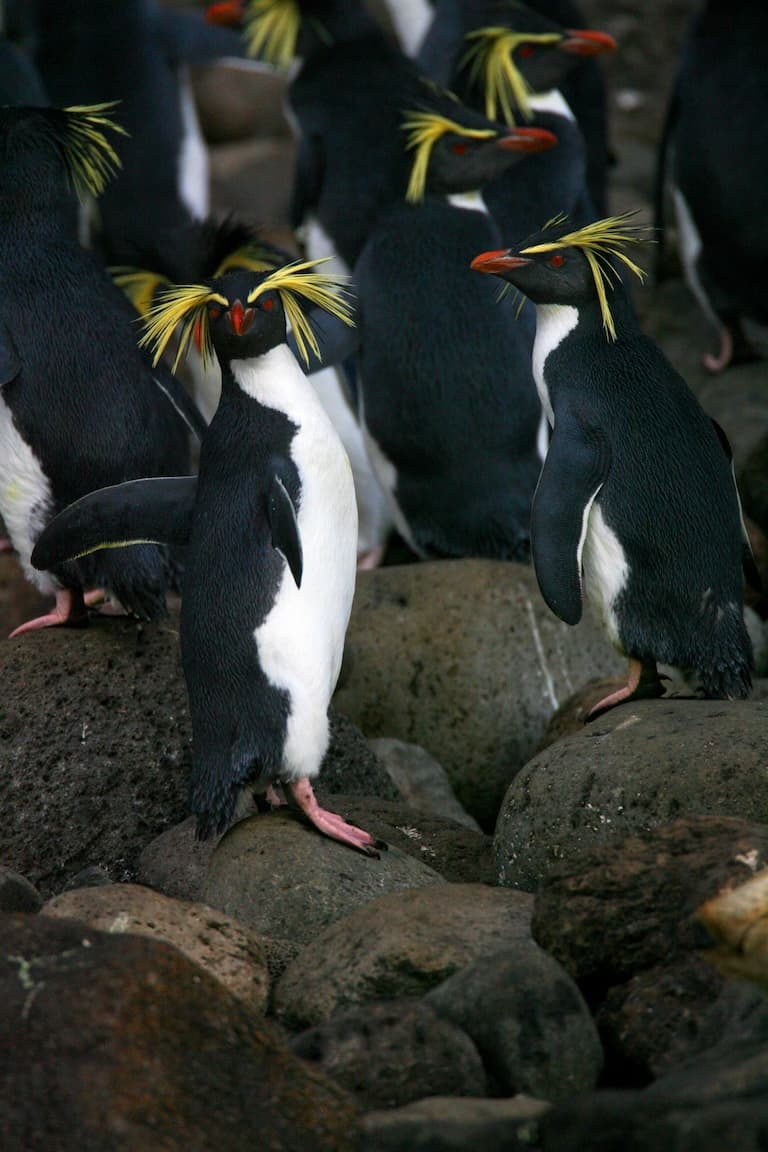
2. They’re hot-weather penguins
The one species model holds Eudyptes chrysocome chrysocome as the true ruler, with the three populations making up subspecies. This is also known as the “Common”, “Western”, or “Southern” Rockhopper when separated by species, which is a bit confusing.
This subspecies or species is the South American population and is commonly found on and around Patagonian coastlines.
Around 10,000 km away, on the other side of the enormous Antarctic landmass, is the eastern rockhopper population, and this one can be found all the way along the Southern coast of Australia, in regions where the temperature is commonly above 35 degrees Celsius.
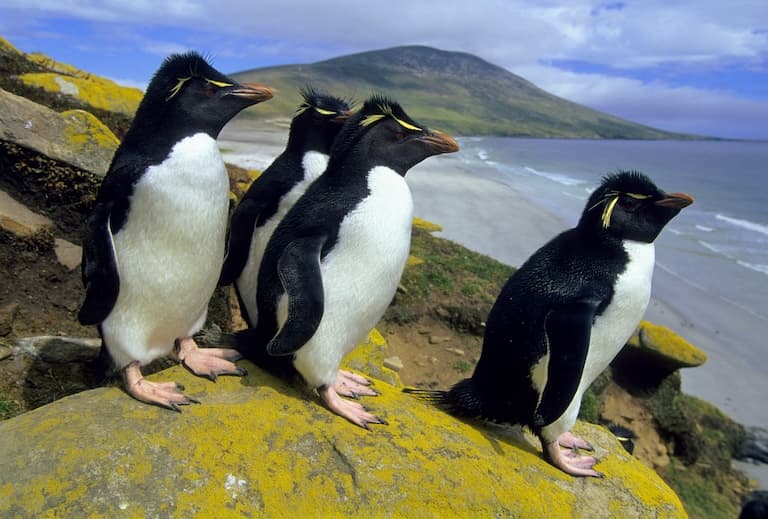
3. They hop on rocks
Here we begin to crack the eternal mystery of why these animals have the name that they have.
Rockhoppers differ from their clumsy Antarctic cousins again, by exhibiting substantial agility on land, especially for a bipedal marine animal!
They’re no mountain goat (but have you ever seen a goat dive for squid?), but the rockhoppers have adapted to nest in locations that few predators can follow them into, and this involved hopping up rocks to altitudes of 100 metres or more.
After up to six months at sea, they come inland to mate, and this all begins with a shaking of those incredible yellow eyebrows.
Once that’s done, they pair up to breed.
4. Penguin milk
Females are the breadwinners of the breeding pair in rockhoppers, and the male is the stay-at-home dad. Males sit on the egg, and the female goes out to get bread, or, more likely, fish, squid and crustaceans, to come back and vomit into his mouth.
But, being small and juicy, these penguins have a dangerous life in the ocean, and if the female doesn’t return, the male will have to rely on his fat stores to complete the incubation.
When chicks are hatched, the male then makes what’s called penguin milk to feed them with.
This is not the kind of milk that the dairy monopolies can complain about being mislabelled; this is actual milk, and is produced with the same hormone that mammals use to make milk. But while birds do have breasts, they don’t have nipples, so it’s administered in the same way all food is passed from bird to bird, with vomiting.
This isn’t unique to penguins – pigeons and flamingos can make this “crop milk” too, and it’s got a similar makeup as mammalian milk, but without any sugar in it. So, possibly a healthier alternative to cow milk, but likely tastes like a burst omega-3 capsule1.
5. Some are in serious trouble
The Northern Rockhopper Penguin Eudyptes moseleyi is the most threatened of the three species.
This is primarily an island species, and can be found on either side of South Africa’s Cape in the Atlantic and Indian Oceans. They are now listed as Endangered on the IUCN Red List, and the causes are a bit of a mystery.
The usual suspects are there: fishermen have been known to use them as bait, hunters to make pillows out of their feathers, and bycatch will always be a problem. But there’s more at play here, possibly linked to a huge oil spill that washed up on the majority of their breeding coastlines and wiped out most of them, and the effect of climate change on ocean currents.
Over in South America, the Humboldt current carries Antarctic cuisine over the South American waters for the resident penguins. During times of climatic strain, like the El Niño phenomenon and climate change in general, this current is depressed, and the Humboldt penguins suffer tremendous losses. Whether something similar is happening to the rockhoppers is not yet confirmed, but the interconnectedness of these oceanic systems is still poorly understood.
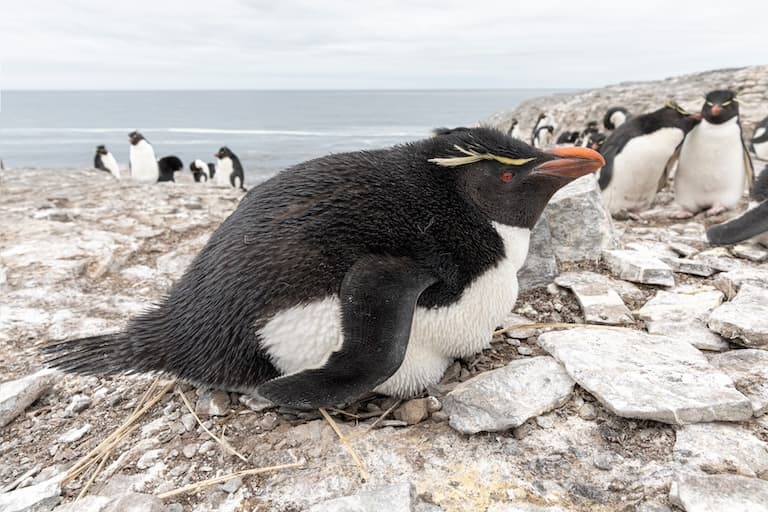
Rockhopper Penguin Fact-File Summary
Scientific Classification
| Kingdom: | Animalia |
| Phylum: | Chordata |
| Class: | Aves |
| Order: | Sphenisciformes |
| Family: | Spheniscidae |
| Genus: | Eudyptes |
| Species Name: | Chrysocome, filholi, moseleyi |
Fact Sources & References
- Paul et al (1988), “Bird Milk”, Stanford.edu.