
Rock Python Profile
The return of John Lennon’s creative side in 1980 is said to have been inspired when he heard the B-52s’ Bizarre fusion song Rock Lobster. A lesser-known fact is that the band tried out multiple versions of the song before settling on the lobster, including Rock Hamster, Rock Manatee, and Rock Python.
None of them worked, obviously, but the Rock Python would eventually make a resurgence just one state South of the Georgian band’s neighbourhood: in Florida.
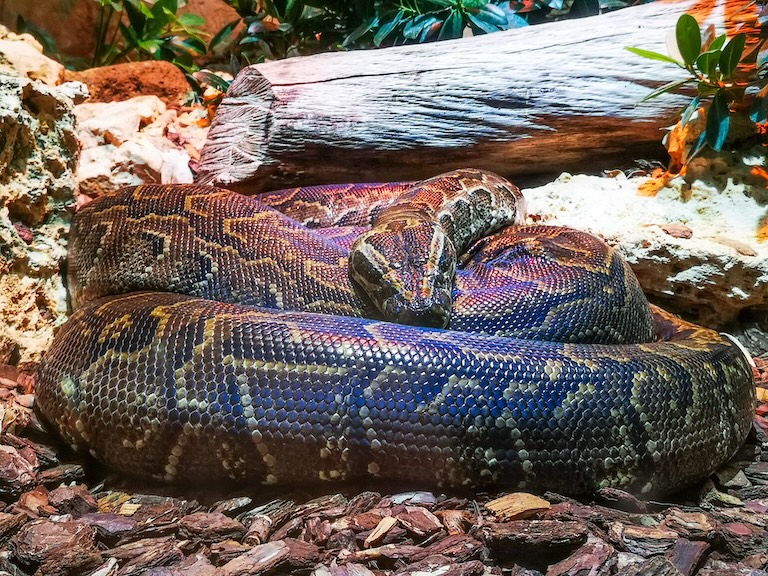
Rock Python Facts Overview
| Habitat: | Forests, swamps, areas with plenty of cover, sometimes semi-aquatic |
| Location: | Two species in Africa, one in India |
| Lifespan: | Over 40 years |
| Size: | Likely up to 9 metres or more, when left alone. |
| Weight: | Up to 90 kg in exceptional circumstances |
| Colour: | Sandy, dappled brown, with black markings |
| Diet: | Large rodents, monkeys, warthogs, antelopes, vultures, fruit bats, monitor lizards, crocodiles |
| Predators: | Crocodiles, humans |
| Top Speed: | Slow |
| No. of Species: | 3 |
| Conservation Status: | Two are Least Concern; the Indian rock python is Near Threatened. |
Rock pythons are some of the largest snakes on the planet today. They are non-venomous, which goes a long way to making them less scary, but try telling that to the people who live alongside them! They are persecuted alongside all snakes in most regions of their Sub-Saharan range, but they are able to avoid detection well enough inside swamps and forests that this has barely put a dent in their populations.
Interesting Rock Python Facts
1. There are three of them
Pythons are a family of mostly quite large constrictors. They’re remarkably similar to the boas in appearance and niche, but are not all that closely related.
The family Pythonidae contains around 40 species across Africa, Asia and Australia, having originated on a landmass that was once made of all three of these landmasses clumped up together.
Pythons are all constrictors, have thermosensory pits to pick up infrared light, and can open their mouths incredibly wide.
There are 11 genera in the family, and Python is the type genus. Within Python, there are around ten species, and three of these are commonly known as the rock pythons. There are two in Africa: the Central and the Southern rock pythons, and one in India, called the Indian Rock python.
2. They’re huge
Snakes don’t fossilise well at all, so the largest specimens from any given place are probably yet to be discovered. In Africa, there was once a marine giant swimming around in an ocean on top of what is now the Sahara Desert, called Palaeophis colossaeus. This was one of the largest snakes known, at an estimated 12.3 metres in length! Thankfully, African snakes no longer get that large, but the rock python is still a substantial animal, and the biggest snake on the continent.
Most grow to more than 3.5 metres long, and some exceptional specimens have made it up to 7.5 metres in length. There are also unconfirmed claims of rock pythons passing 9 metres long. But perhaps even more impressive is that it’s a girthy beast, as well, and by some estimates, this makes it the second heaviest snake after the green anaconda.
In exceptional examples, the rock python can weigh 90 kg, and this makes it one of the heaviest predators on the continent, too. Heavier than a hyena and around three times the weight of a leopard! Chances are good that this species would once have been a lot bigger, and that human hunting has wiped out all the monstrous ones known.
The Indian rock python commonly reaches 3 metres in length, and the Southern rock python often tops 4 metres itself, and both of these will have their own exceptional specimens, too.
3. They’re non-venomous
Regardless of how large they are, a bite from a rock python brings with it no venom at all, as all pythons are non-venomous constrictors.
That’s not to say they’re harmless, though – pythons have a lot of teeth, and they curve back into the mouth like fish hooks to hold their prey still while they’re busy squeezing it with their bodies.
These teeth are long and needle-like, and in an animal as large as the Central African rock python, they are more than big enough to rip flesh and perhaps even puncture arteries. But that’s not their mode of killing. These snakes bring about death by way of cardiac arrest.
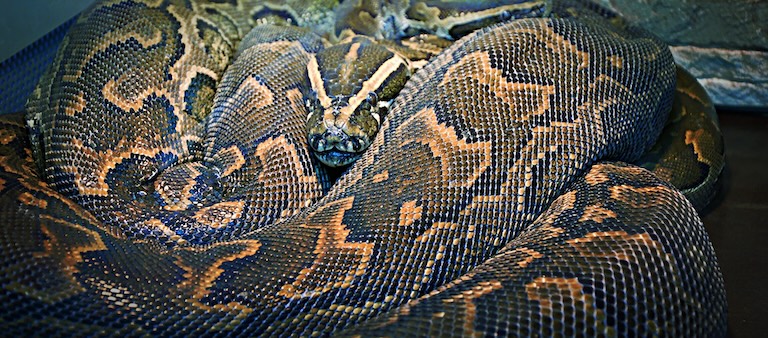
4. They can give you a heart attack
It was once believed (and still is, by most people who haven’t heard this fact yet!) that constrictors suffocate their prey by squeezing a little tighter on the outbreath until the victim finally can’t breathe in at all, and suffocates.
But it’s been discovered fairly recently that it’s a little bit more sinister than this. When a constrictor, like the rock python, gets around its prey and begins the infamous squeeze, it puts tremendous pressure on the entire circulatory system.
This process results in the blood thickening under the pressure, and the heart essentially stalling from a lack of oxygen. And all of it happens a lot faster than suffocation! 1
5. People generally don’t treat them very well
Sensitisation in Sub-Saharan Africa of the rural populations towards ecological harmony is an ongoing struggle, and trying to persuade people not to kill snakes in particular can be borderline masochistic as a pursuit.
With some exceptions, snakes are almost universally feared and are killed indiscriminately across the continent, regardless of whether or not they pose a threat. Some of this comes from superstitious beliefs that snakes are demons, but most of the time, it’s a very simple fear response shared over generations, stemming from the experiences with lethal snake bites that do occur here and there.
Other groups have a different approach to rock pythons specifically, believing that they’re manifestations of a deity, or some otherwise sacred symbol, and in these locations, they’re killed less. Unfortunately, with the loophole of attending a cleansing ceremony available to a person who has killed one, the rock python is still in danger of persecution.
And that’s a real shame, because they are very significant contributors to their ecosystems.
6. They’re population control
The ecology of any location is balanced by predators. Just look at the mess our species has made of the place by figuring out how to avoid being eaten. That’s why scary animals like snakes are so important, and need to be welcomed – they’re population control, and they contribute to the limiting factors that prevent their prey species from developing TikTok or microplastics, or other toxic and devastating pastimes.
Rock pythons are large enough to put pressure on animals as large as a hyena, but they’re also generalists, so they cover many species, from small rodents, hyraxes, crocodiles, and birds.
So, their role is a busy and important one, and one that helps maintain the balance of many of the community members in their habitats.
And only very rarely, if ever, do they harm humans. In fact, it’s almost always the humans’ fault when they do. 2
7. They don’t hunt humans
Snake attacks on humans are almost always down to human error. In venomous animals, these attacks can be extremely dangerous and frightening. But programs in India, where snakebite deaths are substantial, have shown that a handful of behavioural changes, such as wearing boots and carrying torches, can avoid almost all occurrences of accidental bites, leaving only the plethora of incidents in which the snake was trying to avoid being attacked by the human.
But for non-venomous snakes, there’s even less of a justification. In Africa, only the rock python is large enough to cause any harm to anybody, and even then, unless you’re dangling your baby in front of it, it’s not likely to consider a human food.
There have been a handful of cases where a rock python has been implicated in a human death, but none strictly confirmed, and the most plausible ones come from keeping children and “pet” pythons in the same home.
In reality, the most danger from this species comes when it escapes these homes and disappears into a Floridian swamp.
8. They’re invasive
In Florida, pet pythons have gone on a bit of a rampage. Having escaped the confines of their terraria, or perhaps having been let out after they got bigger than the owner was expecting, rock pythons have thrived in the Everglades and similar Floridian habitats.
Their semi-aquatic nature and nocturnal hunting style lend themselves to lurking in the swamps, and in an ecosystem that never evolved to handle them, they’re doing quite a bit of harm there.
Aside from lunging at the pets of unsuspecting locals, they’re also devastating the native wildlife, killing birds that don’t have ways to avoid them, and generally making a mess.
Back in Africa, though, both species are doing okay, despite persecution and are listed as of Least Concern. The Indian rock pythons are faring slightly worse, though, and are now considered Near Threatened. 3 4
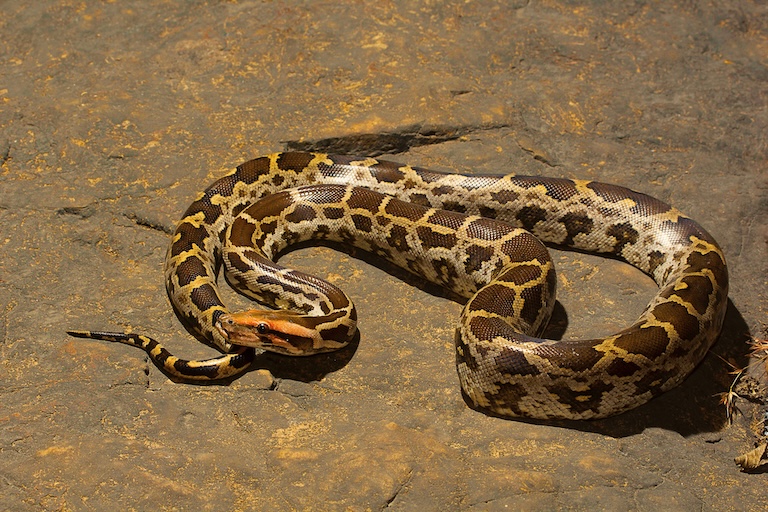
Rock Python Fact-File Summary
Scientific Classification
| Kingdom: | Animalia |
| Phylum: | Chordata |
| Class: | Reptilia |
| Order: | Squamata |
| Family: | Pythonidae |
| Genus: | Python |
| Species Name: | sebae |
Fact Sources & References
- Boback et.al (2015), “Snake constriction rapidly induces circulatory arrest in rats ”,National Library of Medicine.
- (2021), “African Rock Python”, African Snakebite Insititute.
- (2019), “Indian Rock Python”, IUCN Red List.
- , “African Rock Python”, Florida Museum.