
Ringtail Cat Profile
Raccoons are known for making noise in the roof, transferring rabies to your pets, and generally making a smelly mess in the garden. But known is the key word here. Because there are several species of raccoon, and some are far less conspicuous in their behaviours. Today’s animal is a total ninja of araccoonn. Far from the barrel-chested, obnoxious suburbanite, it’s a sleek and silent assassin, and most people in its range will go their whole lives without even seeing one.
The Ringtail Cat is not remotely a cat, but it’s quite far from what most people think of when they hear the word raccoon, too.
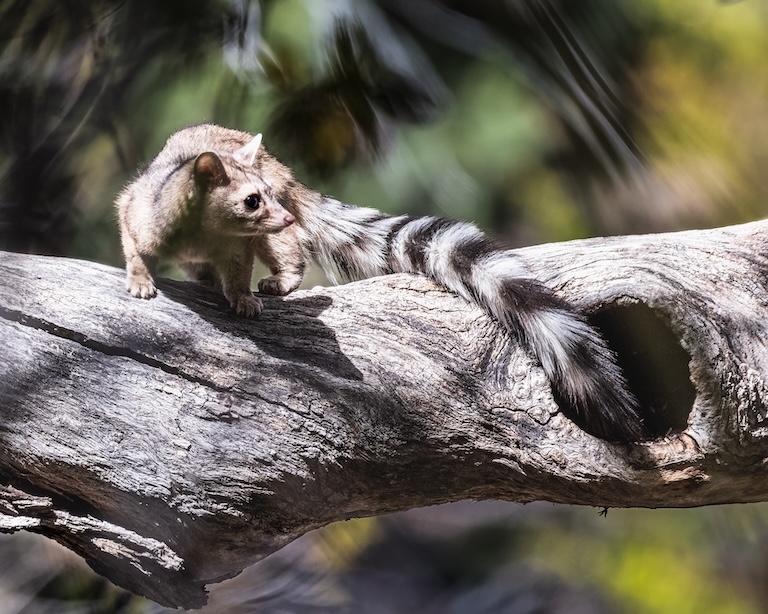
Ringtail Cat Facts Overview
| Habitat: | Rocky outcroppings in forests and woodland |
| Location: | Central and western North America |
| Lifespan: | 16 years in captivity, 8 in the wild |
| Size: | Up to 42 cm (16.54) long |
| Weight: | Up to 1.3 kg (29 oz) |
| Colour: | Black to dark brown in colour with pale underparts |
| Diet: | Mostly rodents, rabbits, squirrels, and insects, also birds, lizards, snakes, frogs, and carrion |
| Predators: | Foxes, coyotes, normal raccoons, bobcats, hawks, and owls |
| Top Speed: | Stealthy and agile, speed not specified |
| No. of Species: | 1 |
| Conservation Status: | Least Concern, but regional data is lacking |
Ringtail cats are closer to weasels than true cats, but closer still to the aforementioned bin bandits that they share the continent with. But these are incredibly agile animals, confined to the shadows, where they hunt from rocky outcrops and deliver killer bites to small mammals and birds under the cover of darkness.
Their exceptional tails have evolved for balance and dazzlement, but unfortunately for the species, have also caught the eye of fur trappers, who like to make hats out of animal organs because they think it’s cool.
Interesting Ringtail Cat Facts
1. They’re raccoons
Raccoons are mostly known for the masked bin bandits of American suburbia and that cartoon from the ‘80s and ‘90s with a tyrannical industrialist aardvark. But the best-known raccoon species, Procyon lotor, is only one of three species in the genus, and around 9 in the family of Procyonidae.
This family is broken into two subfamilies, with the kinkajous and olingos on one side, and the bin bandits and their friends on the other. Alongside Procyon, here are three more genera, with Bassariscus being one of them.
And inside Bassariscus are two quite incredible animals, the cacomistle and the ringtail “cat”. These two animals look quite similar, but the ringtail has much more contrasting markings, including striking black rings around its eyes and the banded tail that gives it the name.
The cat part you can safely ignore, as raccoons are not closely related to cats at all, and are probably closest to mustelids.

2. They’re carnivores
Like mustelids, these animals are carnivorous. In more specialised killers, the teeth at the back aren’t called molars, but carnassials, and function as slicing blades, rather than chewing or grinding mallets.
In raccoons, these carnassials are there, but they’re not all that well formed, though in the ringtail, they are plenty good enough for what it eats, and this can be anything up to the size of a rabbit.
They are slender, quiet, and cunning, and hunt mostly at night. Ringtails are basically what raccoons could be if they hadn’t discovered human refuse.
Ringtail skulls are not as robust as, for example, those of a mink, and so they’re not as brutish as mustelids, but as far as silent assassins go, they’re pretty adept. 1
3. They’re rock climbers
This species is a forest animal, with a preference for rocky outcrops and cliffs. They have semi-retractable claws that aid in climbing, and that elegant, long tail is excellent for balance, too.
They are slender, fit into cracks neatly, and can bound from one surface to another like a chipmunk.
They’re also well-equipped enough to scale vertical tree trunks and can rotate their rear feet by a full 180 degrees to get down the same way. 2
4. They’re Stinky
Skunks are well known for their distasteful butt squirts, but they’re far from alone in this regard.
Many small animals have figured out that predators don’t appreciate the cake nearly as much when it’s blasting pernicious fluid from glands around the anus.
The ringtail cat is just such an animal. When captured, it screams, which is pretty effective as a deterrent already, but if the message isn’t clear enough, it can also secrete some foul-smelling liquids from the anal glands. Its marksmanship is nothing compared to the skunk – this oozes, rather than spurts – but that’s actually very normal, really, and nothing to feel ashamed about. 3

5. They’re solitary
As you’d expect from something that communicates with anal secretions, this is a solitary animal. And this makes it all the more awesome, really.
Here’s a masked, nocturnal athlete assassin who works best alone, like Willem Dafoe in Platoon. They are so good at this that the species as a whole appears to be doing fine, and this is seemingly in spite of all human efforts to correct that.
6. They’re killed for fur
In the Pleistocene, wearing animal furs kept our species alive. Today, there is a wealth of alternatives that make ripping the very skin off an animal just to put it on your body quite an inconsiderate thing to do.
Yet, tens of thousands of these cute little animals are trapped in Colorado, Arizona, New Mexico and Texas just to make a pelt that sells for $5. When processed, they go for around $30.
This practice has declined – it was responsible for the sale of 135,000 pelts in 1979 – and now amounts to a few thousand per year, but it’s undeniable that the need to kill ringtails is limited to a small demand for a pelt that isn’t even all that useful as a textile.
Unfortunately, fur harvesting isn’t regulated strongly enough, and while the species is listed as of Least Concern on the IUCN Redlist, the authority itself admits that data is lacking from many of the locations where the trappings are most common. 4

Ringtail Cat Fact-File Summary
Scientific Classification
| Kingdom: | Animalia |
| Phylum: | Chordata |
| Class: | Mammalia |
| Order: | Carnivora |
| Family: | Procyonidae |
| Genus: | Bassariscus |
| Species Name: | astutus |
Fact Sources & References
- , “Ringtail Cat vs Mink Skulls”,Bone, Art, & Nature.
- Kim A. Cabrera, “Ringtail”, Bear.Tracker.
- Jeffrey Goldberg (2003), “Bassariscus astutus ”, Animal Diversity.
- (2015), “Ringtail”, IUCN.