
Ribbon Eel Profile
If you want your animals to look like they’re always saying, “Aaaaaaaa”;
If you like your animals to look like they were drawn by kids in the ‘90s;
If you like them wet, flat and savage, and to wave their nostrils at you as you pass;
You’ve come to the right place. This is the ribbon eel.
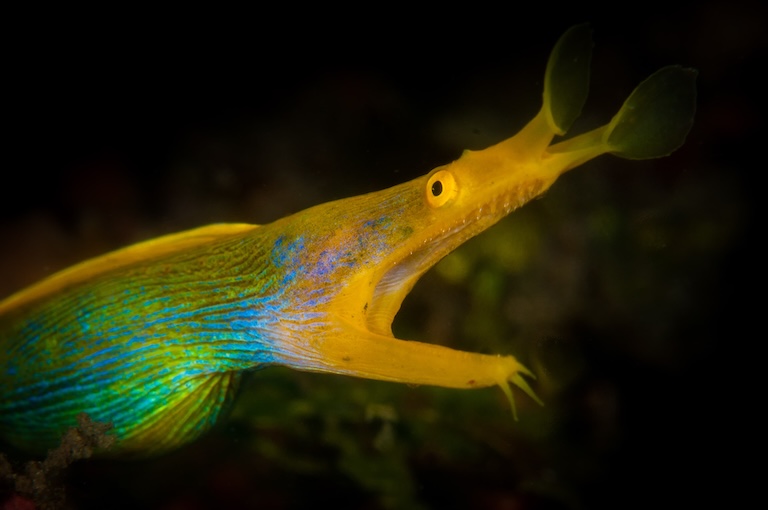
Ribbon Eel Facts Overview
| Habitat: | Marine, shallow waters |
| Location: | Tropical regions of the Indian and Pacific Oceans, mostly Australasia |
| Lifespan: | Not recorded |
| Size: | Up to 94 cm (37 in) long |
| Weight: | Not recorded |
| Colour: | Jet black with yellow, bright blue with yellow, or orange-brown with green |
| Diet: | Anything that will fit in its mouth |
| Predators: | Larger fish, likely marine mammals |
| Top Speed: | Slow and undulating |
| No. of Species: | 1 |
| Conservation Status: | Least Concern |
Ribbon eels are about the best-looking mouth breathers you can find, and they probably don’t even get nosebleeds, either. These beautiful, elongate fish would be well at home in Transsexual Transylvania; from their glamorous poses down to their ability to kill swiftly and savagely
Interesting Ribbon Eel Facts
1. That’s a Moray
Eels, despite what they’ll try to tell you, are just weird-looking fish. Specifically, ray-finned fish, like pretty much all the bony fish in the world, give or take a few species.
They’re part of a diverse order of snake-like fish called the Anguiliformes. One level down, the ribbon eels are members of the suborder Muraenoidei, which houses the congas (named after noisy chains of people at Brazilian weddings), snake eels and (among some others) the morays.
And these stunning water stripes are indeed morays, which makes them members of perhaps the cuddliest of fish families that can also bite your thumb right off.
2. There are two types
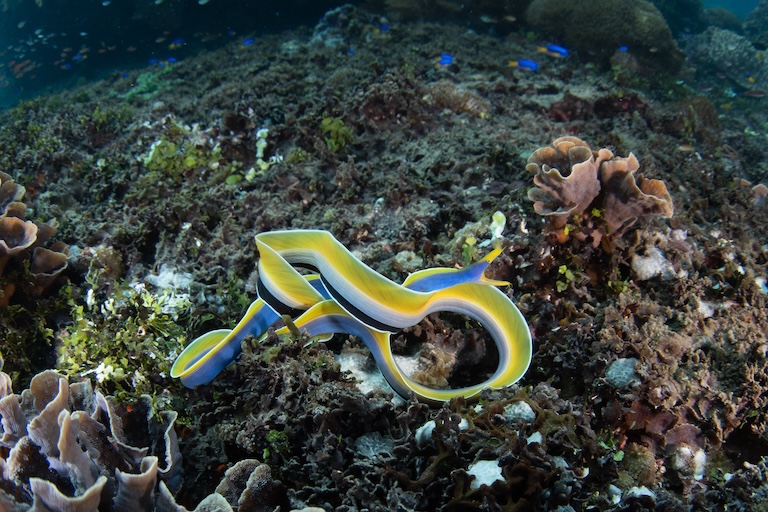
There’s only one genus of ribbon eel, and only one species in that genus. It was once thought there were two species, because some are bright blue and others are bright black, and on looking at their genitals (as taxonomists usually do), these two were clearly different from the others.
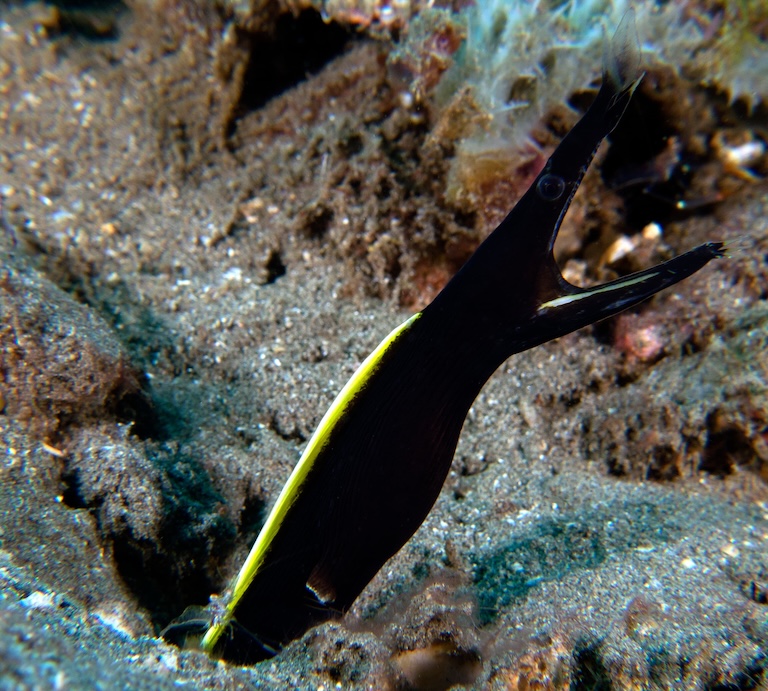
But as it turns out, the blue and black ribbon eels are two varieties of the same thing; juveniles are jet black with a striking yellow stripe, and as they mature, males become the blue ones, and females become a sort of orange-brown with iridescent green hues.
[Note: There’s a white ribbon eel, but this is a totally different genus, and not related, and is also known as the ghost eel, so it will be listed under that name on this site.]
So, there are three colour morphs, and if you’re still not sure, look at their noses. 1
3. They have weird nostrils
It has been said that the ribbon eel “can be easily recognised by its hugely expanded anterior nostrils”. This does seem secondary to the eel’s more obvious quality of being an enormous strip of neon pappardelle, but the nostrils are impressive, nonetheless.
This is a schnoz that gives the proboscis monkey a run for its money, and manifests in the eels as two leaf-like structures, one on each nostril. The lower jaw is not without its appendages, either, and houses three small tentacles, like those of a gnarled, witchy grandma, and for the same reason – to sense your presence.
These sensory organs help the eel prepare itself for killing, and also tell it when to retreat back into its hole. The eels can often be found poking their heads out into the water and waving them about with their mouths open.
This is a lot sexier to other eels, but it isn’t just for show. Nor is it an aggressive pose, as these eels, like the bloggers who write about them from their parents’ basements, need to keep their mouths wide open to breathe. 2
4. They’re transsexuals
We now know that gender is a social construct and can be waived, bent or flipped to meet our will, but nobody alive so far has ever succeeded in changing their sex. Nobody human, anyway.
Ribbon eels can.
And that’s really lucky for the species, because all ribbon eels are born males and so would immediately become functionally extinct if they couldn’t.
This isn’t as rare in the ocean as it is on the land, and is actually a bit of a thing in the fish world. It’s called protandic hermaphroditism, and despite practising this for countless millions of years, it hasn’t done their societies any harm at all.
Ribbon eels are one of the many animals whose sex changes as they grow, beginning as males, mating with females, and then maturing into females to mate with the upcoming males. It’s all very bohemian, at first glance, but then you remember these animals are moray eels and are therefore dangerous killers. 3
4. They’re dangerous killers
Did we mention that ribbon eels are dangerous killers? Whether male or female, juvenile or adult, as pretty as ribbon eels are, they are moray eels through and through, and kill things accordingly.
As any sensible creature should, ribbon eels will attack more or less anything that gets too close to their hole uninvited. But on the other hand, they will stuff anything that fits into their mouths, and this is really less widely advised, but for a moray, is par for the course.
These aren’t very large for morays, and so their mouths can mostly handle small fish and shrimp and things, but of course, they’re moray eels, and so have no sense of inferiority in this regard – they’ll attack with the full vigour of a giant moray. 4
5. They die in captivity
These stunning animals are, as you’d expect, targets of the pet trade, at least in Indonesia. Thousands are collected, housed in some amateur setup, and then promptly die.
Professionals have had marginally better success at keeping them in captivity, and some even managed to spawn, but for the most part, this is not an animal that does well in captivity.
Curiously, colour differences in captive animals appear to lose all meaning, and they will come in all colours regardless of age or sex! 5
6. But they seem to be doing ok
Despite the collection issues locally in Indonesia, this isn’t thought to be affecting the species as a whole, and the ribbon eel is listed as of Least Concern by the IUCN.
The damage to the local population, though, isn’t clear, nor is it certain what will happen when they run out. So, as of now, it’s best to get your ribbon eel fix from the public aquarium, or even better, from sustainable ecotourism in their native habitats. 6
Ribbon Eel Fact-File Summary
Scientific Classification
| Kingdom: | Animalia |
| Phylum: | Chordata |
| Class: | Actinopterygii |
| Order: | Anguiliformes |
| Family: | Muraenidae |
| Genus: | Rhinomuraena |
| Species Name: | quaesita |
Fact Sources & References
- , “Colourful critters that are just a little bit weird? Meet the Ribbon Eel!”, Two Fish Divers.
- Mark McGrouther (2021), “Ribbon Eel, Rhinomuraena quaesita Garman, 1888”, Australian Museum.
- (2018), “Blue Ribbon Eel”, Ocean Life.
- Millie Sheppard (2025), “Ribbon Eel Care Guide: Tank, Color Change, Diet & Size”, Aquarium Source.
- Preininger et. al (2014), “First observations of fertilized eggs and preleptocephalus larvae of Rhinomuraena quaesita in the Vienna Zoo”, Wiley Online Library.
- (2009), “Ribbon Moray”, IUCN Red List.