
Rhinoceros Beetle Profile
Insects have done very well for themselves. They were the first known animals to develop flight, which they did before vertebrates even made it onto land and about 250 million years before mammals even existed. They have covered all continents, all terrestrial biomes, and almost all niches over the course of their existence and have benefited from tremendous diversity. And few orders of animal – let alone insect – can claim the dizzying range of diversity as the beetles.
Beetles make up around a quarter of all animal species listed, and likely more to come. So, narrowing it down a bit can be difficult. Even the rhinoceros beetles, a small fraction of a single beetle family, make up over 225 genera and more species than we can count.

Rhinoceros Beetle Facts Overview
| Habitat: | Usually wooded areas with foliage and sap, and soft ground |
| Location: | Worldwide except Antarctica |
| Lifespan: | 5+ years |
| Size: | Up to 18 cm (7 inches) long |
| Weight: | Up to 140 g (8.5 oz) |
| Colour: | Usually black or brown |
| Diet: | Sap, rotting wood, foliage |
| Predators: | Birds, mammals, reptiles |
| Top Speed: | Slow |
| No. of Species: | 1500+ |
| Conservation Status: | Varied, most not listed |
Rhinoceros beetles are known best by their champion, Hercules. But they are so much more than this. Valued for their adornments, their incredible strength and their ability to generate lucrative crowds of gamblers in Thailand, these beetles are overlooked as necessary contributors to their woodland habitats.
Interesting Rhinoceros Beetle Facts
[1] They’re Scarabs
Scarabs are well known for two things: rolling big balls of poo, and looking like Ancient Egyptian jewellery. But, they’re beetles, so of course they will do almost everything else, too.
Scarab beetles make up around 35,000 of the over-400,000 beetle species described, and they’re generally considered hard-bodied and immensely strong. And so, unsurprisingly, this is where Atlas beetles, Goliath beetles, Hercules beetles and our guys here, the Rhinoceros beetles, all come from.
For many of us, the Melolontha beetles are the most familiar scarab beetles, commonly getting stuck in windows in May or June, and bearing the hilarious name of cockchafers. Rhinoceros beetles are not as scruffy-looking as those funny little things, but they do share that fluffy underbelly, at least in many species, and the resemblance is hard to miss, once you spot it.
But rhinos aren’t known for their hairy bellies, so the name must come from something else.
[2] They’re horny
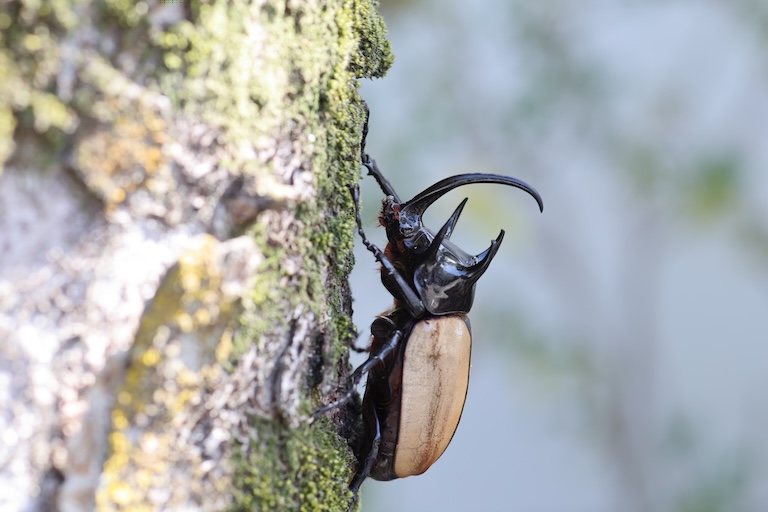
Technically, only the male rhinoceros beetles have horns, and only in most species. This is a monophyletic group, which means they’re connected genetically, and not just by name, so there’s some variation across different species, and even ones without a conspicuous weapon attached to their heads are entitled to the name rhinoceros beetle.
These are a subfamily of the scarab beetles, and mostly have horns. Some are large, some are smaller, some are pointed, others paired, spatulate or trident-like, but they’re all used for the same thing: war.
The fact that only the males have them goes to show that they’re not used as an anti-predation device, but as a battle tool against other males for the rights to females. Horns are specifically evolved to deal with other males of the same species, and battles are primarily fought as wrestling matches – the aim being to toss or flip the rival off the tree. 1
[3] They’re huge
These beetles are some of the largest insects in the world. The Hercules beetle is a member of this subfamily, and its larvae can grow to 140 g in mass, making it one of, if not the heaviest, insect on record.
These beetles spend many years as larvae, and only gain their glorious weaponry upon maturing. They’re lighter as adults, but significantly larger, with the longest of them reaching up to 18 cm long.
These are, of course, outliers, as there are 34,999 other species to choose from, and most are substantially smaller. Still, as scarabs go, these are real beasts. And with such a huge size comes incredible strength. 2
[4] They’re strong
In classic internet style, if you do a quick search, you’ll see a commonly repeated claim that a rhinoceros beetle can carry 850 times its own bodyweight.
This is, to put it politely, bollocks. But it’s widely permeating bollocks, nonetheless – as is so often the case with animal facts.
Chances are, the beetle might be able to pull 850 times its own bodyweight, but that’s a very different task, as the ground does the majority of the lifting. When actually tested by actual scientists, they could just about carry 40 times their weight before exhausting after a few minutes.
This is already impressive, but it gets even more interesting. While 40 times its body weight is unsustainable, 30 times appears to be a sweet spot. When loaded with this weight, the beetle appears to barely struggle at all!
For most of us animals, carrying capacity is directly proportional to metabolic expenditure. Simply: carrying twice as much uses twice as much energy. But this beetle appears to have some incredible metabolic efficiency secrets that allow it to carry 30 times its mass with only a 4x multiplier on its energy expenditure. In fact, it’s five times more efficient at least than we are!
These incredible insects are immensely powerful and use mechanical quirks to distribute and move loads without running out of steam. 3
[5] They’re everywhere
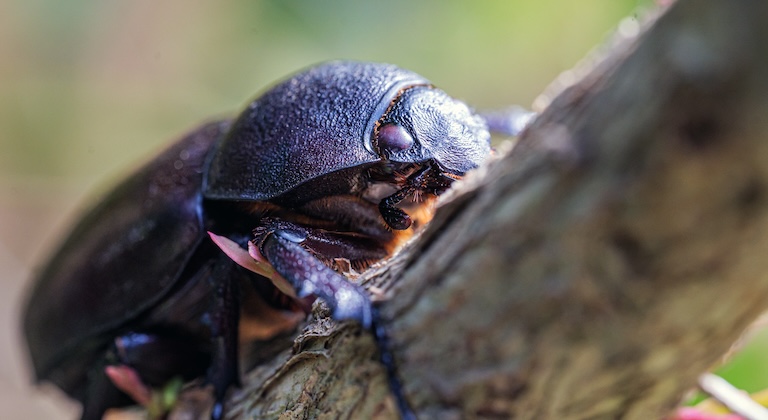
Almost. Rhinoceros beetles seem like exotic, tropical beetle finds, on account of how glorious they are, but they’re actually found on every continent except Antarctica.
This is another common quality of beetles, in that there are just so many of them. Even Europe has them. There’s one beetle in the UK called a rhinoceros beetle that isn’t: Sinodendron cylindricum, named for its horn but belonging to a different family. But the European rhinoceros beetle is a true rhinoceros beetle, and one of the largest in Europe.
Most species do live in the tropics (this is true for pretty much everything), and it is in the tropics that you will find entire gambling industries dedicated to them.
[6] They make money
In Thailand, rhinoceros beetle fighting rings have opened up and generate a surprising amount of income from bets made on the bouts. As much as it seems unsavoury to pit animals against one another for fun, this generally does not much harm to the beetles, who get returned to the jungle if they lose and kept as pets if they win.
One interesting side effect of this, though, is that it reverses the ecological process of granting mating rights to the strongest beetle. Still, the industry likely isn’t big enough to have much of a noticeable impact. Meanwhile, betters can make over a thousand dollars on a fight. 4
[7] They belong in the wild
Of course, their main role is not to impress us with feats of strength, but to tie a forest ecosystem together. The years-long lifespan of the larva alone contributes to the recycling of nutrients in the forest, as it eats dead wood.
Adults feed on nectar and plant sap, which likely contributes to pollination, since they’re also quite hairy. And their huge size no doubt provides a valuable food source to their various predators. All in all, the rhinoceros beetles are exciting and beautiful members of a vast and diverse group of insects.

Rhinoceros Beetle Fact-File Summary
Scientific Classification
| Kingdom | Animalia |
| Phylum | Arthropoda |
| Class | Insecta |
| Oder | Coleoptera |
| Family | Scarabaeidae |
| Genus | 40 + |
Fact Sources & References
- Ed Yong (2014), “Rhino Beetle Weapons Match Their Fighting Styles”,National Geographic.
- Andy Kulikowski , “Dynastes hercules”, Animal Diversity Web.
- Rodger Kram (1996), “Inexpensive Load Carrying by Rhinoceros Beetles ”, Journal of Experimental Biology.
- Taylor Weidman (2016), “Winning big in Thailand’s rhinoceros beetle matches”, Aljazeera.