
Reticulated Python Profile
If you’re like many of us animal lovers who learned the word reticulated from Lisa Simpson, then you might be aghast to find out that not only was that chipmunk so not reticulated, but there isn’t such an animal as a reticulated chipmunk at all. And while we’re at it, Smarch doesn’t exist, either.
This Reticulated python, though? Totally real. And it’s the only species of snake that’s been verified to have eaten a person.
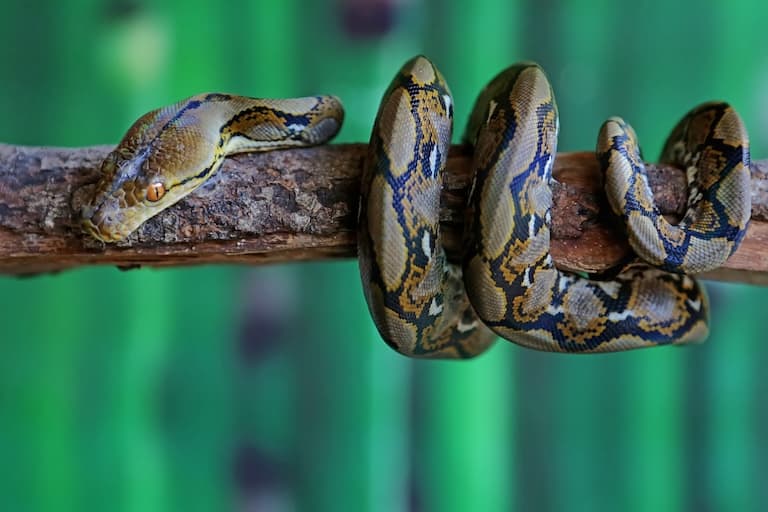
Reticulated Python Facts Overview
| Habitat: | Forests, wooded areas, and comfortable in freshwater systems |
| Location: | South and Southeast Asia |
| Lifespan: | 32 years in captivity, 23 in the wild |
| Size: | Up to 9 metres (29.53 ft) long |
| Weight: | Up to 270 kg (594.71 lb) |
| Colour: | Usually grey-brown, with reticulated, yellow-bordered black patches |
| Diet: | Birds, mammals, reptiles |
| Predators: | Raptors and small mammals when eggs/young, crocodiles when adults |
| Top Speed: | Slow |
| No. of Species: | 1 |
| Conservation Status: | Least Concern |
Unlike Smarch and the reticulated chipmunk, reticulated pythons are, as the name suggests. They’re truly reticulated and truly pythons, and about the beastliest examples of such that you can find. This is one of the biggest snakes in the world, and far closer to the largest snake ever known than it is to the smallest.
They are Old World snakes that look and act like the boas of the New World, but do it in Southeast Asia, and without ever having come across their doppelgangers in the wild. Their enormous size means they’re not often found in captivity, and also that they’re persecuted for being scary in the wild, but so far, so good with this species, in regard to its conservation, and naturally occurring small variants are gaining popularity in the home.
Interesting Reticulated Python Facts
[1] They’re reticulated
Alright, so what is this all about? Reticulated is a common term in animal names, which is why it sounded so right in The Simpsons to begin with, but while it’s a word that sounds very formal, it has a very basic meaning. Reticulations are simply repeated, grid-like patterns, and they’re not limited to animals, but when a creature has it in their name, it will be referring to the patterns on their skin.
So, that chipmunk was not reticulated, despite Lisa’s insistence, and this just added to the confusion. There’s a reticulated giraffe, reticulated frogs, reticulated rays, morays and sea cucumbers. And they’re all named for this gridlike pattern.
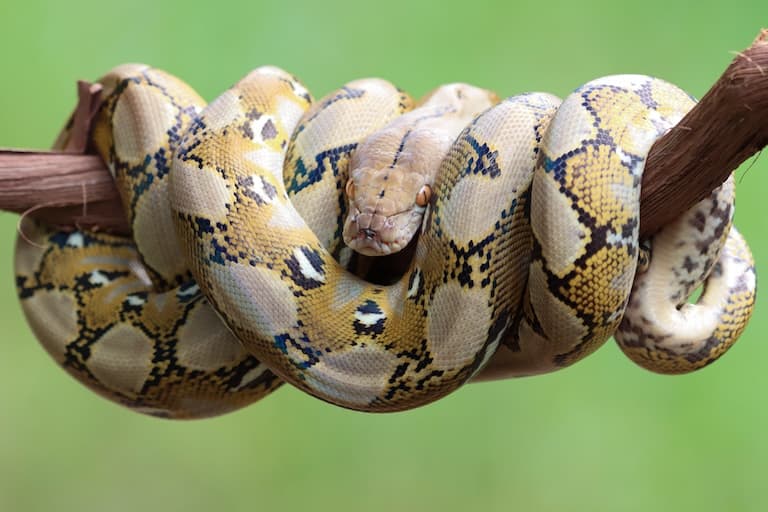
And the python in question, being absolutely plastered in squares or diamonds in this fashion, more than deserves the name.
[2] They’re long
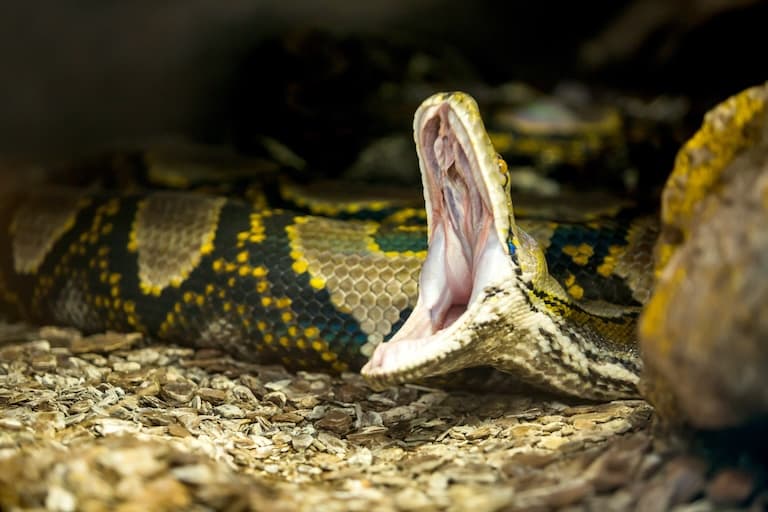
Reticulated pythons are pythons, and pythons are generally quite large snakes. But none are larger than this one. In fact, there’s no snake longer on the planet, and the only heavier snake is the green anaconda.
Anacondas are boas, and boas are rather fat animals. They spend a lot more time on the ground and in water than pythons, and so they sort of expand and fatten, and don’t need to be as slender as the more arboreal reticulated python.
So while it is slimmer, the reticulated python outsnakes the anaconda by a wide margin. This is a snake that can grow to over nine metres long in some cases, which is pushing up against some of the prehistoric monster snakes that have popped up in the fossil record.
Unfortunately, this size comes with two vulnerabilities. First, nobody wants to keep them in captivity, and when they do, they often end up being euthanised when they get too big to look after; and second, they are so scary to the locals where they live, they’re persecuted just for being enormous.
Now, this would normally be an opportunity to point out the human stupidity involved in killing a harmless animal, but the reticulated python happens to be the longest snake in the part of the world where our species is commonly at their smallest. Indonesians are some of the smallest people in the world, and this is why the reticulated python is the only species of snake that has been verified to have swallowed a whole person1.
[3] They’re excellent in water
They don’t eat people often, though, as they’re more keen on smaller animals. Still, these are all-terrain killers and are comfortable in the water as much as on the ground. While anacondas spend time in water out of necessity, the sleeker reticulated python does so just to show off.
They’re remarkable swimmers and can use rivers to traverse habitats and move through or between forests with ease. They even take to the ocean, and this is how they’ve managed to colonise so many islands in the region, too.
So the land and water aren’t safe, but the tree canopy isn’t, either. These snakes climb with ease, maintaining their slender physique with plenty of daily callisthenics.
[4] Females can self-fertilise
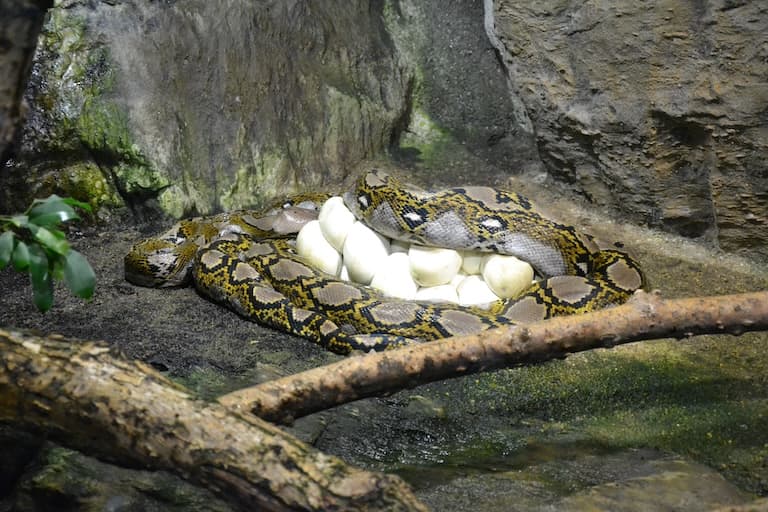
Not only are these snakes good at moving in almost any medium, but they are hard to wipe out. As has been witnessed in several reptiles and amphibians, reticulated pythons exhibit parthenogenesis when they aren’t able to find a mate.
This is similar to the Jurassic Park problem, but in this case, instead of some females turning into males, they remove the need for males entirely, and just fertilise their own eggs. This doesn’t happen often, and is likely even rarer in the wild, where males would naturally be found, but it’s happened in captivity, more than once2.
[5] Super dwarfs
In this species, as mentioned, captive animals often suffer from neglect and ultimately death when they inevitably outgrow the 30-gallon terrarium that came with the impulse buy and start to eye up the family dog.
But the patterns on the python and its docile nature, as well as how tough and adaptable it is, make it almost the perfect snake for the home in every other regard, so it’s very fortunate that not only are there mini versions available, these are naturally occurring variants, and not the product of overzealous in-breeding programs to make an unhealthy poscket-sized morph.
Dwarf reticulated pythons, and super dwarfs are found on various islands across the species’ range and are classified as legitimate subspecies in most cases. These, then, are the snakes you’re looking for if you want a reticulated python that fits inside a normal-sized car.
These small snakes are still pretty big and are more akin to ball pythons in size. They naturally occur as a result of being on islands for so long, and succumbing to what’s called insular, or island dwarfism, where a species shrinks to meet the resource abundance of the island.
Reticulated Python Fact-File Summary
Scientific Classification
| Kingdom | Animalia |
| Phylum | Chordata |
| Class | Reptilia |
| Oder | Squamata |
| Family | Phythonidae |
| Genus | Malayopython |
| Species | reticulatus |
Fact Sources & References
- Stuart et al (2018), “Reticulated Python”, The IUCN Red List of Threatened Species.
- Cameron (2016), “Python reticulatus ”, Animal Diversity Web.