
Regal Angelfish Profile
Everyone knows how much biodiversity can be found in a tropical rainforest – they’re the most biodiverse terrestrial biomes we’ve got! And as monkeys, the forest is our hometown. But all life comes from the ocean, and despite all our efforts, this is where we still find the most biodiverse habitats on the planet. Specifically, the reef ecosystems.
Amid this bustling crowd of stripes, tentacles, and flashes of colour are the angelfish. And sitting near the top of the pile, when it comes to charisma and beauty, is a unique species both in appearance and taxonomy: the regal angelfish.
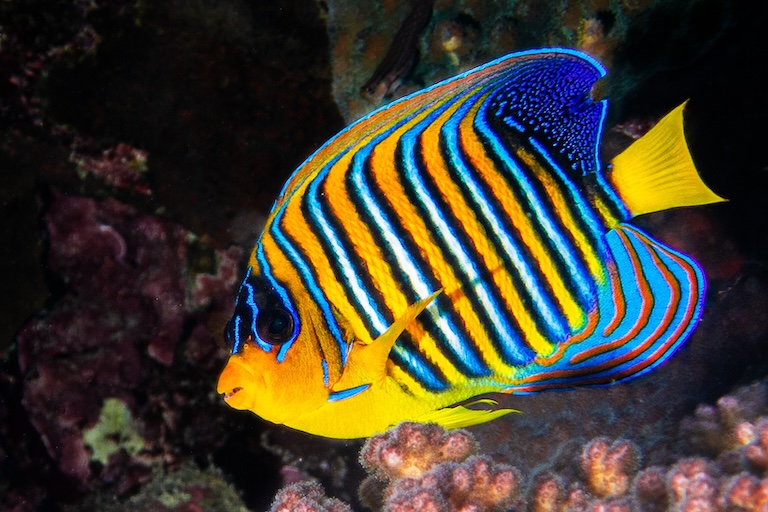
Regal Angelfish Facts Overview
| Habitat: | Shallow, tropical marine |
| Location: | Indo-Pacific |
| Lifespan: | 15 years in the wild |
| Size: | Up to 25 cm (10 inches) long |
| Weight: | Not listed |
| Colour: | Yellow base with vertical blue bands, lighter, silver-blue bands within |
| Diet: | Mostly sponges and tunicates, also algae |
| Predators: | Larger predatory fish, mammals, and eels |
| Top Speed: | Not listed |
| No. of Species: | 1 |
| Conservation Status: | Least Concern |
Regal angelfishes, sometimes known as royal angelfishes, are a staple among the high coral density habitats of the Indo-Pacific. From West Africa to Australasia, these pretty animals are well adjusted to life around coral and have outlasted all others in their genus as a result. They are a primitive species, basal to most, if not all, of their extant family members, but their position in the ecosystem is still a strong one, and their survival skills have kept them out of the conservation books so far.
Interesting Regal Angelfish Facts
1. They go by many names
The etymology of this fish’s name is hard to pin down. Royal anglers belong to the genus Pygoplites. The prefix plygo- translates to “buttocks” and the rest has been declared to mean anything from weapon, to shield, to wide. Evidently, this fish’s backside is the focal point, but what it is about that ass that’s so interesting, we aren’t quite sure1.
In common naming, it’s also called the Regal angelfish, and sometimes the blue-banded angelfish, and the Empress angelfish, all of which refer to how stunningly attractive it is.
2. They’re marine angelfish
Taxonomically, they sit in a family of fish known as marine angelfish. These are not the same as the freshwater angelfish from the Amazon, and are not even closely related.
The marine angelfish are characterised by their flat bodies and bright colours, and so the Royal angelfish fits right in here. They’re mostly reef fish, and the family contains about 86 described species in 7 genera. But the Royal angelfish takes up one of these genera all by itself2.
3. They’re the only ones
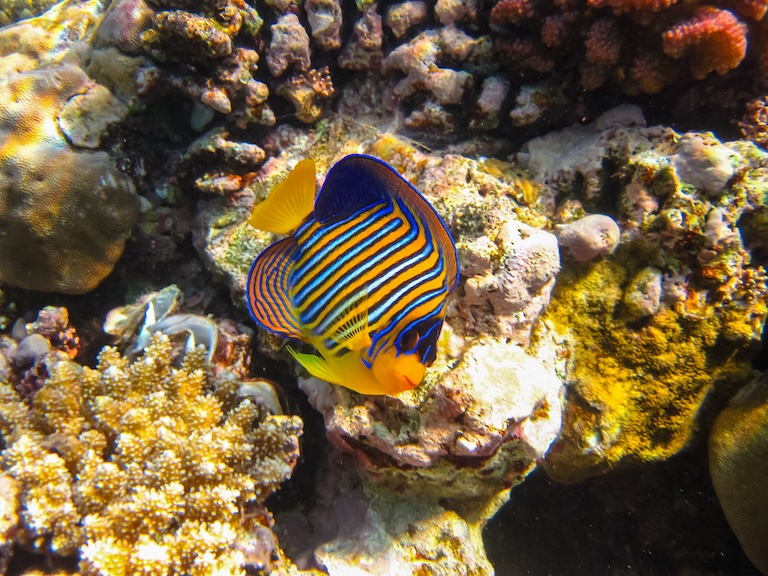
This species, Pygoplites diacanthus, is the oldest known member of the family, and the only member of its genus.
It’s dated back to the early Pleistocene, more than 8 million years ago, when it’s thought to have diverged from the genus Holacanthus. And so has done pretty well for itself to last this long, surrounded by the up-and-comers its ancestors gave rise to. There are several mostly discrete populations, with two lineages found in the Indian Ocean, having radiated out from the Red Sea.
Being non-migratory, these populations mostly stay put and exhibit colour and genetic differences that are obvious, but not stark enough to define them as separate species. As such, it’s proposed that there are several subspecies of Royal angelfish, but there can be only one species!3.
4. They aren’t always visible
This is a member of one of the most colourful groups of fish on the reef, and it’s one of the brightest members, to boot. Reef fish are often some of the most dazzling of any animals you’ll find, and this seems counterintuitive at first, in a world where pretty much everything bigger eats everything smaller.
The reasons for this are seemingly not fully established, but there are some good ideas: the chaotic nature of the reef’s colouration means that contrast really helps animals of the same species find one another. Further, patterns can break up the outline of an animal and make it harder for predators to spot.
On top of this, marine animals have very different eyes from ours, so what they’re seeing is likely totally different to what we’re seeing, and finally, there’s a trade-off between being visible enough to find a mate and hiding from danger. And this last point is why, when the Royal Angelfish is a young’un, it’s not the vibrant and glorious image of fishy beauty that we expect from it as an adult.
Juveniles are drabber and more cryptic in their colouration, and this allows them to mature more safely in the reef before they’re ready to mate. And this is one of many ways in which this species is well-suited to a life on the reef, more than anywhere else.
5. They’re reef specialists
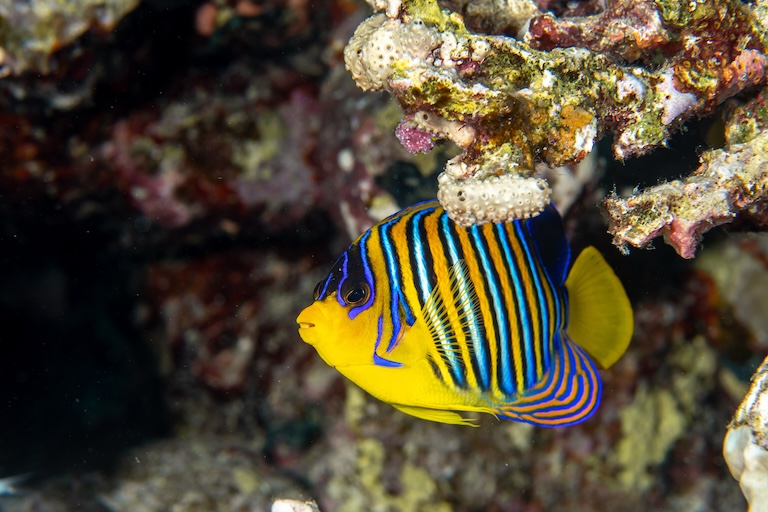
Royal angelfish have a strong preference for high coral density environments with hard substrates. Reefs are its speciality, but under that umbrella, it’s actually not super fussy. So, it’s a reef specialist with a generalist preference across reef environments.
And once they’re in their spot, they don’t tend to move much. They’re very well adapted to reefs, as long as the water temperature is right, and will pick at soft food, hide in rocks, and socialise in small groups for the entirety of their lives without ever dreaming of anything bigger.
Being so visible as an adult works well on the reef, but is incredibly dangerous in the open water, so migrations are off the table, but this doesn’t seem to bother the fish.
And unlike many of the harder-mouthed reef-fishes, these ones tend not to damage the corals at all, with a few exceptions.
6. They’re mostly reef safe
This species is widely reported to be reef safe on account of their diet of soft-bodied animals like sponges and tunicates, but experienced aquarists do offer warnings that soft corals, like brain corals, and clams, and other soft-bodied life forms in the tank could also be at risk when keeping these fish.
There are suggestions to limit this behaviour, including keeping the fish well fed, but it is also commonly said that angelfish – even royals – shouldn’t be kept with corals in an aquarium.
In the wild, though, this species isn’t one of the primary perpetrators of coral destruction.
7. They’re semi-aggressive
Being adaptable animals, they don’t confine themselves to rigid social structures. This species can be found on its own, in pairs or in groups of up to seven. They’ll tend to stick around crevices and caves, since their bright colours are pretty conspicuous, and they have been known to be a bit territorial.
Most aquarist sources consider these fish to be semi-aggressive – that is, pretty chilled out in the right company, but liable to get into fisticuffs if conditions aren’t right.
In the wild, they have a lot more space, and their enormous distribution and well-populated communities mean that they’re still doing well. This is a species of Least Concern to the IUCN Red List4.
Regal Angelfish Fact-File Summary
Scientific Classification
| Kingdom | Animalia |
| Phylum | Chordata |
| Class | Actinopterygii |
| Order | Acanthuriformes |
| Family | Pomacanthidae |
| Genus | Pygoplites |
| Species | diacanthus |
Fact Sources & References
- (2025), “Royal angelfish”, Grokipedia.
- Coleman et al (2016), “Regal phylogeography: Range-wide survey of the marine angelfish Pygoplites diacanthus reveals evolutionary partitions between the Red Sea, Indian Ocean, and Pacific Ocean”, ScienceDirect.
- Coleman et al (2016), “Regal phylogeography: Range-wide survey of the marine angelfish Pygoplites diacanthus reveals evolutionary partitions between the Red Sea, Indian Ocean, and Pacific Ocean”, ScienceDirect.
- Pyle et al (2010), “Royal Angelfish”, The IUCN Red List of Threatened Species 2010.