
Redback Spider Profile
In 1972, Slim Newton released a cautionary tale about the humiliation, discomfort and lust for revenge that would resonate with any Australian who has had a run-in with a small member of the black widow genus.
This pretty little spider packs a serious punch, and like its infamous cousin, the black widow, it sports a classy little red-on-black number to warn you about it.
Unfortunately for the redback spider and those who sit on it in the dark, this is often too little too late.
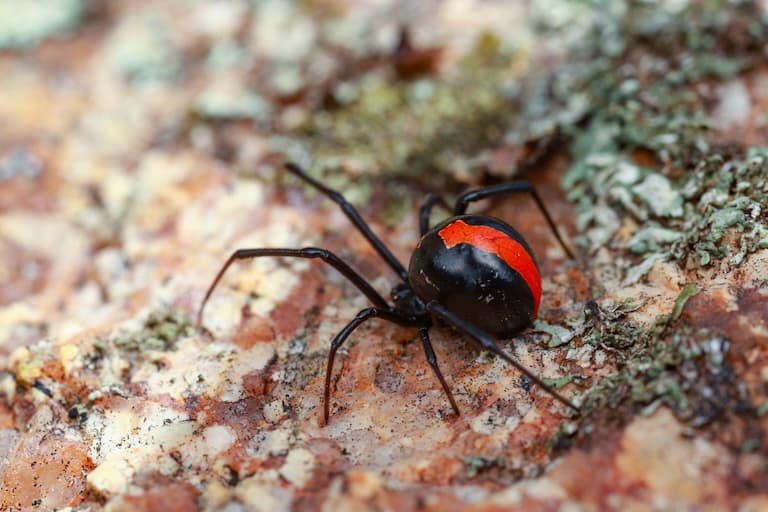
Redback Spider Facts Overview
| Habitat: | Urban, sheltered areas; toilet seats |
| Location: | Australia and New Zealand, introduced to Asia |
| Lifespan: | Females live up to 3 years, males less than a year |
| Size: | Around 2 cm (0.8 inches) long |
| Weight: | Not recorded |
| Colour: | Females are black, with stark red markings; males are light brown |
| Diet: | Smaller arthropods |
| Predators: | Birds, lizards |
| Top Speed: | Sedentary |
| No. of Species: | 1 |
| Conservation Status: | Not listed |
Redbacks are a small member of the widow genus in the tangle-web family of spiders. They look a lot like black widows and are probably even more dangerous, and have a bit of a reputation in their native Australia as such.
These beautiful, but very toxic little critters are expanding outwards, too, so we might be lucky enough to find them hiding about in our garden latrines worldwide, soon.
Interesting Redback Spider Facts
[1] They’re tangle-web spiders
Spiders are incredibly diverse! There are over 50,000 species described, and that’s not likely to be close to all of them.
There are around 140 families of spiders, and usually only a handful of very common families in any particular region, so this is the level most spider fans get to with their identification.
The common garden spider, for example, is a member of the Araneidae family, and these are generally recognisable for their shape and the webs they make. Jumping spiders are another easy one, forming the family Salticidae, and wolf spiders, who run through the grass, are their own family, too, the Lycosidae.
Redback spiders look a little like the orb weavers. They have the bare legs and bulbous abdomens of their cousins, but their webs are totally different, and this gives them their common family name, the tangle-web spiders.
Redback webs are deep as well as tall, and certainly don’t look as elegant and well-planned as those of the orb weavers, but they are no less structurally impressive, and perhaps even more complex. They involve a series of vertical supports, anchoring a web that is strong in all three dimensions.
Perhaps the most well-known example of a tangle-web is the black widow: an animal known for its formidable bite. And the redback does absolutely nothing to dispel that reputation.
[2] They’re quite venomous
The tangle webs are very diverse, and the widow spiders are only one genus within it, but the redback is a member of this genus, Latrodectus. These spiders are so profoundly toxic they have a condition named after them: latrodectism. This is the condition you get when one bites you, and it’s not a good one.
Latrodectism is characterised by pain, muscle rigidity, vomiting, and sweating, though fatalities from any member of this genus are surprisingly rare, and that’s usually the worst of it. That said, they have killed before, and no doubt will again, so this is certainly not one you want to mess around with.
Fortunately, for the spider, venom is expensive to produce, only stored in small amounts, and absolutely vital to its ability to feed itself, so in the case of defensive bites, a redback is prone to “dry-biting”, which is a way of telling you to gtfo without wasting its precious venom.
So, this reduces the odds somewhat, but the reduction is more than countered by the species’ preference for urban environments.
[3] They like people
Redbacks and humans value much of the same habitat. Dry, sheltered, somewhat private spaces where they can eat and defecate in peace.
Being that one of these species is far larger than the other, it’s the spider who is more easily surprised, and as Slim Newton’s wise words suggest, often by the rump of an unassuming defecator. Redbacks are said to have killed just as many as the infamous funnel web spiders, but antivenom is now available, and since its introduction, there have been no confirmed deaths.
Like all spiders, redbacks won’t bite people unless they feel like they’re about to die, but accidents do happen, and sometimes this can lead to a trip to the hospital.
So, humans aren’t on their hit list. In fact, one of the most common victims of redback bites are other redbacks.
[4] Copulatory somersault
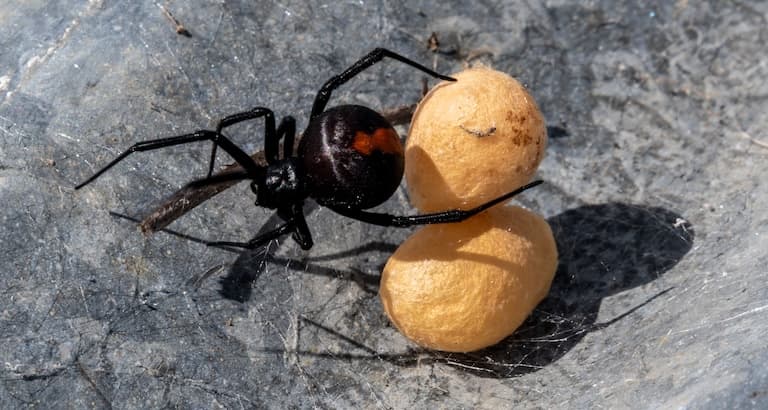
Redbacks are solitary by nature, but gregarious all the same. Spiders like these produce copious quantities of offspring, who venture very little out into the world before deciding to set up a web. Most, thankfully, fail – or we’d have hundreds more per eggsack every season – but those that survive are generally in the company of others.
When it’s time to mate, the smaller, browner male will go off to find a far larger, shiny, black female with a big arse. The mating procedure begins with the male reaching out and touching the female’s sperm-storage organs. This is not the recommended starting point for human males, as it is generally considered rather forward, but spiders aren’t as fussy.
At this point, the male will engage in a so-called copulatory somersault, which is a rapid 180-degree rotation, and actually is pretty similar to human courtship in many ways – most obviously with the danger to the male.
[5] Why women live longer
The internet is awash with examples of boys and men doing silly and dangerous things for clout, and if we were a cynical bunch, we could summarise clout as a sort of reproductive currency, linking this recklessness to the ultimate goal of mating. If that’s the case, then we have a lot in common with the redback males, who, in the pursuit of getting their legs over, usually offer the ultimate sacrifice.
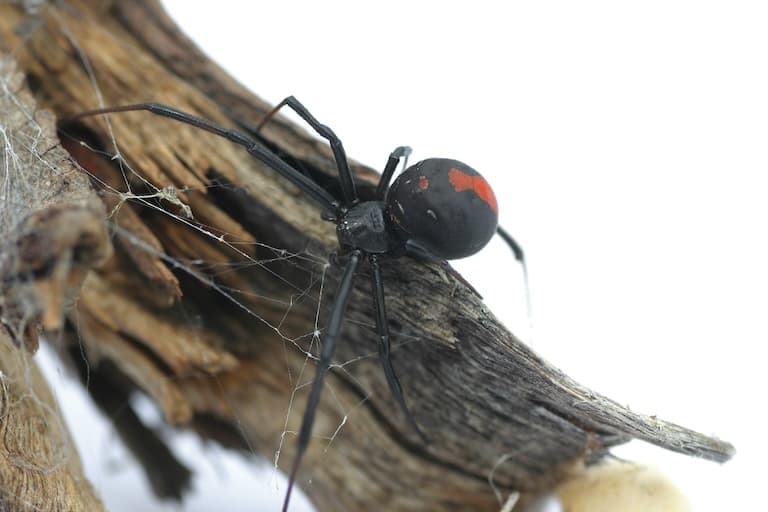
After the copulatory somersault, the male is now in a position of having to hand over sperm while keeping its vital organs out of reach of the female, who typically, at this point, starts trying to eat him. Females will chew on the male’s abdomen, and for around 30% of males, this is the end of the line. For the remaining 70%, they will get another go at inserting more sperm, and this reduces their chances to 35%.
So, in almost all cases, males only mate once, and the females will completely consume the males. For this reason, and seemingly this reason alone, male redbacks live for only a few months, while females can continue on for three or more years1.
[6] They’re spreading
One population of redbacks found in Japan have shown that this species can endure temperatures as low as -3 degrees Celsius. It’s not clear if this is their limit, or that of the literature, but either way, it implies a resilience to climates far-reaching, and a potential for the species to establish itself all over the place.
And, anecdotal evidence supports this dispersal idea, as there are unsubstantiated claims of redbacks turning up in greenhouses in Belgium, likely as stowaways among cargo shipments.
So, redbacks might be bringing their cannibalistic, painful and potentially lethal presence into the Northern hemisphere, and it remains to be seen how this will unfold as global temperatures up there gradually align with their native climate.
Redback Spider Fact-File Summary
Scientific Classification
| Kingdom | Animalia |
| Phylum | Arthropoda |
| Class | Arachnida |
| Order | Araneae |
| Family | Theridiidae |
| Genus | Latrodectus |
| Species | hasselti |
Fact Sources & References
- Bindman (2013), “Latrodectus hasselti”, Animal Diversity Web.