
Razorbill Profile
If Happy Feet has taught us nothing else, it’s that the bar for writing a $400 million box office hit is so painfully low, even a penguin could do it just how much penguins lament their loss of flight. Sure, they are positively mesmerising underwater, but this comes at a high cost to their ability to look cool on land, let alone in the air.
But what if a penguin could fly? And what if we didn’t have to go all the way to Antarctica to see them? Fortunately for us, these questions have been answered by the Auks, and the razorbill, in particular, is the embodiment of the best of both worlds.
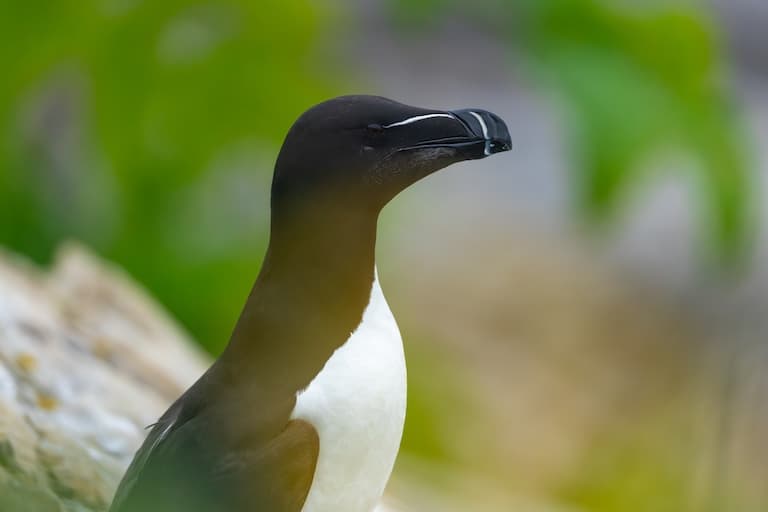
Razorbill Facts Overview
| Habitat: | Coastal, subarctic waters |
| Location: | Atlantic Ocean |
| Lifespan: | 30 years |
| Size: | Up to around 40 cm (15.7 inches) long |
| Weight: | Up to 900 g (32 oz) |
| Colour: | Black and white |
| Diet: | Fish and krill |
| Predators: | Gulls, foxes, ravens and raptors, polar bears |
| Top Speed: | Around 39 km/h, 23.6 mph in the air |
| No. of Species: | 1 |
| Conservation Status: | Least Concern |
Razorbills are everything the penguin wishes it were. They have the looks, the grace, and the ability to traverse land, sea and air with equal dignity. They are also members of the original penguin group, before that name was appropriated by the lesser-deserving.
Perhaps most outstanding is that these fatty, tasty, coastal animals have not only survived the human impacts on their existence so far, but still appear to be thriving. These tenacious birds are not invulnerable, though, so still it’s up to our species to turn the tide before they go the way of the Great Auk.
Interesting Razorbill Facts
1. They’re Auks!
Penguins are almost exclusively a Southern Hemisphere phenomenon – there is a small pocket of these birds just over the equator, but not by much. But for as popular as they are, penguins aren’t the original penguins – Auks are.
The first penguin was the Great Auk, at least in terms of etymology. This was named in Europe by Europeans, long before they’d recorded any black and white fishing birds from Antarctica. This word shows up as far back as the 1500s, and it wasn’t until around 300 years later that it began to be applied to what we now know as penguins.
But these two groups of birds are unrelated, and just look a bit similar. Auks are all Northern birds, for one thing, but are members of the unrelated family Alcidae, which is also home to guillemots, puffins and the adorable auklets, among others. This family is where we find the so-called Auks, and once upon a time, the great auk, Pinguinus impennis. Sadly, we killed them all in the late 1700s, right around the time the Razorbill was described by Carl Linnaeus.
The razorbill is a crow-sized auk in its own genus, Alca, and is one of the most stylish of the group, as well as being one of the fastest.
2. There are two subspecies
Razorbills are exclusively an Atlantic Ocean bird, occupying the chilly coasts of its subarctic regions. There are two accepted subspecies, with the A. t. islandica subspecies being slightly smaller and prone to warmer waters than its larger sibling, A. t. torda.
These two overlap considerably, and the species as a whole is found along the East coasts of North America, along the Arctic passage and well into Europe, as far South as Germany.
3. They are incredible predators
Fish have it really rough. In the absence of any meaningful amount of plant matter, pretty much everything in the ocean eats everything smaller than it. To make matters worse, while a gazelle only has the two dimensions of the African plains to consider when looking for threats, fish have a third. That’s two extra directions to scan for danger.
And from above, that danger often comes in the form of the razorbill. This bird dives with grace, but unlike many that hit the water like a spear and hope for the best, this species is agile enough to chase down and catch fish itself.
This is a strategy that has worked for so many penguin species, too, and this is no coincidence.
4. They behave a lot like penguins
What works in one cold place may well work in another, and so the razorbills, despite evolving separately from penguins, exhibit many other similarities than just their looks.
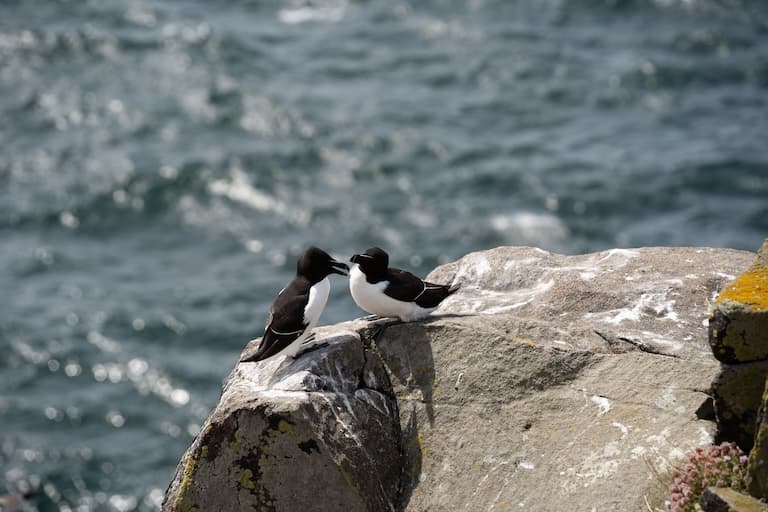
These birds breed in large colonies in barren, rocky outcrops, are monogamous, and return to the same nest site, time after time. Like penguins, they don’t spend much time at all on land, other than to breed, but unlike penguins, these ones are competent in all three realms.
5. But they can fly
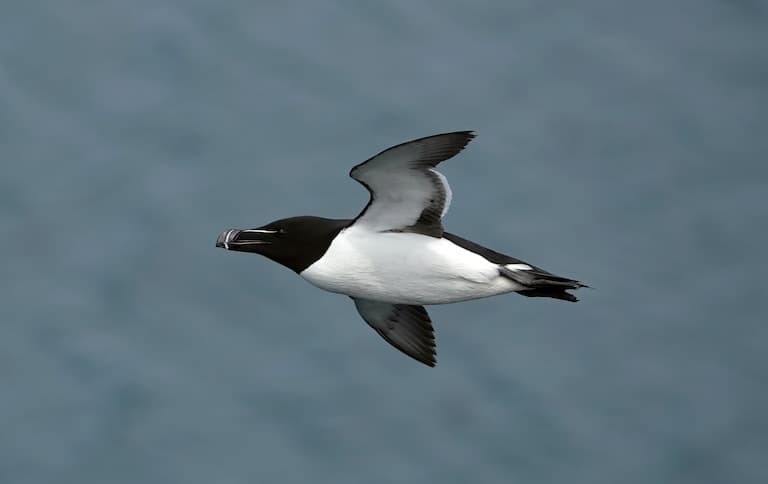
Razorbills have a similar approach to feeding as penguins: they’re black-and-white torpedoes, capable of launching themselves into spectacular dives – the difference is, these ones do it from the air.
They spend most of the winter on the surface of the water, from which they dive for food, often more than 100 metres deep! They’re incredibly agile beneath the waves, but they are equally adept in the air, and appear to surf on the wind, hovering over their local rocky outcrops and really enjoying themselves.
They’ll also be spotted far out to sea, carrying multiple fish in their beaks at once, as they do when breeding. Females do more fishing than males, but they both take care of the offspring, and this can involve hanging up to ten little fish out the sides of their mouths and gliding back to base to share them with the little one1.
6. There are loads of them
Unlike the extinct Great Auk and lots of other fatty shorebirds that the whaling centuries affected, this species is doing really well.
They are not without their threats – breeding sites are being destroyed, oil spills are a routine danger, and climate change is scrambling the composition of the ocean food supply – but these seem to be adaptable birds, and have moved further afield to compensate for all of this.
The global population has been up and down over the years, but appears to be stable and increasing, currently boasting up to 1.7 million individuals, as of 20212.
7. This makes them an important food source
Being a mid-tier predator, this places the razorbills right in the middle of the food web. They provide tremendous selective pressure on the fish they eat, but also a lot of good fats and protein for their own predators, of which there are many.
Breeding is the time that razorbills are most vulnerable, as this is when they spend most time on hard ground, where there is a plethora of lethal animals to contend with. Local species like foxes and polar bears threaten both the birds themselves and the eggs, but a far more dangerous prospect is the arrival of introduced predators like mink and rats3.
When in the air, they’re still on the menu of some of the larger raptors, and in the water, while they are the safest of all, there are still raptors and possibly sharks to think about. And, of course, the ever-present devastation from fishing nets.
So, the life of a razorbill is not as glamorous as it seems at first glance, but they do appear to have penguins beat in almost every category. And with so many still around, this species has a chance to endure our clumsy, destructive phase and still be with us in a more sustainable future, if and when we get there.
Razorbill Fact-File Summary
Scientific Classification
| Kingdom | Animalia |
| Phylum | Chordata |
| Class | Aves |
| Order | Chradriiformes |
| Family | Alcidae |
| Genus | Alca |
| Species | torda |
Fact Sources & References
- Christopher (2025), “Dorsal View of Razorbill in Flight with Fish”, Nature Photography Blog.
- (2021), “Razorbill”, The IUCN Red List of Threatened Species.
- Joyce (2002), “Alca torda”, Animal Diversity Web.