
Rays Profile
With scientific naming often being similar but different to the common names for things, it can get a little confusing.
Take rays, for example: you have ray-finned fishes, x-ray tetras, g-ray squirrels, vascular rays, ray-bans, and Ray Liotta; none of these are true rays, in the sense that they’re outside of the 600 or so species of fish known as rays.
But worry not! Because we’re here to provide a concise introduction to a group of animals so unfairly overshadowed by their more popular, sharky relatives. Time to catch some rays!
Rays Facts Overview
| Habitat: | Mostly marine, some freshwater. |
| Location: | Worldwide |
| Lifespan: | Some species more than 50 years old |
| Size: | From around the size of a human hand to over 9 metres (30 ft) long |
| Weight: | Up to 3,000 kg (6,600 lb) |
| Colour: | Usually, sandy brown or bluish grey |
| Diet: | Crustaceans, small fish, zooplankton, molluscs, some algae |
| Predators: | Sharks, cetaceans, humans |
| Top Speed: | Potentially up to 24 km/h (15 mph) |
| No. of Species: | 600+ |
| Conservation Status: | Varied, many Critically Endangered |
Rays don’t get enough credit. With sharks taking the limelight, this group of bendy animals is commonly overlooked, but they shouldn’t be, because they are the largest group in their class, and are an eclectic bunch of large, small, delicate, monstrous, sluggish, speedy, gentle and lethal mostly flat fishes that deserve recognition!
Interesting Ray Facts
1. They’re shark-adjacent
Believe it or not, the word “fish” is another word that has no phylogenetic girth to it. If fish includes salmon and sharks together, for it to be all-encompassing, or monophyletic, we’d have to include the descendants of fish that moved onto land. So, us. Instead, we separate fish-like things into three main groups: The jawless fish, which contains the worm-like monsters such as lampreys; the bony fish, which contains things like the salmon and bass (and still arguably, us); and the cartilaginous fishes, which are made up of the sharks, rays and chimaeras.
This latter group is astonishingly old. The earliest sharky fossils appear in the sediment from around 450 million years ago, but since cartilage doesn’t preserve well, this might change. Interestingly, it was once thought that cartilage was a primitive form of skeleton that evolved before bone, but even this has come into question in the wake of new evidence to suggest that bone evolved into cartilage.
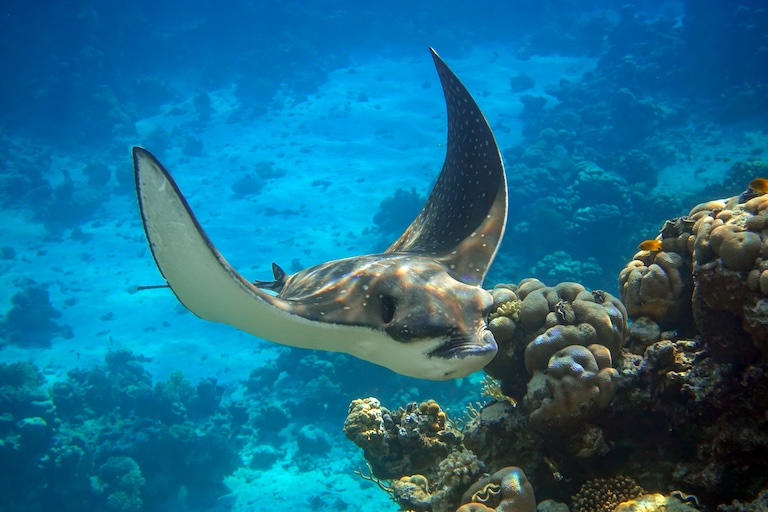
Regardless, these bendy fishes are characteristic of a class of vertebrates known as Chondrichthyes. It has the sharks, rays, chimaeras, and also the sawfishes and skates. The subclass Elasmobranchs separates most from the chimaeras, and one step beneath this is the “division” Batomorphi, or rays. This division is a tiny separation, which implies that rays are particularly close to the rest of the group in their taxonomy.
And so, they are. In fact, they could be considered a type of very flat shark. Except that their most recent common ancestors diverged during a time when dinosaurs were still struggling to climb to the top, back in the Triassic.
2. They’re flat
In all that time since, rays have done a wonderful job of filling niches that sharks and other bendy fishes can’t.
If the stereotype of a shark is a sort of flesh-cutting torpedo, the ray’s general approach is more of a metal detector: it’s a disc-like scanning device that takes the ancestral traits of electro-reception and spreads them out across a surface wide enough to pick up on the smallest of sea creatures living in the sand.
Tiny pits in their downward-pointing faces pick up on small electrical signals escaping from the gills of their victims, and this gives away their position. The rays then suck up the substrate, victim included, and use plates of crushing teeth to break them apart before swallowing.
Most rays feed in this manner, but their diet depends on their location and niche. And within the group, there’s quite a lot of diversity that shows up! 1
3. They’re diverse
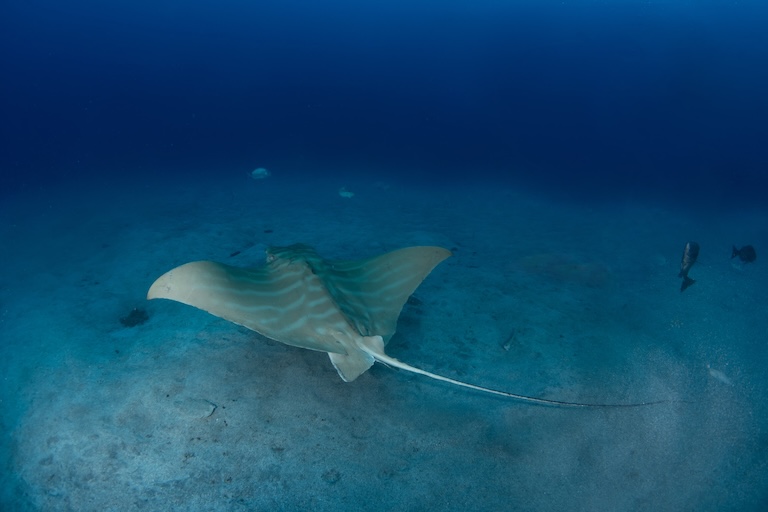
Size is the most striking range to be found within rays. This is, in fact, the largest group of cartilaginous fishes, with four extant orders and hundreds of species within those. The smallest is likely the short-nosed electric ray, which reaches a maximum length of about 10 cm. At the other end is the monstrous manta, which is one of the largest fish in the ocean at 9 metres long.
Mantas are also some of the smartest fish you’ll come across, and our monkey brains are only just starting to realise this – we have a long way to go in terms of figuring out how bright these animals are, but the early signs are good that they may be the most relatable cartilaginous fish we know of.
Then, there are stingers, shockers, biters, whippers, freshwater and saltwater variants. Some of the most infamous, of course, being the stingrays. 2
4. Stingers
Stingrays, like all rays, are relatively gentle animals unless you’re a crustacean. But, being made of meat puts them on the menu of larger fish, so they do need to be able to defend themselves. They do this using a very hard and very sharp, serrated barb in their tails, which flicks up in a frighteningly powerful attack when the animal feels threatened.
This barb is tough enough to pierce bone, and it houses venom, to boot. The venom isn’t thought to be all that dangerous to humans, but all accounts point to it being remarkably painful.
5. Shockers
There are several animals in the water that have figured out some electrical superpowers. The electric eel is probably the most infamous in this regard, and this one really can kill a person. But this is a bony fish, not an eel. Electric rays are far less famous, but they exist all the same.
In fact, that torpedo-shark comparison from earlier ignores the reality that the word “torpedo” comes from the genus of electric rays, Torpedo. Rays in this genus have a reputation for paralysing people who grab them, and the weapon was named after this destructive marine force.
Plato wrote about this fish, and electric rays were even used in a form of medical therapy as early as 46 AD.
6. Giants
As we mentioned, lots of rays spend much of their time being small scanners and vacuum cleaners in the sediment. But plenty don’t! Some of the largest fish in the ocean are rays, and many traverse great swathes of open ocean on the regular.
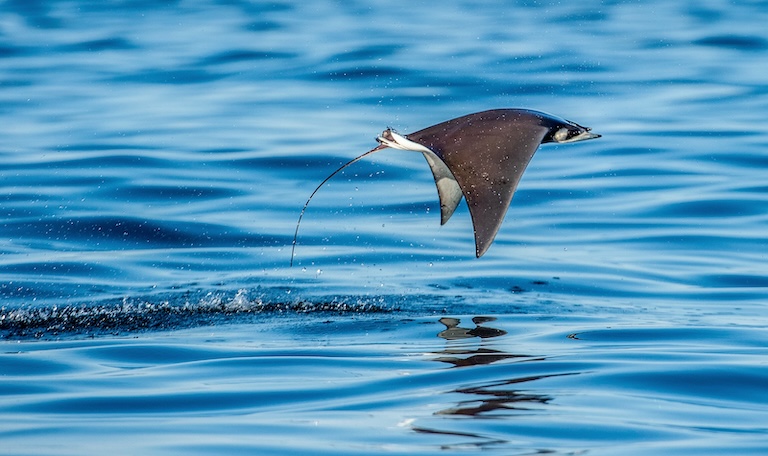
Manta and Mobula rays are the giants of the group, and these are the long-distance experts: graceful, streamlined, and surprisingly fast! Mobula rays, or “devil rays”, are known to leap out of the water at sunset, and Mantas, as we mentioned, can be colossal in size.
7. Freshwater rays
The majority of rays live in the ocean. These are primarily marine animals, but there are still quite a few successful species that inhabit brackish waters and even freshwater systems. There are 35 species of river stingray alone, and these also happen to be some of the prettiest animals in the river.
River rays are often spotted, sometimes patterned or striped, usually round, and can also be huge. Giant freshwater stingrays can grow to over 600kg in weight and 3 metres long! 3
8. Many are in trouble
As fascinating and diverse as rays are, they are some of the most pressured fish in existence. Being often shallow-water feeders, they get caught both on purpose and by mistake, and so there are countless threatened species that are in danger of disappearing forever.
Two examples are the Reticulate round ray and the Ornate eagle ray from Central America and Australasia, respectively. These are two unrelated species, but both occupy shallow, tropical coastlines, and both overlap with commercial and small-scale fisheries as a result.
Both of these species are now Critically Endangered and still in decline. 4 5
Rays Fact-File Summary
Scientific Classification
| Kingdom | Animalia |
| Phylum | Chordata |
| Class | Chondrichthyes |
| Order | Four orders |
Fact Sources & References
- , “Electroreception: The Shark’s Sixth Sense”, Save our Seas Foundation.
- , “Species Fact sheet”, Shark Bay Ecosystem Research Project.
- Kelsey Thompson, “Himantura chaophraya ”, Animal Diversity Web.
- (2023), “Ornate Eagle Ray”, IUCN Red List.
- (2020), “Reticulate Round Ray”, IUCN Red List.