
Raven Profile
Corvids are some of the smartest animals around, and while most of us are very familiar with the crows, there are perhaps no other members of this family who more encapsulate Corvid charisma and intellect than the Ravens.
But they’re not just smart – In 1845, Edgar Allen Poe said aloud what our species had been thinking for thousands of years: (paraphrasing) “Ravens are really creepy”. They are huge, ominous, morbid, and as corvids, they travel in what’s commonly called a murder.
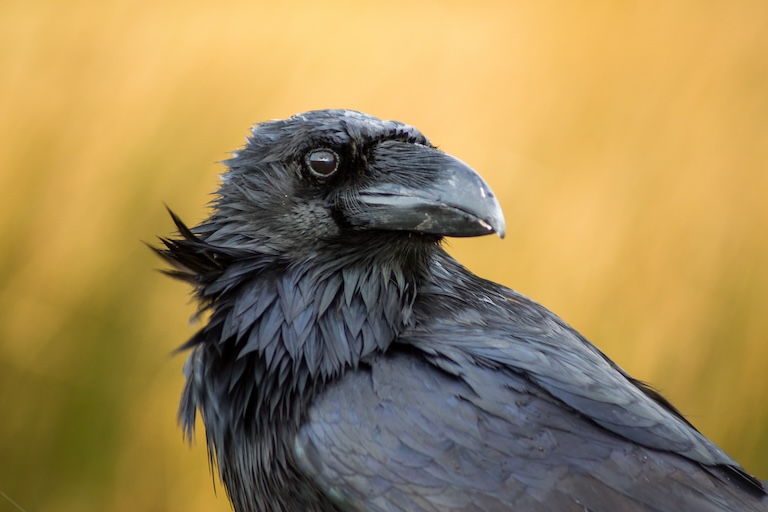
Raven Facts Overview
| Habitat: | Varied: Forests, tundra, deserts, cliffs, urban areas |
| Location: | Mostly Northern Hemisphere, patchy globally |
| Lifespan: | Around 25 in the wild, some captive ravens live 50+ years |
| Size: | Up to 70 cm (28 in) |
| Weight: | Up to 2 kg (4.4 lb) |
| Colour: | Black with iridescent sheen |
| Diet: | Omnivorous: carrion, insects, seeds |
| Predators: | Eagles, owls, humans |
| Top Speed: | Possibly up to 55 km/h (34 mph) |
| No. of Species: | Around 8 species |
| Conservation Status: | Mostly Least Concern (species varies) |
Ravens are no ordinary crows. First of all, they are enormous—the size of a buzzard! This is especially weird, considering that they belong to the songbird group of birds, who are usually a lot smaller and prettier.
Ravens are exceptional corvids, with a combination of size, intelligence, social capacity, a spoken language and a dark, avian heart. And they’re one of the only other animals to have teamed up with wolves.
Interesting Raven Facts
1. They’re Passerines
Birds are a class of vertebrates, and can be categorised in numerous ways, which can get very convoluted, but generally, the simplest groupings are at the order level. There are some 40+ orders of birds, and these break this huge class into more manageable chunks. For example, the ducks and geese are one order; chickens and turkeys are another, pigeons are their own order, too.
But the largest order of them all is the “sparrow-shaped” birds, or songbirds, in the order Passeriformes. Most of these are, as the name suggests, small birds with pretty voices. But there are some surprising members, too. And because of this, the order is now more commonly referred to as the “Perching birds”, and the songbirds represent a suborder within it.
But this doesn’t change much, since the ravens are, in fact, members of the songbird suborder anyway, so they still make a very surprising addition.
They are neither sparrow-sized, nor pretty to listen to, but being that the Passerines make up more than half of all bird species, they are at home there, even if only by statistical chance. In fact, the ravens are such an outlier, that they are the largest passerine bird on record. 1
2. They’re huge
All ravens are enormous for being Passerines, but in the Horn of Africa, it’s the thick-billed raven that takes the record for the largest of their kind.
This bird averages around 64 cm long, but can reach 70 cm in length, which also makes it more than 1.5 kg in weight. This one is occasionally matched by other raven species, but is consistently the largest and heaviest on average.
This is larger and heavier than the common buzzard, and more in line with the American Ferruginous Hawk (technically a buzzard) in grandeur. So, this is a songbird that’s the size of a raptor!
3. They’re corvids
We’ve talked about birds at the order level, but one step down the taxonomic ranks, we come to families, and ravens are among the crow family, known as corvids. This family is well known for several reasons, but one of them, at least to animal nerds, is their intelligence, which we’ll come back to in a moment.
Corvids are, in fact, named after the raven, and the type genus and species is Corvus corax, the European raven. But this is an outstanding family of birds that also includes jays, magpies, jackdaws and rooks, some of which are even in the same genus as the raven, as these are not, technically, a taxonomic group of their own.
4. They’re crows
Another rank down in their taxonomy, we come to the genus level, and this is where we find out that ravens aren’t actually a thing. At least, they aren’t a taxonomic grouping and are simply select members of the genus Corvus.
This name might sound familiar, as it’s the one we commonly call the crows. There are around 47 species in it, and these can be named all sorts of things, from rook to raven, and, of course, crow.
So ravens, rather than being a genetic cluster in the Corvid family, are simply the largest and most spectacular of the crows.
The ravens differ from their siblings in their vocallisations, the shape of their bills, and their size. But like the crows, they are very communicative.
5. They can talk
Corvids are emerging as some of the smartest animals on the planet, and as we struggle to decipher avian intellects with our juvenile, mammalian brains, they appear to be using quite a complex vocal language.
Not only can ravens mimic human speech, they have their own, too. It’s not much to our ears than a sort of croaky bark, but when studied in detail, there are repetitions and contextual cues that do suggest this is more than a mindless grunting, and perhaps a sophisticated language.
This is still the frontier of animal behaviourism in general, and one that’s frustratingly slow to progress, so we have yet to uncover the full complexity of such social behaviours, but there’s no question that these are very smart and unsettlingly lucid animals. And, it appears, they have also tamed the wolf. 2
6. They work with wolves
Ravens, among other birds, have been studied forming symbiotic relationships with wolf packs, in which both species help one another find food.
Ravens can fly overhead, find injured animals, and then snitch on them to the wolves, who can move in for the kill. This absolutely horrifying example of mutualism grants the ravens easy meat in exchange for their services to the wolves.
But on the cuter side of this relationship, ravens show affection with the cubs in the wolf pack, and can be seen playing with them as they grow up.
Raven Fact-File Summary
Scientific Classification
| Kingdom | Animalia |
| Phylum | Chordata |
| Class | Aves |
| Order | Passeriformes |
| Family | Corvidae |
| Genus | Corvus |
| Species | 8 |
Fact Sources & References
- Gill et. al (2019), “Orders of Birds”, IOC World Bird List.
- John M. Marzluff (2012), “The Alluring Language of Crows and Ravens ”, Psychology Today.