
Rainbow Shark Profile
In Southeast Asian waters, there are plenty of beautiful sharks to consider: the puppy-like blacktip reef sharks, the derpy and glorious hammerheads and the majestic whale sharks, to name a few. But all of these marine animals stay well away from the freshwater systems.
The rivers and streams, then, are the home of a fish commonly known as the ruby shark, red-finned shark, whitefin shark or, as the title of this post prematurely exposes, the rainbow shark. But this isn’t a shark at all! It’s just a total jerk.
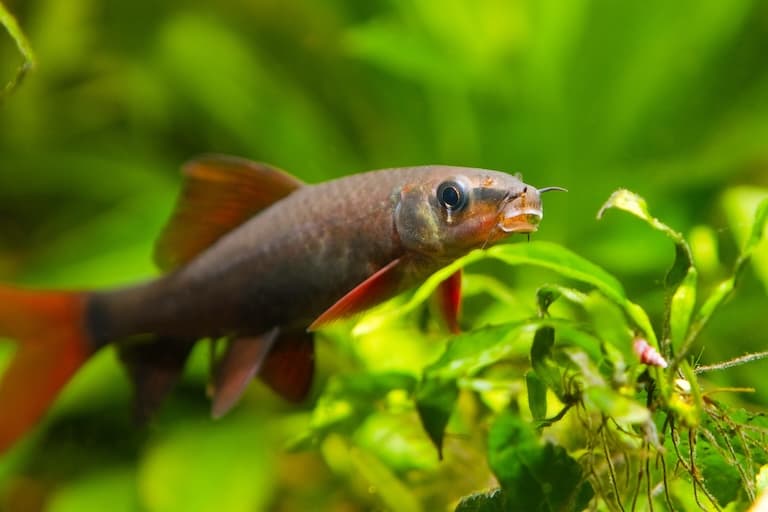
Rainbow Shark Facts Overview
| Habitat: | Freshwater rivers |
| Location: | Thailand, Mekong & Chao Phraya basins |
| Lifespan: | Up to 8 years |
| Size: | Up to 15 cm (6 in) |
| Weight: | Unknown |
| Colour: | Dark body, red fins |
| Diet: | Generalist omnivore: algae, plant matter, invertebrates |
| Predators: | Larger fish |
| Top Speed: | Unknown |
| No. of Species: | 1 |
| Conservation Status: | Least Concern |
Not since Sharky and George has there been a fish so shrouded in mystery. The rainbow shark has a wallet full of fake IDs, a history of misidentification, and a prior record of violent behaviour.
There are only four species in the genus, all of which are commonly referred to as “Freshwater sharks”. But these little fish are more like goldfish than sharks, both taxonomically and in their ability to suck up all kinds of dirt. Unlike most popular goldfish, though, these little jerks are not easy to keep in captivity.
Interesting Rainbow Shark Facts
1. They have so many names
For a fish of this size and obscurity, the rainbow shark sure has a lot of aliases. Alongside all the sharky nicknames we listed in the intro, this species is also commonly called a green fringelip labeo, a whitetail sharkminnow, and a whitetail sharkminnow.
And these latter names are a little more accurate in terms of where it sits in the fishy taxonomy web. Because this is, of course, not a shark! In fact, it’s not a cartilaginous fish at all, and is a member of the bony fish group that most freshwater fish also belong to.
To be more specific, this is a Cyprinid, more commonly called Minnows.
2. But they’re carp
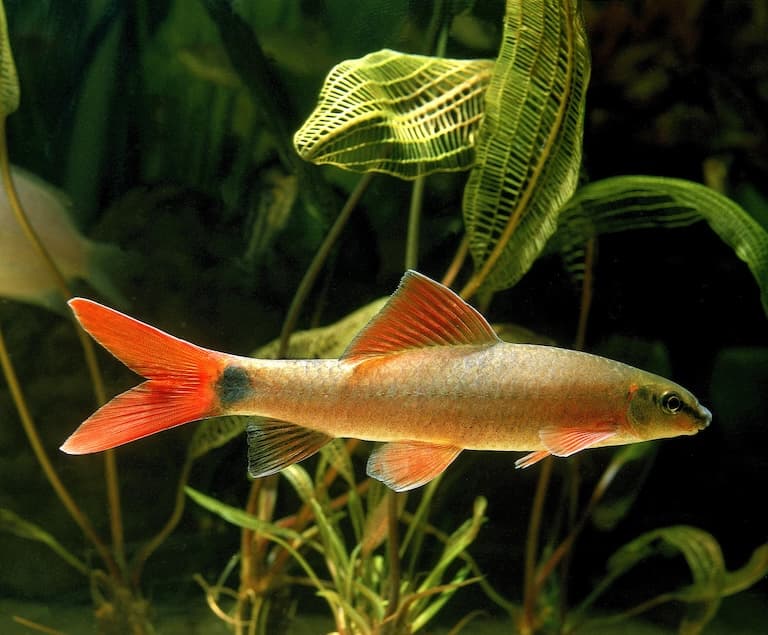
Cyprinidae is a family of freshwater fish, probably best known for the small gold ones people keep in tanks. The name minnow is commonly used, as well as carp, and these two examples do reflect the diversity within the family. In fact, the Cyprinids are the most diverse fish family there is!
Even cooler, it’s the largest family of vertebrates on the planet, too. So, there are plenty to choose from, and they range from around a centimetre to over three metres long.
The rainbow shark is closer to the small end of this spectrum, at around 15 cm in length. It’s in a genus of so-called freshwater sharks, and this is likely just because they’re superficially a bit shark-shaped, but as mentioned, they are unrelated, and certainly more phylogenetically closer to all other vertebrates (including us) than to true sharks.
Like all Cyprinids, this one has no stomach and no teeth. And this sounds like a huge handicap for something that needs to eat with its mouth, but carp have teeth in their necks, instead, and combined with a diet of soft food, this gives the rainbow shark all it needs to keep its home clean.
3. They’re janitorial
Like most familiar carp, this one is a bottom-feeder. Rainbow sharks aren’t strictly benthic – they’ll occupy the mid-tiers, too, but regardless, these are algae feeders, mostly, and will also suck up anything soft like worms or plants.
Their seasonal cycles involve continual floods, during which terrestrial land will become submerged, and a plethora of these little sharkminnows will expand into the new territories to feed on all the exciting resources made available.
In this manner, they are a cleanup crew, and they’ll have a strong impact on the biotic arrangement of any habitat they work in1.
4. They have very good hearing
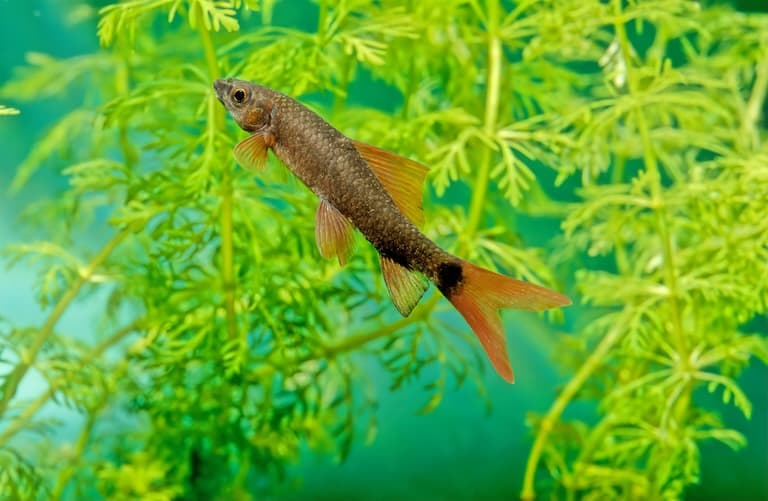
The rainbow shark may not have a stomach, but it has an organ that other fish families don’t have. The Weberian organ, or Weberian apparatus, is essentially a bridge from the swim bladder to the ear, and this essentially gives it an enormous eardrum in the middle of its body.
The inner ear of a 15cm fish is, as you can imagine, pretty tiny, so adding the swim bladder to the hearing setup is a massive upgrade. This is a feature of the Cyprinid family, as well as the ability to gulp in air from the surface to fill the bladder.
So, this little freshwater shark has a big ear, and this is likely used to both communicate and avoid detection. Socially, though, these fish don’t seem to be all that friendly to one another2.
6. They’re jerks
In the wild, a large rainbow shark will chase away any smaller ones. This is merely an inconvenience for any victim in a river, as they can easily get away. But if kept in a tank, the larger fish will not stop until the smaller one dies from exhaustion.
This is considered an aggressive fish, and some suggest that if they are to be kept in captivity, it’s useful to have several and a very large space, so that the aggression is more evenly distributed. It’s also worth noting that they will chase any members of similar genera to the point of death, so they aren’t recommended for amateur aquarists, and are generally considered douchebags3.
7. They’re popular in aquaria
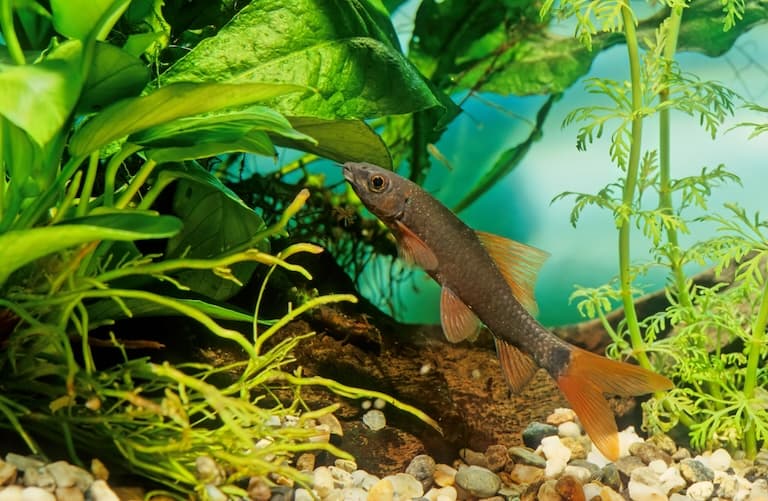
Being so unfussy about food, this is a pretty easy fish to look after in terms of diet. As long as it’s kept among fish that can hold their own against its bullying, they can add a touch of unique character to an indoor fish tank, and breeders have messed about with their colours to make some unusual variants, too.
There are now even albino rainbow sharks on the market, which look a lot like those white chocolate fish from the “fish and chips” sweets you can find in the pick n’ mix. They’re likely not as tasty, but this has yet to be confirmed. It’s also worth noting that there’s some dubious labelling involved in this example, and some say that the albino rainbow shark isn’t the same species, but a close relative.
A little deeper into the genetic tweaking rabbit hole, we find the infamous glo-fish, an animal who has been so fundamentally altered that it now glows in the dark. This is one of many species whose genes have been tweaked to make them fluorescent4.
Rainbow Shark Fact-File Summary
Scientific Classification
| Kingdom | Animalia |
| Phylum | Chordata |
| Class | Actinopterygii |
| Order | Cypriniformes |
| Family | Cyprinidae |
| Genus | Epalzeorhynchos |
| Species | frenatum |
Fact Sources & References
- Fowler (1934), “Epalzeorhynchos frenatum”, Fish Base.
- Grande & Pinna (2004), “The evolution of the Weberian apparatus”, Mesozoic Fishes.
- (2021), “Rainbow Shark”, Tropial Fresh water Fish.
- “The Rainbow, Redfin and Albino Minnow Sharks, Epalzeorhynchos munense & E. frenatum”, Wet Web Media.