
Rabbit Profile
There are few animals as universally admired as the rabbit. Outside of Australian farmers, these are animals that pretty much everyone loves to look at. But their popularity extends well beyond our species.
Rabbits are more than just pets – they are a wealth of biomass for almost every meat-eater in the ecosystem.
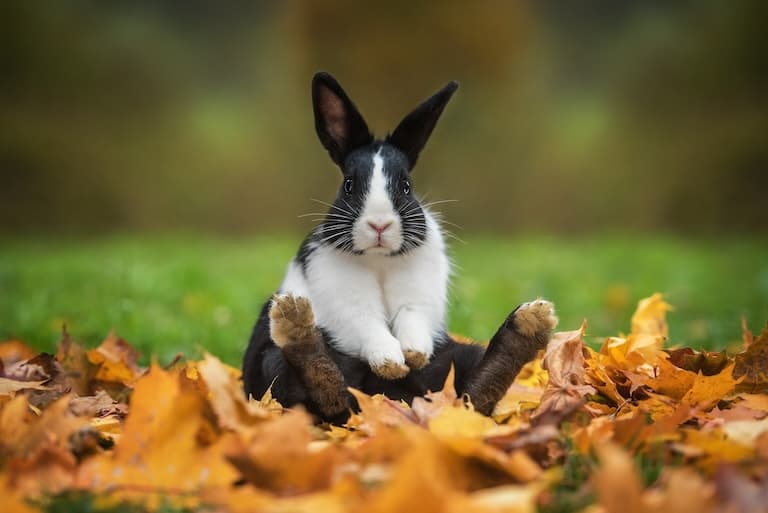
Rabbit Facts Overview
| Habitat: | Mainly open grassland, some wooded or forest species too |
| Location: | Worldwide, outside of Antarctica |
| Lifespan: | 10-12 years in the wild, up to 15 years in captivity |
| Size: | Wild rabbits are usually no more than 40 cm (16 in) long; domestic rabbits can reach 76 cm (2.5 feet) long |
| Weight: | Usually around 1.5 – 4 kg in the wild, domestic rabbits can reach 25 kg |
| Colour: | Usually grey/brown, sometimes black, domestic breeds are more varied |
| Diet: | Grasses and forbs, some insect protein |
| Predators: | Everything |
| Top Speed: | Up to around 40 km/h (25 mph) |
| No. of Species: | 70+ |
| Conservation Status: | Most are doing well, many are still Endangered |
There’s no question that the European rabbit is the most infamous species, but there are over 70 to choose from, and there’s a fair bit of diversity among them. Not all rabbits burrow, for one thing. Some live solitary lives in the forest, giving birth to a single kit in a litter. Others, as we know, explode onto the scene and can bring fantastic waves of destruction with them.
These cute, unassuming rodent-like animals are perhaps more significant than they appear at first glance.
Interesting Rabbit Facts
1. They’re not rodents
It’s pretty easy to mistake a rabbit for one of the plethora of rodent groups. For one thing, rodents make up almost half of all mammal species, so they’re quite diverse to begin with. Then, you have the large, ever-growing incisors of the rabbits, which is a pretty classic rodent trait.
They’re also expert diggers, which is not a prerequisite for a rodent, but a common theme among them, as is living on the ground and destroying crops or undermining buildings.
This was enough to convince early taxonomists that rabbits do share a recent ancestor with rodents, but it turns out that the two groups evolved these similarities independently and aren’t all that closely related.
Rabbit teeth are also a bit different, on closer inspection. Instead of the paired incisors of the rodents, they have two sets of four. And while, in rodents, it is only the incisors that keep growing, in rabbits, all of their teeth do this.
So, the rabbit is a different order entirely, belonging to what are known as the Lagomorphs. This order contains mostly rabbits, but also pikas, who make up the second of the two families. Lagomorph translates to “hare-shaped, which is a bit ironic, as the rabbits – all 70+ species of them – form all but one genus in the larger family Leporidae. The other genus is where we find the hare.
2. They’re not hares
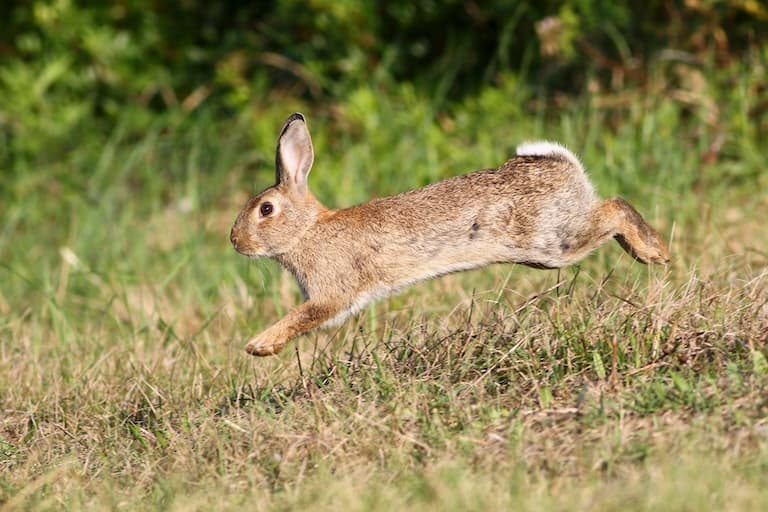
So, the word rabbit isn’t a strictly taxonomic term, but it refers to all except one genus in the family. The hare, the exception, is also one of the coolest of the lagomorphs and stands literally head and shoulders above the smaller rabbits as a solitary sprinter.
(You could argue that hares are rabbits, and this would uncomplicate things, taxonomically, but it would be a tremendous insult to the hare)
Rabbits have a common ancestor dating back to around 50 or 55 million years ago, probably from Mongolia. Since then, they have split into at least ten, possibly 13 or more genera and, as we’ll touch on shortly, come to dominate much of the planet.
In most cases, they do this by grouping together, something that hares refuse to do.
3. They’re generally very social
There are some exceptions to this rule, still. The Annamite striped rabbit, one of two extant Asian species in the genus, is a solitary rabbit. This one is from Indonesia, and not very well understood, but it seemingly lives more like a hare than the majority of rabbits.
Its only companion in the genus, the Sumatran striped rabbit, is even more of a mystery, and is only found in a small region of Sumatra, in the remote forests of the Barisan mountains.
But for most of the other genera in this family, social life is the only life, and rabbits can form family groups, clans and in some cases unsettlingly voluminous colonies. Within these colonies, they are hierarchical and maintain a pecking order with dominant individuals and subordinates.
In European rabbits, perhaps the most well-studied rabbit species, their breeding involves induced ovulation, which essentially means they can get pregnant at any time of year. This isn’t the same as in humans, for whom ovulation is on a roughly 28-day cycle all year-round, but both species are unusual among mammals in their ability to breed far too much.
On the flipside, rabbits can also administer their own abortions, and can absorb the foetus back into the body to reclaim the nutrients.
As such strategic breeders, they create tremendous downward pressure on the selection of the plants they feed upon, and provide a similar level of service to all the animals that eat them1.
4. They’re very important
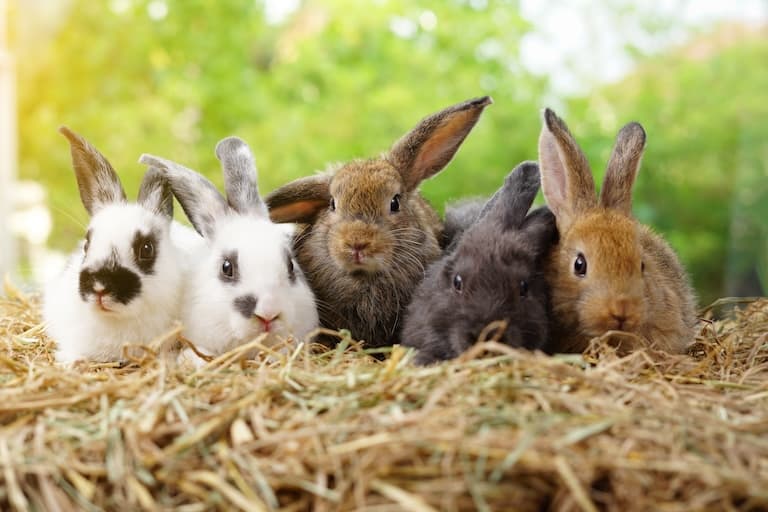
Being widespread, plentiful and tasty, these little herbivores can contribute a substantial amount of biomass to a region. Pretty much every predator larger than (and including) the stoat considers the cute little bunny rabbit a good meal, and so rabbits support a vast range of higher trophic tiers.
Common predators include foxes, mustelids, snakes, cats, raptors and raccoons, so rabbit meat certainly goes a long way, but they are equally significant to the ecosystem’s lower tiers, too.
Rabbit herbivory can be formidable, so the plants they eat are under substantial pressure to adapt. The burrowing habits of these animals also aerate the soil, and the ungodly amount of waste that comes out of the back end of a gazillion rabbits serves to recycle nutrients as well.
In regions where the predators and the local flora have evolved alongside rabbits, all of this effect is buffered and stabilised by the natural limiting factors. But in some places, where the ecosystem never did evolve to support them, introducing rabbits can bring all of their potential with none of the restrictions. And this can be catastrophic2.
5. They can be devastating
Rabbits have long been popular as a food source for humans, too, and so it seemed like a good idea to the colonists in Australia, in the 1800s, to bring some onto the continent for hunting. But the breeding rate of rabbits is well described, and so it should be no surprise that they began multiplying exponentially. In their native habitats, mortality among rabbits within the first year is close to 90%, but in places where this pressure doesn’t exist, they explode.
Within a very short time, hundreds of millions of European rabbits were laying waste to the local plant life, including the crops that sustained the human population.
Infamously, the solution was to take a virus very much like smallpox, from a South American rabbit population, and introduce it to the Australian one. The latter, being the European species, had no natural defences against it, and the plague reduced their numbers by around 99%.
This was, likely, the only viable solution to avoiding total devastation, but it came at a cost. Firstly, the virus causes tremendous suffering to the individuals infected, and secondly, as viruses do, it spreads. Myxoma virus is now present in much of the world in some form or another3.
6. They can make good pets
Rabbits have been domesticated since at least Roman times, likely earlier. The so-called domestic rabbit you can find today is a subspecies of the same European rabbit that makes Australians uncomfortable.
And within this subspecies, there has been a lot of selective breeding. There are big ones, small ones, floppy ones, spotted ones, shaggy ones and occasionally even hairless ones. Rabbits, then, are vulnerable to the same oversights in husbandry of any popular pet species, and so people looking to buy one would be wise to support only the most ethical breeders.
But with good practices, rabbit breeding can be done kindly, and healthy genetic pools produce healthy animals, and are some of the easiest to look after in the home4.
7. They eat their own poo
It’s always worth ending on a crappy note, and this is about as good as it gets. Rabbits are well known for engaging in a practice that zoologists call Autocoprophagia. This is a snazzy word that allows us to avoid saying “They eat their own shit.”
But as far as poo goes, rabbit droppings are some of the least offensive, and this is, in part, because rabbits aren’t ruminants like cows – they don’t have the multi-chambered stomachs to heavily process cellulose in plants and extract the nutrients – so, grass comes out fairly similar to how it goes in5.
And this, then, is why they eat it again. While a cow will chew, swallow, regurgitate, chew some more, swallow again, and run its food through multiple digestive stages this way, the rabbit does something similar simply by giving its dung another go-around.
Humans, as it happens, aren’t ruminants either, but unless you are eating grass and nothing else, this strategy is ill-advised. [edit: our crack team of lawyers has advised us to clarify that even if you are eating only grass, we do not advise engaging in Autocoprophagia]
Rabbit Fact-File Summary
Scientific Classification
| Kingdom | Animalia |
| Phylum | Chordata |
| Class | Mammalia |
| Order | Lagomorpha |
| Family | Leporidae |
| Genus | Ten genera |
Fact Sources & References
- Ati (2000), “Oryctolagus cuniculus”, Animal Diversity Web.
- Facundo and Sergio (2023), “Invasive herbivores shape food web structure: European rabbit and hare acting as primary prey are conservation challenges”, Science Direct.
- Elizabeth (2019), “Seventy years ago, humans unleashed a killer virus on rabbits. Here’s how they beat it”, Science.
- “Rabbits”, RSPCA.
- Adrienne(2025), “Reasons Why Rabbits Eat Their Own Poop”, The Spruce Pets.