
Quelea Profile
The foreigner’s image of African wildlife is dominated by the big five: lions, leopards, buffalo, rhino and elephant.
But the African plains are dominated not by mammals, but by birds. Specifically, weavers. These sparrow-like birds hang upside down in grass pouches and form thick, squabbling colonies amid the safety of Acacia thorns. And they are some of the most charismatic animals on Earth.
And one genus may well be the most populous non-human vertebrate on the planet. These are the Queleas. An overlooked, yet breathtaking African animal.
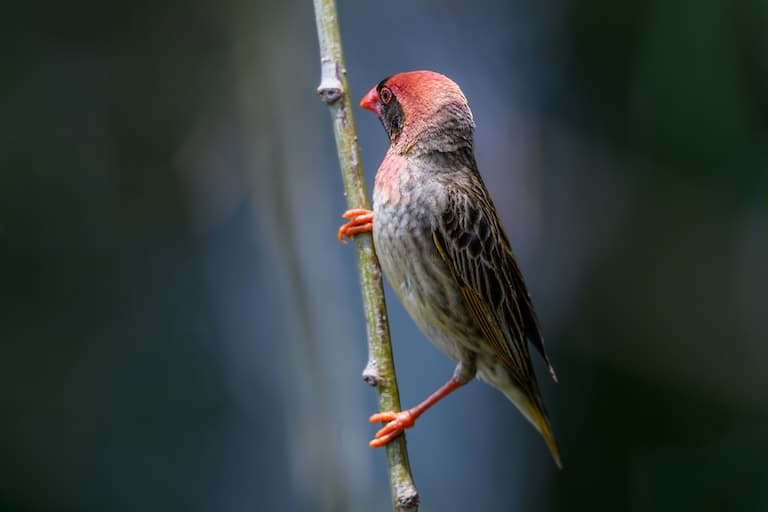
Quelea Facts Overview
| Habitat: | Grasslands and savannas |
| Location: | Sub-Saharan Africa |
| Lifespan: | Unknown |
| Size: | Around 13 cm (5 inches) long |
| Weight: | Unknown |
| Colour: | Varied browns and greys, males have red heads or beaks |
| Diet: | Mostly seeds |
| Predators: | Mostly raptors and snakes |
| Top Speed: | Unknown |
| No. of Species: | 3 |
| Conservation Status: | Least Concern |
Of all African animals, Quelea are probably the most valued creatures most of us have never heard of. These small birds are some of the most populous winged animals and they bring with them an incredible amount of biomass, seed dispersal and fertiliser that is crucial to the healthy maintenance of the African grasslands.
And they do all this with just three species of unassuming little weaver. Quelea are the masters of murmuration, and a destructive force to farmers that should earn them much more respect than they get.
Interesting Quelea Facts
1. They’re weavers
Quelea is a small genus of just three species of little bird with a lot of attitude. They are in the Ploceidae family, which contains around 16 genera of very noisy birds, most commonly known as weavers.
They’re called this because they make their nests out of woven grass, and each species has a slightly different way of doing it.
Almost all members of this family are native to Africa, but there are a couple in Asia, too, though not the Quelea – these are purely African weavers, and they are some of the most successful animals on the continent.
2. There are loads of them
This is a little animal with a lot of ambition. The three overlap in range, with the cardinal Quelea being the least numerous, the red-headed Quelea coming in second, and the red-billed Quelea really raising the bar for what is possible in wild birds.
The red-billed quelea is exceptionally numerous – perhaps the most abundant of all bird species (that aren’t being intensively farmed). These sparrow-sized animals are thought to number in the billions. Around 1.5 billion, to be more precise. To put this in perspective, that was the human global population in 1900 and a much more reasonable carrying capacity for our species on the planet1.
3. They have enormous ranges
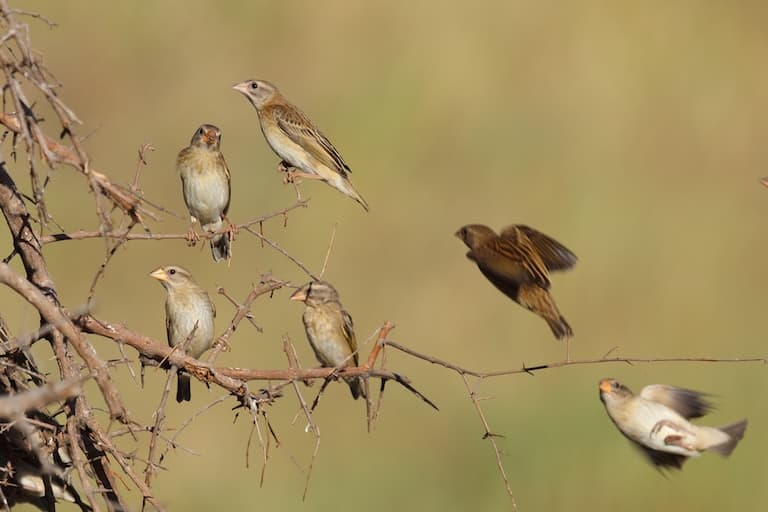
As mentioned, there are only three species in this genus. The Cardinal Quelea occupies a range around Lake Victoria in East Africa, which might not sound like a large area, but it’s the second-largest lake in the world.
Cardinal Queleas are the least widespread of the three species, followed by the red-headed Quelea, whose distribution is patchier but spans almost the entirety of sub-Saharan Africa with the exception of the southwest.
Finally, we have the red-billed Quelea, and this one takes itself very seriously. This little bird spans an unbroken range from West to East, all through the southern continent, and is really only absent from the thickest forests of DRC and its neighbours2.
They may or may not be nomadic. It appears that this is hard to establish since there simply are so many of them! But one thing’s for certain, this species puts on one of the most spectacular shows you can find south of the Arctic.
4. Murmurations!
Not too long ago, all across Europe, starlings would put on a show so spectacular that it rivalled the northern lights as a natural phenomenon. They are still doing this, to a lesser degree, but the decline in their populations makes them a fraction of their former glory.
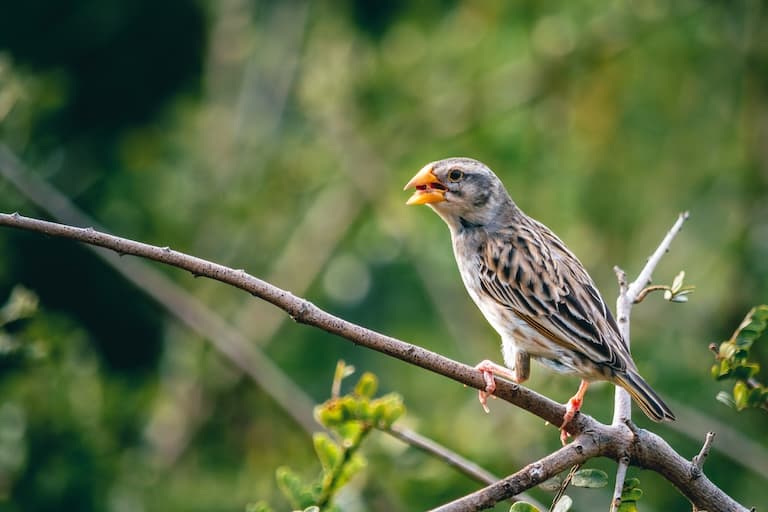
Head into Africa, though, and the practice is still going – and stronger than ever! The red-billed Quelea in its formidable abundance, performs what are known as murmerations – these are vast, coordinated, group flights with an unknown purpose.
These noisy, astonishing events are best seen rather than read about, and involve so-called mega-flocks of mixed ages, coming together to dance in the sky.
5. That’s a lot of food
Being such a widespread and numerous genus, these birds play a significant ecological role. They are food for all sorts of other animals – often raptors and the acrobatic servals – and perhaps more importantly, they are predators of innumerable grasses!
6. And a lot of damage
Quelea have been described as feathered locusts, because when they go on a feeding frenzy, their force is in the millions.
Birds at the back run out of food, fly to the front, and begin feasting on the next line of grass, creating a sort of lawnmower of rolling seed eaters that can absolutely devastate crops3.
7. They’re still not well known
As you’d expect from an animal this widespread and abundant, the Quelea are of Least Concern in relation to their conservation status4. But this comes with the caveat of a dearth of information about them.
This is an often-overlooked genus in a world of much larger species with mainstream popularity, so perhaps this plays a part in lack of our understanding of these birds. For example,
And that’s a pity, because all of that eating, all of that being eaten, and – of course – all of those mountains of bird poo are of unquantifiable value to their ecosystems; ecosystems which spread across much of the largest continent on the planet5.
But, so far, so good, it seems, for one of Africa’s unsung heroes, and the hope is that they continue their noisy and thankless reign over the savannas of sub-Saharan Africa, undeterred6.
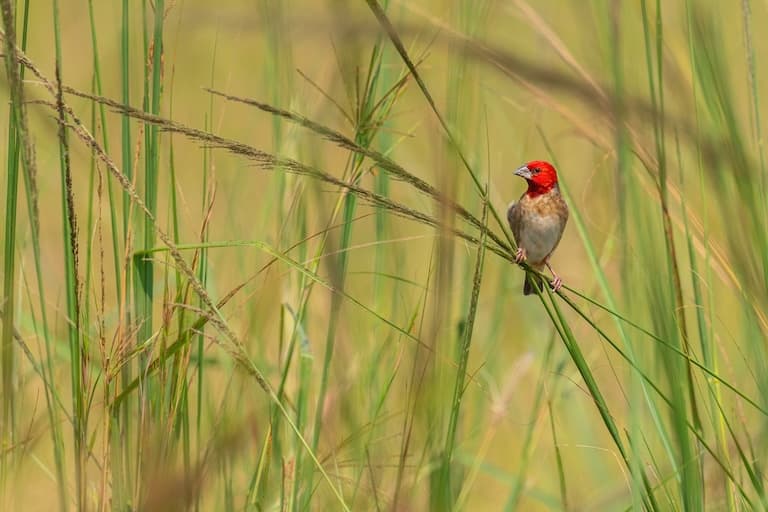
Quelea Fact-File Summary
Scientific Classification
| Kingdom | Animalia |
| Phylum | Chordata |
| Class | Aves |
| Order | Passeriformes |
| Family | Ploceidae |
| Genus | Quelea |
| Species | 3 species |
Fact Sources & References
- (2018), “What Is the Most Abundant Wild Bird in the World?”, Audubon.
- (2018), “Red-billed Quelea”, The IUCN Red List of Threatened Species.
- “Red-billed Quelea”, eBird.
- (2018), “Cardinal Quelea”, The IUCN Red List of Threatened Species.
- (2018), “Red-billed Quelea”, The IUCN Red List of Threatened Species.
- (2024), “Red-headed Quelea”, The IUCN Red List of Threatened Species.