
Queensland Lungfish Profile
Convergent evolution is the process by which two unrelated organisms are shaped by the same external conditions to evolve into very similar-looking things. There’s a range of similarity from quite interesting to truly breathtaking, and at the breathtaking end of this spectrum, we find some of the bony fishes.
A Queensland lungfish might look like any other bottom-dwelling fish, but evolutionarily speaking, it’s more closely related to us than it is to the carp it shares its home with.
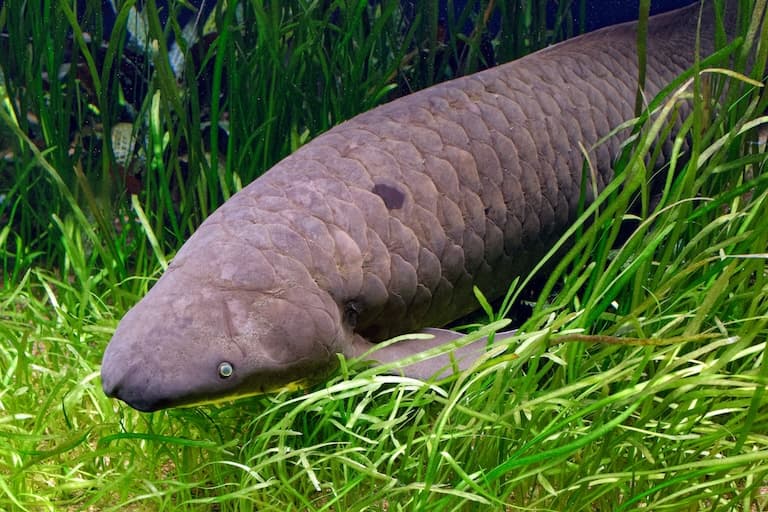
Queensland Lungfish Facts Overview
| Habitat: | Rivers and still water |
| Location: | South-eastern Queensland |
| Lifespan: | Up to 100 years |
| Size: | 150 cm (4.9 ft) |
| Weight: | Up to 43 kg (95 lb). |
| Colour: | Olive green to brown |
| Diet: | Generalist predators: any smaller animals from worms to frogs and fish |
| Predators: | Humans, birds |
| Top Speed: | Mostly sluggish but capable of bursts of speed |
| No. of Species: | 1 |
| Conservation Status: | Endangered |
The Queensland lungfish, also known as the Australian lungfish, or the barramunda, looks like a typical bottom-dwelling fish, but it is so much more than that. It’s a member of a once-grand and dominant race of marine vertebrates that has dwindled significantly in the water, but come to conquer the land instead.
These fish have changed very little in the last 100 million years, date back to more than 400 million years, and even live for over a century at a time. They are remarkable animals with some prehistoric qualities that, at least in this species, have clearly served them well.
Interesting Queensland Lungfish Facts
1. They’re Sarcopterygians
The Devonian period spanned around 60 million years, beginning around 420 million years ago. This was before vertebrates had made their way onto land, and so everything with a spine was in the water. It’s known as the Age of the Fishes, and it’s when most of the clades of modern fish separated from one another.
Lungfish, and countless other animals on this branch, parted ways from what would become the ray-finned fishes, who make up the vast majority of fish bony species now. So, the relationship between a lungfish and a carp dates all the way back to before anything tried to evolve onto land.
And it would be the lungfish group, the Sarcopterygians, who would make that move to expand into all the land vertebrates, and all the marine vertebrates that had a sting on land first (whales, seals, etc).
And while the ray-finned fishes now fill most of the aquatic niches, Sarcopterygians once dominated the waters. Today, though, there are hardly any of this group remaining.
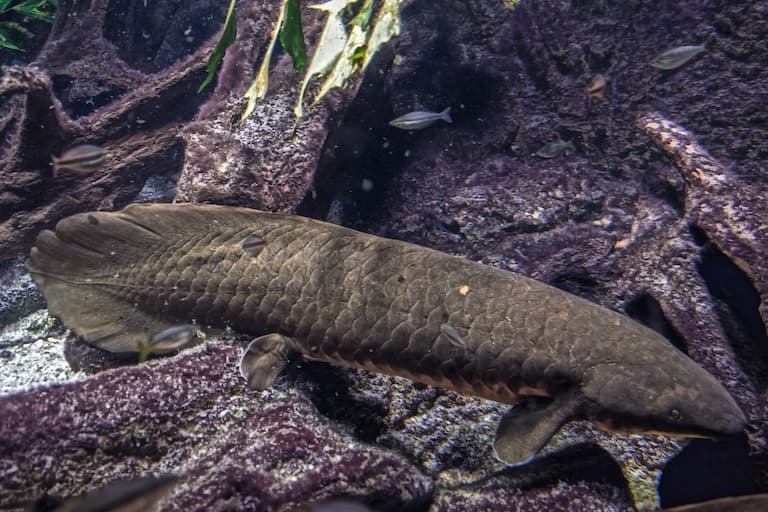
2. They are one of only six remaining
There are six species of lungfish around today, and around 6 species of Coelacanth, the only other Sarcopterygian group left.
This is one of the oldest remaining vertebrate species on the planet, belonging to the family Neoceratodontidae, and representing its only extant member. It has a skeleton that’s partly bone and partly cartilage, and, as the name suggests, a lung!
In fact, this is likely not far off where our lungs come from, too, and it allows the Queensland lungfish to stay out of water for days by breathing air. And this strategy has served them well, as they’ve outlasted almost everything else that was around when they arrived.
3. They haven’t changed much
The term “Living fossil” gets thrown around a lot and is often unreasonably attributed to animals that have changed a whole bunch over the years.
But the Queensland lungfish may not be one of these, as its fossils appear to show something almost identical stretching back to around 100 million years ago.
So, not only does this animal represent one of the oldest groups of vertebrates, but the genus itself might be one of, if not the, oldest vertebrate genus still around.
So, this animal has longevity built in, and even at the individual level, this is a long-living fish.
4. They can live for ages
Young lungfish can change colour in response to light, and this, presumably, helps keep them camouflaged through their lengthy maturation. Once they reach sexual maturity, after 15-20 years of growth, they remain in that state for a remarkably long time1.
The oldest aquarium fish in the world is said to be Methuselah, a Queensland lungfish in a San Francisco aquarium. So, as old as she is, at around 100 years, she’s not likely to be the oldest around, meaning this species has the ability to live a lot longer than we do!2
5. They don’t take up much space
Perhaps one way the Queensland lungfish survives for all this time is that it doesn’t really venture out of its comfort zone. This may sound a bit like a waste of potential, but you can’t really argue with a strategy that’s been winning for over 100 million years.
Queensland lungfish don’t migrate, they don’t go on holidays, and they don’t really travel very far at all. An individual’s home range is essentially just the pool it was born in, or thereabouts, and here it will spend most of its life, give or take a few exploratory journeys to spawn.
This species is, therefore, highly restricted and native only to two river systems in south-eastern Queensland. It may well have been more widespread, as there were once even seven species of lungfish in Australia alone, but as with all sarcopterygians, this one is a slow, prehistoric, and dwindling remnant of a greater time.
6. They don’t make cocoons
This species is a very slimy animal when picked up, and this mucous is one of the adaptations to surviving in air, rather than water.
It can live out of water for many days, as long as it’s kept wet, but this isn’t as resilient as some other species of lungfish, such as those found in Africa, who can spew out a whole mucous cocoon to withstand a season of drought.
The Queensland lungfish, then, is more dependent on water than some of its kind, but still far less so than most fish!
Unfortunately, being so restricted in its behaviour, maturing so slowly, and living around waterways that humans are now heavily modifying, are all vulnerable conditions for the species, which is now considered endangerd3.
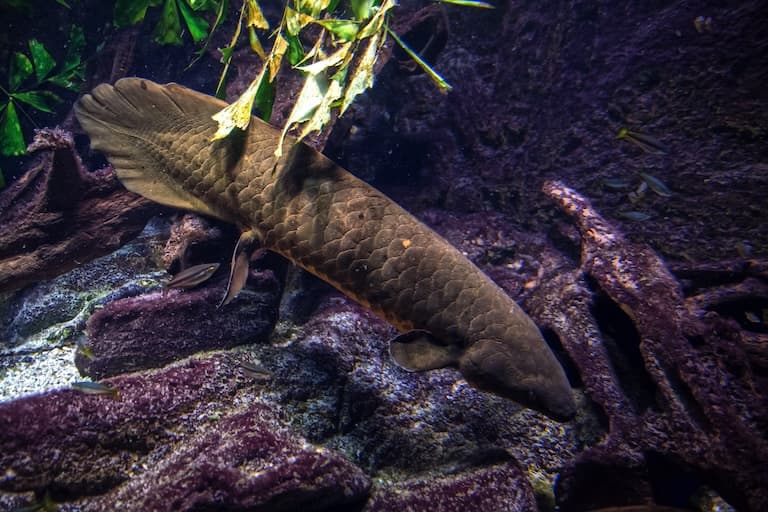
7. They make sounds
Lungfish are well known to be noisy mouth breathers, but some suggest that this is more than simply a side-effect of being a fish – it might be a way to communicate.
The door has well and truly opened in recent decades, as scientists discovered fish communicate with one another under the water using sounds, much like almost everything on land does, too. So, it’s not far-fetched to consider that lungfish use these sounds as a way of declaring their presence.
Queensland Lungfish Fact-File Summary
Scientific Classification
| Kingdom | Animalia |
| Phylum | Chordata |
| Class | Dipnoi |
| Order | Ceratodontiformes |
| Family | Neoceratodontidae |
| Genus | Neoceratodu |
| Species | fosteri |
Fact Sources & References
- Author Name (Year), “Methuselah (Our Australian Lungfish)”, Carlifornia Academy of Sciences.
- Garner (2011), “Neoceratodus forsteri”, Animal Diversity Web.
- Brooks et al (2019), “Queensland Lungfish”, The IUCN Red List of Threatened Species .