
Queen Victoria’s Riflebird Profile
From a distant vantage point, Australia is a land of arid desert, invasive frogs and an item of clothing known as a “budgie smuggler”. But it’s not all dry! In Northeast Queensland, there are dense, tropical rainforests, both lowland and upland, and it’s exceptionally rich in wildlife. Birds, especially, are unusual here, and the birds of paradise are infamously so.
Among them, the smallest and arguably the most adorable, is the Queen Victoria riflebird – an animal whose flight fills the forest with the sound of rustling paper, and whose dances are some of the sweetest things a bird has ever done.

Queen Victoria’s Riflebird Facts Overview
| Habitat: | Tropical rainforest |
| Location: | NE Queensland, Australia |
| Lifespan: | Unknown |
| Size: | Up to 30 cm (11.8 in) |
| Weight: | Up to 134 g (4.7 oz) |
| Colour: | Males are black with iridescent blue/green markings on his head, chest and tail; females are dull brown |
| Diet: | insects, insect larvae, spiders, and fruit |
| Predators: | Black; male withan iridescent throat |
| Top Speed: | Raptors, snakes |
| No. of Species: | Unknown |
| Conservation Status: | Vulnerable |
Queen Victoria’s Riflebird, sometimes just called the Victoria riflebird, is a member of one of the Southern Hemisphere’s most revered bird families. These animals are known for their vibrant colours, their cute displays and their exceptional dances, and this one is no exception.
Interesting Queen Victoria’s Riflebird Facts
1. They’re Paradise Birds
The island of New Guinea hosts some of the most beautiful and unique species in the world. This is a region that competes very strongly with South America for those accolades, even when it comes to birds.
The family Paradisaeidae hosts around 44 species in 17 genera, all of which are commonly known as the Paradise Birds, and are world-famous for their elaborate mating rituals, in particular.
But New Guinea wasn’t always isolated. In fact, just a few thousand years ago, it was connected to Australia by a small land bridge across what is now the Torres Strait archipelago. As recently as the Late Pleistocene, the two countries, combined with Tasmania, formed the continent of Sahul.
And so, a few species of paradise birds can also be found in Northeastern Australia, and the Queen Victoria’s Riflebird is one of them. This explains the Victoria part, and the rifle part is thought to refer to the uniforms of the colonial riflemen.
2. They’re little!
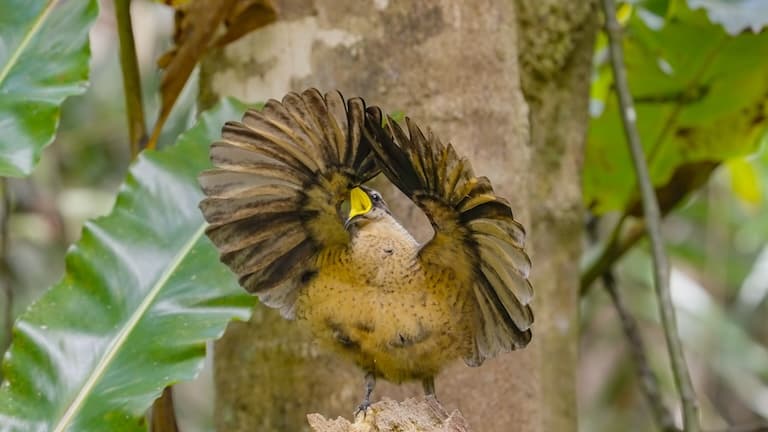
There are several species of riflebird, and together they make up one genus in the Paradise family: Ptiloris. The growling riflebird is named after its call, and the magnificent riflebird is named after its plumage, but the Victoria riflebird has both!
The Victoria’s riflebird is the smallest in the genus, or at least a contender for the rank. They grow to around 25 cm long at most, compared with 35 cm or more in the Magnificent riflebird, but they wear it well and are just as impressive.
3. But no less grand
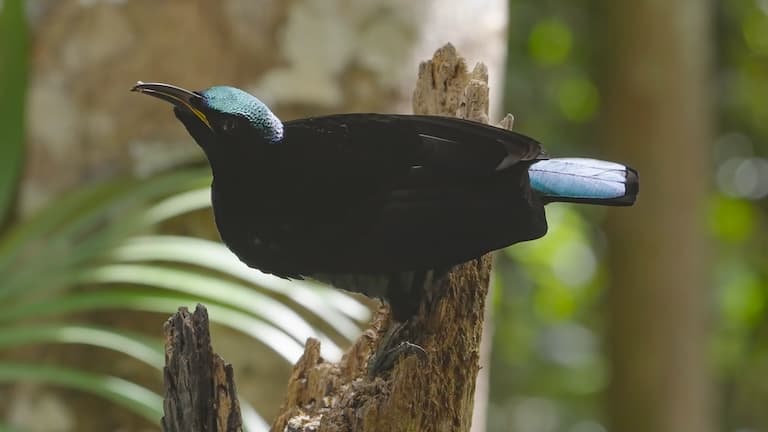
Riflebird magnificence is based on the male’s plumage, rather than that of the females. This is common in birds, and in this species, the female is a sort of dull brown colour, while the male carries all the charm.
His feathers are mostly black, but have a vibrant, iridescent purple and blue sheen across the head, which morphs to a reddish gold on the chest. In the middle of the throat, there’s a metallic blue-green patch, worn like a jewel to show off his health.
For vigour, like all paradise birds, he does a special little dance.
4. They’re experts in courtship
Despite his size, the male Victoria’s riflebird puts on one heck of a show. His dramatic dance is one of the most impressive of any Australian bird species, and in it he flashes and displays the agility of his wings, the colour of his feathers, and the rhythm of his overall motion.
All of this is accompanied by a softening of his vocalisations into a song, and if the female is receptive, the pair will become synchronised as she joins him in the dance. At the peak of the crescendo, the male wraps his long wings around her, and they mate.
An event as grand and choreographed as this doesn’t come to the birds entirely naturally; it takes time to learn these skills!
5. This takes practice
This highly ritualised courtship routine requires timing and posture, both of which only come with practice.
Young males can be seen alternating the role of the female to give each other a chance to work on their dances. Rehearsals like this can begin quite clumsily and incompletely, and a learning process is clearly visible over time.
Females don’t spend nearly as much time practising – their role is to build the home for their babies1.
6. Breeding
After all this work, the male doesn’t naturally stay with the female and will instead try his luck with the next lady available. Meanwhile, the fertilised female will take on the task of nest building, incubation and rearing.
They will nest around 20 metres up a tree, and they get the job done relatively quickly, too. In less than three weeks, the egg will hatch, and around two weeks later, the chick will begin fledging2.
7. Threats
Climate change has already begun ravaging many parts of Australia, and it’s thought that this is the biggest threat to Victoria’s riflebird.
Food availability, heat waves, and prolonged dry seasons are all impacting life in Northeastern Australia, and this species is now listed as Vulnerable, likely in decline3.

Queen Victoria’s Riflebird Fact-File Summary
Scientific Classification
| Kingdom | Animalia |
| Phylum | Chordata |
| Class | Aves |
| Order | Passeriformes |
| Family | Paradisaeidae |
| Genus | Ptiloris |
| Species | victoriae |
Fact Sources & References
- (2017), “Victoria’s Riflebird”, Crater Lakes Rainforest cottages.
- (2019), “Victoria’s Riflebird”, Australian Museum.
- (2022), “Victoria’s Riflebird”, The IUCN Red List of Threatened Species.