
Queen Triggerfish Profile
Reef fish lead such intricate and fascinating lives, and they do it all while looking equal parts stunning and stupid at the same time. But they have an even more disparaging opinion of us, and theirs is actually justified.
Far from being stupid, these seemingly expressionless and pretty animals are sharp, both intellectually and at the front end, and some of the mid-to-large ones, like the Queen Triggerfish, get a bad rap simply for refusing to take our shit.
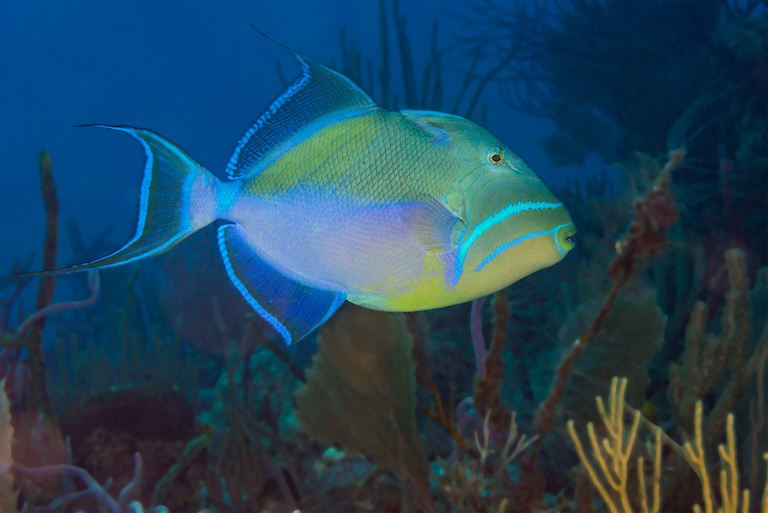
Queen Triggerfish Facts Overview
| Habitat: | Coral reefs, rocky bottoms |
| Location: | Western Atlantic, Caribbean; from Massachusetts to Brazil |
| Lifespan: | Possibly up to 10 years |
| Size: | Up to 60 cm (23.6 in) |
| Weight: | Up to 11 kg (24 lb) |
| Colour: | Blue, green, yellow with spots |
| Diet: | Sea urchins, crustaceans, molluscs |
| Predators: | Sharks, large predatory fish like groupers and jacks |
| Top Speed: | Unknown |
| No. of Species: | 1 |
| Conservation Status: | Near Threatened |
As part of the reef royalty, the queen triggerfish is in good company. It’s one of the stunning reef defenders, this one with a jurisdiction over much of the Western Atlantic, down through the Caribbean and well into Brazil. Like many of its kind, it scans the corals, picking off pests like starfish and keeping algae the feeders under control, too.
This is a bold, large, and intelligent fish with a fantastic personality and a host of reef adaptations that make its role critical to the most biodiverse habitats on Earth.
Interesting Queen Triggerfish Facts
1. They’re triggerfish
The class Actinopterygii contains the so-called ray-finned fishes, and this is the most populous class of fish on the planet. Within it, we find pretty much all freshwater fish (give or take a few) and the vast majority of marine vertebrates – something like 95% or more fish species in the ocean are members of this class.
In the reef, there is a home for up to 25% of all marine species – fishy and otherwise – and this is likely a more biodiverse ecosystem even than the tropical rainforest on Earth. But dominating this ecosystem are a handful of ecological heavyweights: wrasses, parrotfishes, angelfishes, and the genus known as the triggerfish.
This is a member of the order of fish called Tetraodontiformes – named after their highly modified teeth, but best known to contain the pufferfish.
Triggerfishes are in the separate family Balistidae, and the genus Balistes, and these are large, flattened fish with derpy faces that belie their smarts. The Queen triggerfish is on the larger side, too, at up to 60 cm long and 11 kg in weight.
And in the words of Prince Philip, she is a proper corker.
2. They are very pretty
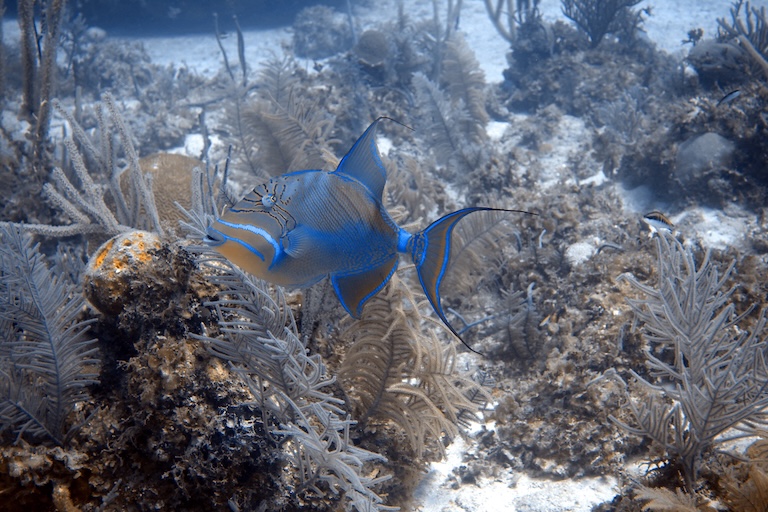
Triggerfish are among a whole community of pretty animals, whose vibrant colours are flags of communication in a world of light.
Species like this one use their colour to advertise who they are, where to find them and what they’re packing. Triggerfish are so-named for their dorsal spines, which are paired, with a tall, imposing spine supported by a smaller one behind it. This taller spine locks in place and can only be folded down by pulling on the smaller one like a trigger.
This is another adaptation to the reef, as brightly coloured animals like this are at their best during the daylight hours and hide in crevices at night. The locking spines allow the triggerfish to embed itself into a small enclave and not be pulled out by a marauding eel unless it really wants to be.
Once the nocturnal threat has disappeared, they get back to running the day shift on the reef. And they’re really good at it.
3. They flip urchins
Triggerfish, with their hardened beak-like teeth, are crucial, high-ranking predators on the reef. Their jobs are to pluck off meaty morsels that threaten to kill corals or eat up all the algae.
Unfortunately, four billion years or so in the ocean has taught those meaty morsels a trick or two about self-defence, which is why everything juicy on the reef is covered with stings and spines.
Being a vertebrate, though, the queen triggerfish has access to more advanced computational power and has figured out that if you blow a jet of water under an urchin, you can flip it upside down, avoid the spines and suck out the goo. This is, incidentally, one of the hypothesised hunting strategies of the terror birds in South America, when they took out monster armadillos, so it’s a tried and tested approach. 1
4. Then cough them back up
It might appear, when watching them feed, that they’re not all that good at eating. Triggerfish will take in a crusty crustacean, fumble it in the mouth a bit, then spit it out again. They’ll do this a few times, but it’s not clumsiness – this is how they de-hull their victims.
Cracking them like a nut, the fish remove the inedible parts and reposition their food before swallowing. They don’t have any fingers, so this is pretty much how it’s done with just a bony oesophagus to work with. In fact, there is a lot more dexterity here than it appears – there are at least 11 cranial muscles involved in this process! 2
5. They can attack people
This species has a reputation among divers for attacking humans without provocation. This is, of course, a lack of self-awareness and hypocrisy on the divers’ parts; the behaviour of coming into someone’s home, rummaging about in their fridge and disturbing their children with spear guns would be considered really rather provocative if done to a fellow human.
What’s really happening is that the Queen triggerfish is an intelligent and protective animal, both of itself and its family. So, when an entitled terrestrial predator starts clumsily threatening all of these things with a sharp stick, they fight back.
Generally, the species is shy and avoids conflict, even when approached, but it has been known to give a nasty bite, and in classic human fashion, we have assigned it a bad reputation for standing up for itself. This is a habit that’s been clearly described by human feminism for a long time, but sadly hasn’t extended in scope all the way to fish, yet.
Aggression is highest during breeding season, for obvious reasons (and we’ll come back to this shortly in the context of captive animals), but it’s safe to assume that as a monkey, anything that bites you when you’re in the ocean is your fault.
6. But they are still hunted
Of course, our species is best in the world at not taking a hint, and so this species is still relentlessly hunted.
It’s a common food fish in Latin America, where it’s fished for on purpose, but across its range, it’s also caught by accident in nets as bycatch.
When eaten, it has yet another line of defence, which is the presence of toxins similar to those documented in its relatives, the puffer fish.
While the pufferfish have tetrodotoxins that they accumulate via bacterial sources, the triggerfish accumulates various poisonous compounds from Gambierdiscus algae and dinoflagellates in its food. 3
7. They’re popular in aquaria
So, being a poisonous, barbed biter should disqualify it as a food source, but the species is now considered Near Threatened as a result of overharvesting. And it’s not only for food.
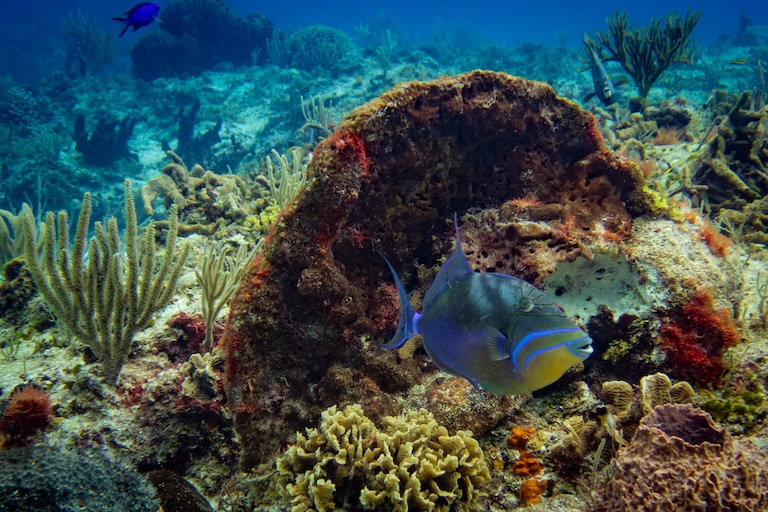
This stunning animal is, of course, sought after in the aquarium trade, but it is by no means an easy fish to keep.
They don’t breed well in captivity, which makes their sourcing a dubious matter of live-caught extractions, and their aggression can make them difficult to pair with other animals.
For most private tanks, this is not a good pet. Indeed, even in well-balanced professional, public aquaria, they are tricky animals to look after. 4
Queen Triggerfish Fact-File Summary
Scientific Classification
| Kingdom | Animalia |
| Phylum | Chordata |
| Class | Actinopterygii |
| Order | Tetradontiformes |
| Family | Balistidae |
| Genus | Belistes |
| Species | vetula |
Fact Sources & References
- Cathleen Bester, “Queen Triggerfish”, Florida Museum.
- Turingan et. al (1993), “Morphological and functional bases of durophagy in the queen triggerfish, Balistes vetula (Pisces, tetraodontiformes)”, Wiley Online Library.
- (2011), “Queen Triggerfish”,IUCN Red List.
- Alison Yang(2025), “Queen Triggerfish Care: Diet, Size, Reproduction and Teeth”, Aquarium Source.