
Queen Conch Profile
Those pesky little shelled beasts eating your garden lettuce may seem more than plentiful, but gastropods are, in fact, predominantly marine animals, and terrestrial snails are the exception.
And so, it should come as no surprise that in the ocean, they’re even more diverse and abundant! Not only in size and shape, but in life cycles, too. The Queen Conch is a perfect illustration of how different and interesting snails can be when they’re not considered a pest, and perhaps the upper bound of how cute a snail can get.
Queen Conch Facts Overview
| Habitat: | Seagrass beds, sandy shallows |
| Location: | Caribbean, W Atlantic |
| Lifespan: | Possibly up to 30 years |
| Size: | Up to 35.2 centimetres (13.9 in) |
| Weight: | Up to 2.3 kg (5.1 lb) |
| Colour: | Pink interior shell, brown exterior |
| Diet: | Algae, detritus |
| Predators: | Sharks, rays, and octopus |
| Top Speed: | Slow |
| No. of Species: | 1 |
| Conservation Status: | Near Threatened |
There are a few creatures that give themselves completely to the ecosystem as the conch. These are a planktonic food supply to the higher trophic tiers when they’re young, and a host to innumerable other organisms while they’re alive. On death, they even provide a lasting home for generations of crabs.
And in between all this, they’re surprisingly cute, very good at peeking, and can hop about along the seabed. Despite this adorable awesomeness, they are in decline because people like to eat them.
Interesting Queen Conch Facts
1. They’re snails
Snails are much more than they seem, at least if you’ve only considered them in the context of vegetable gardens and flowers.
They are molluscs, so belong to the same enormous phylum as the octopuses, clams and sea slugs (which are true slugs, and therefore snails).
And as many slugs and snails that we see on land, there is a tremendous amount more to be found in the water. Snails, or Gastropods, are primarily a marine clade with a few terrestrial exceptions, including several freshwater examples, and together they make up the largest class of animals after the insects.
The marine snails are mostly represented by the order Littorinimorpha, which is a huge group containing at least 15 superfamilies and likely thousands of species.
One such superfamily is the Stromboidea, which contains some medium to very large snails, including the Strombidae family of true conches. These are mostly very big, very shallow-water snails that feed primarily on algae. One genus inside this family, Aliger, has two or three known species, and the Queen Conch is one of them.
And she is a large snail! reaching over 35 cm across and weighing almost two-and-a-half kilos!
2. They’re cleaners
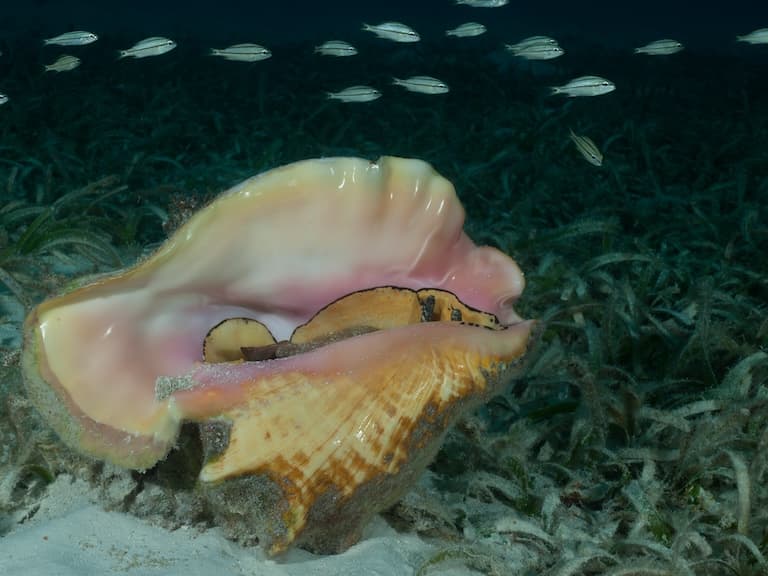
Like most conches, this one is a generalist herbivore. Interestingly, early descriptions of conches had them all pegged as voracious predators, which just goes to show how much effort it was to go out and actually observe these animals in the early days of naturalism.
Like garden snails, queen conches move slowly around plants and algae, occupying seagrass beds looking for food. They mostly prefer plant matter that’s already dead, and in this regard, they’re excellent for the health of the ecosystem, as they hoover up waste and recycle it into plant and animal food.
One thing they have over their terrestrial counterparts (aside from being enormous) is an operculum1.
3. Opercula
Snails on land can often be seen resting with a dried film over the opening to their shells to keep in their moisture. Marine snails go a step further and often have a hard, calcareous door called an operculum for protection. Winkles are a familiar example, but conches have these, too.
Only, in the Queen conch, this is taken a step further: its operculum is long, claw-shaped, and actively used for both defence and movement, and this allows the conch to seal itself inside at the same time as offering a nasty jab to anything trying to get in.
But perhaps most impressively, it’s used to jump.
4. They hop
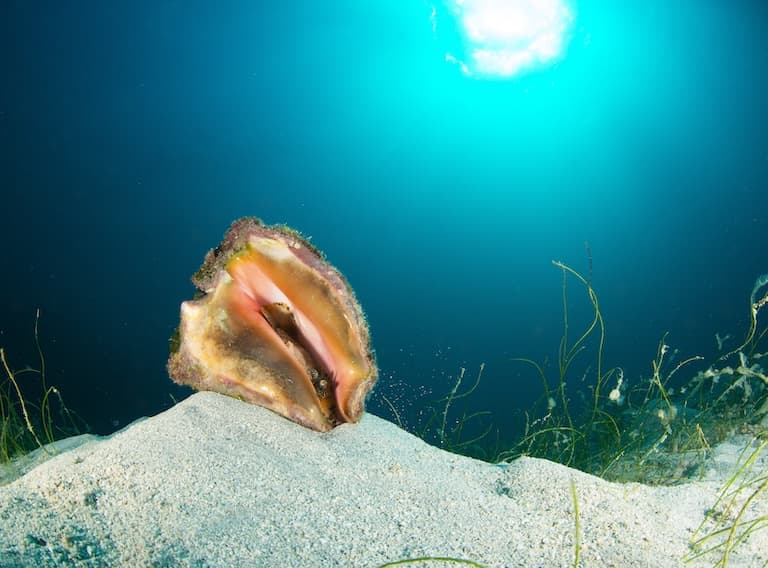
The queen conch moves just like any other snail, for the most part. It rolls on a meaty “foot” along the seabed, moving from plant to plant. But unlike terrestrial snails, it has this special operculum, and with it, the Queen conch can vault forward in a hurry.
This claw-shaped device works similarly to the pole used by Olympians to get over high bars, and it can also be used to turn the conch the right way up if it happens to find itself upside down2.
5. They have eyes!
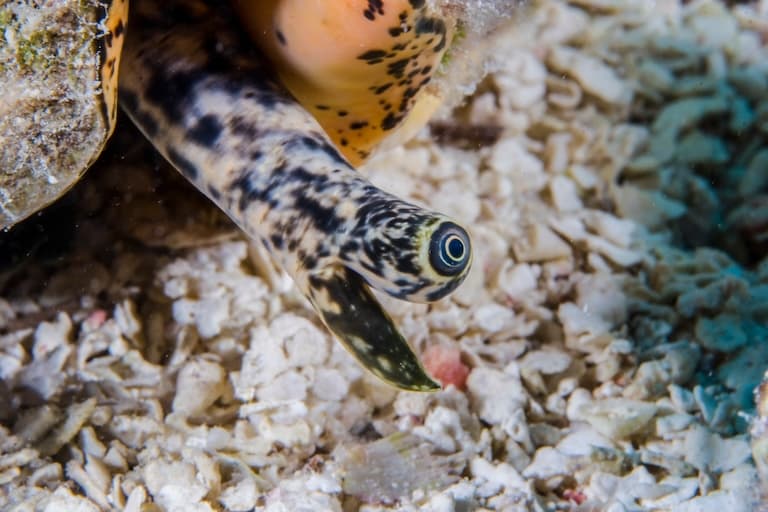
Perhaps the most amazing thing about these animals is that they can see you. Land snails typically have two simple eyes on stalks that give them a very cute appearance already, but conches have very complex eyes that peek out innocently from inside their shells.
These are well-developed, camera-like eyes, which can see with an almost 360-degree radius. They’re equipped with two lenses – one more than our own – and are called Ommatophores, and are a defining characteristic of the family.
They’re also ridiculously cute.
But if a snail that can peek up at you isn’t weird enough, these ones also have tentacles. These sensory appendages feel around the environment and seem like quite an unusual addition until you remember that they are molluscs, like the infamously tentacled squid and nautilus3.
6. They’re ecosystems
We’ve covered in the past how the slow-moving and hairy sloths gather algae and beetles and even an animal called the sloth moth around their person as they amble around the rainforest.
Well, in the ocean, the queen conch provides a similar sense of community, as it roams slowly around, gathering algae and generally chilling out, and on its travels, it picks up a multitude of hitchhikers. The large shell of the queen conch provides real estate and feeding grounds for animals like smaller snails, crabs and certain types of fish, which all hang out with the conch, keep it clean and feed on its pests.
But every stage of the queen conch’s lifecycle is beneficial to something in the ocean. As larvae, they’re planktonic, free-floating little things that get eaten by some of the filter-feeding marine giants; after they die, their huge shells become shelters for hermit crabs; and while they’re fully grown and alive, they make a great ceviche.
7. They’re meaty
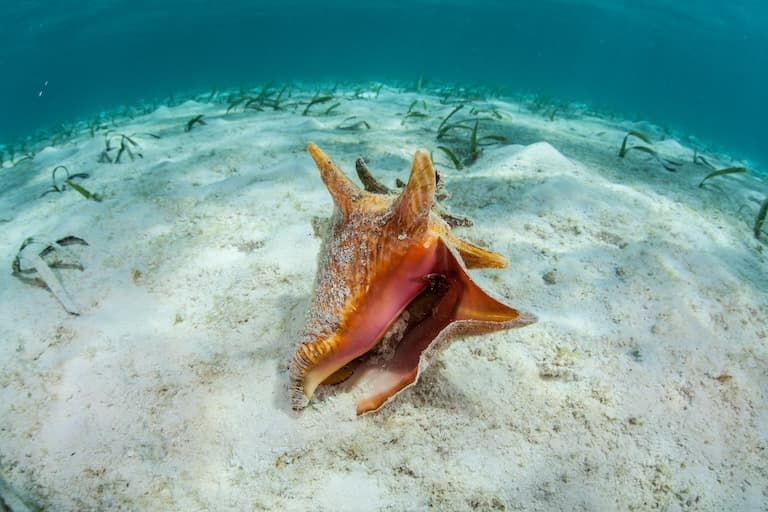
If you can overcome the pressure of conscience from killing such an innocent and puppy-eyed mollusc, you might find it surprisingly good food4.
In the Bahamas, where this species is native, it’s a huge source of local protein and is prepared in a plethora of ways: fried, in salads, or as soup, to name a few.
The most significant threat to this species, then, is overharvesting. This is a species in decline, but it’s not very far along yet, at least according to the IUCN, who list it as Near Threatened5.
Queen Conch Fact-File Summary
Scientific Classification
| Kingdom | Animalia |
| Phylum | Mollusca |
| Class | Gastropoda |
| Order | Littorinimorpha |
| Family | Strombidae |
| Genus | Aliger/Strombus/Lobatus |
| Species | gigas |
Fact Sources & References
- “Getting to Know the Queen Conch”, Queen Conch Lab.
- (2006), “Queen Conch”, Florida Fish and Wildlife Conservation Commission.
- “Queen Conch”, NOAA FISHERIES.
- Chet Raymo (2022), “Our cousins in name and life”, Science Musings.
- Tallowin (2025), “Queen Conch”, The IUCN Red List of Threatened Species.