
Queen Angelfish Profile
Rocks are much of a muchness to most of us who aren’t geology nerds, especially ragged, barren rocks sticking out of the remote ocean. But off the coast of Brazil – almost 1000km off the coast, in fact – sits a small archipelago with a lot of secrets.
Among them are the stunning Queen Angelfish – a species of reef fish whose vibrant colouration has made it very popular in the large marine aquarium industry.

Queen Angelfish Facts Overview
| Habitat: | Coral reefs, rocky reefs |
| Location: | Western Atlantic, Caribbean |
| Lifespan: | Up to 15 years |
| Size: | Up to 45 cm (18 in) |
| Weight: | Up to 1.6 kg (3.5 lb) |
| Colour: | Vibrant colouration: Blues, yellows, greens |
| Diet: | Sponges, algae |
| Predators: | Large reef fish, sharks |
| Top Speed: | Unknown |
| No. of Species: | 1 |
| Conservation Status: | Least Concern |
The Queen angelfish is one of the largest marine angelfishes, and a fine representative of such a beautiful and charming group of animals. This is a generalist feeder and isn’t all that fussy about what kind of reef it lives on, either, as long as it’s warm enough.
Of course, it is popular in captivity, but the species appears to be doing well, and is unlikely to be decimated any time soon, on account of its portfolio of remote ocean, Bond-villain lairs.
Interesting Queen Angelfish Facts
1. They’re “Full Spines”
Angelfish can be found on various reef habitats in the shallow tropical biomes of the Indian, Atlantic and Pacific Oceans, and there are plenty of these reefs to choose from! These are marine angelfish, in the family known as Pomacanthidae, and they are entirely unrelated to the freshwater angelfish, who are equally pretty!
Marine angelfish are known for their vibrant colours, of course, but also by divers for their natural curiosity and personalities.
There are around 8 genera described, comprising at least 88 species, and 8 of these belong to Holacanthus, a genus of angelfish more commonly found on rocky reefs, rather than coral ones. The Queen angelfish is one of, if not the largest, in the genus, at upwards of 5 cm in some cases. This one does still spend a lot of time in and around coral, but, as we’ll come to shortly, there are some very special rocks it likes to inhabit, too.
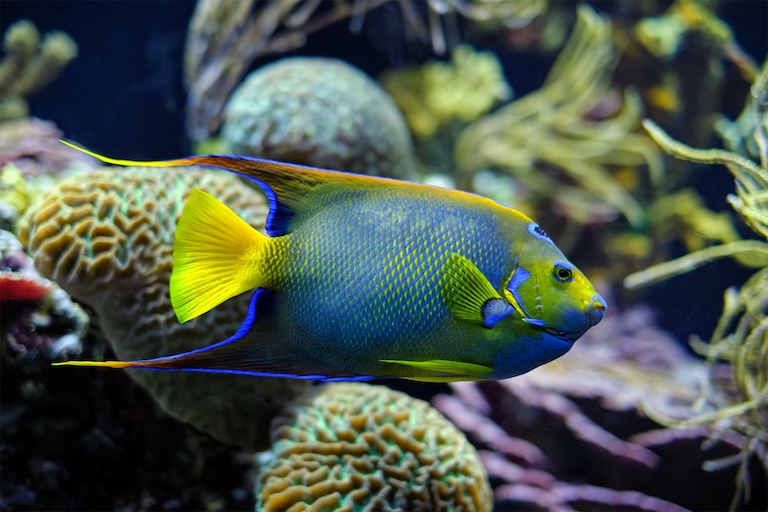
The genus name roughly translates to “whole” or “full” spined, and as pretty as they are, these are very sharp fish.
2. They hurt
These friendly, stunning animals are known to be confident during the day, and this is in no small part due to the fact that they can pack a punch.
The reference to spines in their genus name relates to several hardened spears in the dorsal fins, as well as anal and pectoral spines present in the fish. These aren’t obvious to look at, but if you were to try to swallow one of these lovely animals whole (as is tradition in the ocean), you would likely experience them very clearly.
Their dorsal fins have 14 spines in them, and the anal fins have three each, so these are well defended during the day. 1
3. They hide well
There are two things to remember about colouration in the ocean. Firstly, it needs light to be effective – this means that diurnal animals can be as bright as you like and still hide well when the sun goes down. The Queen angelfish is surprisingly invisible in low-light, and its narrow body fits well into crevices for this purpose.
Secondly, marine animals don’t see the world the way we do. In fact, in many cases, they see better. Light travels as rays, but each ray is also a wave, giving it a two-dimensional orientation. By using very fine, aligned bands, polarised sunglasses block light waving up and down while allowing those moving side-to-side through.
In the ocean, light enters as rays, reflects off objects as linearly polarised light, and can then reflect again off the mirror-like surface of the water from below, becoming circularly polarised. This is a more complex optical state than a simple zoologist should confidently be able to explain, but this is also the same basic principle modern IMAX 3D glasses use to separate images between your eyes.
Many marine animals can detect not just linearly polarised light, but circularly polarised light as well, along with colours outside the human visible spectrum. As a result, fish patterns that look bold and obvious to us may appear cryptic or well-hidden to their natural predators.
With more colour receptors available, animals can evolve body colours that remain visible to their own species while being harder for predators to detect. 2
4. Their courtship is cute
There’s no question that Queen angelfish can see one another very clearly. And when it’s mating time, it appears that this species engages in a harem-based breeding strategy with males courting and supporting up to four females.
To each one, he shows off his fins, flicking them outwards as if to show how well defended he is and therefore how well defended his offspring will be when they inherit his spines.
Then, he swims up under the female, sniffing around her butt until the pair release a plume of gametes. This is more or less what Ocean Ramsay based her wedding ceremony on, but in the angelfish, a female can release up to 75,000 eggs, so they have her beat.
5. They’re popular in aquaria
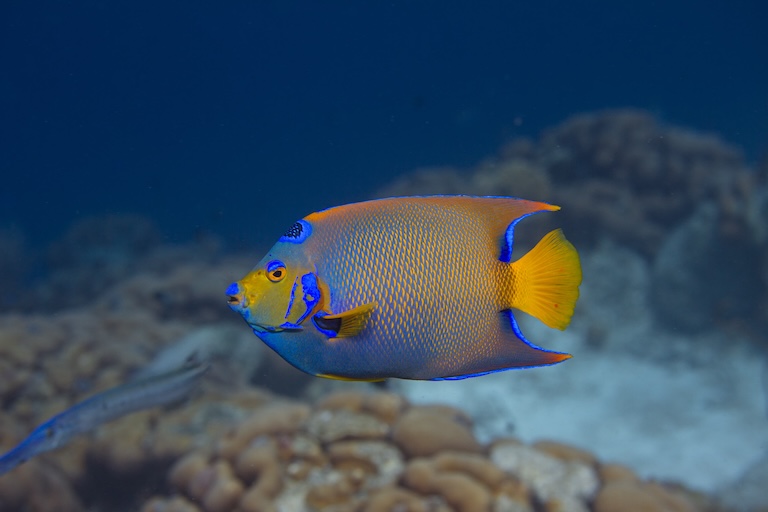
The Queen angelfish is a species of Least Concern to the IUCN, though it’s worth noting that they were last assessed in 2010.
There are several populations across the range, some more affected than others, and primarily, the threat seems to come from collection for the aquarium trade.
This is to be expected for such a beautiful and intelligent fish, but so far it appears not to have put too much pressure on the species, and in 2010, their global population was considered stable.
One reason for this might be their ability to hide in places few can reach. 3
6. They have an island sanctuary
Around a thousand miles off the coast of Brazil, there is a fascinating cluster of rocks jutting out of the ocean. While rocks can be a hard sell for all but the most enthusiastic of geologists, these ones really are very cool, as they’re not like almost any other rock we can touch.
The St. Peter and St. Paul archipelago is a more or less uninhabitable lump of marine mantle, jutting out of the ocean, and it has its roots in the abyss! Of course, it’s more than habitable for many other animals, and this is one of the remotest refuges of the Queen angelfish.
Abyssal mantle is usually as hard to come by as the name suggests, so studying this spot is of great interest, and it’s one of the only places on Earth you can do it without a submersible. The angelfish draws no such significance from this, but it does find itself more than at home among the cracks and crevices, and a thousand miles from the nearest hobbyist aquarist. 4
Queen Angelfish Fact-File Summary
Scientific Classification
| Kingdom | Animalia |
| Phylum | Chordata |
| Class | Actinopterygii |
| Order | Acanthuriformes |
| Family | Pomacanthidae |
| Genus | Holacanthus |
| Species | ciliaris |
Fact Sources & References
- , “Angelfishes”, Talk About Fish.
- Cortesi (2020), “Visual system diversity in coral reef fishes”, Science Direct.
- (2009), “Queen Angelfish”, IUCN Red List.
- Myers et. al (2009), “Queen Angelfish”, IUCN Red List.