
Quaker Parakeet Profile
In 2005, Roger Allen Wade observed that if you’re gonna be dumb, you’d gotta be tough. And the converse is that if you’re really pretty, you usually don’t have to invest so much in being smart or strong or any of that.
There are some exceptions: Valentina Schevchenko is the human example, and in the bird world, there are few who can tick so many boxes as the parakeets. And more specifically, several species of very green parakeets. Because of this, the Quaker Parakeet, often also called the Monk Parakeet, is likely going to be the prettiest survivor of the apocalypse.
Quaker Parakeet Facts Overview
| Habitat: | Savannas, scrub forests, and palm groves, but adaptable to eucalyptus |
| Location: | Paraguay, Bolivia, Argentina, and Brazil, introduced to North America, Europe, the Middle East, SE Asia |
| Lifespan: | Over 22 years |
| Size: | Up to 29 cm (11.4 in) |
| Weight: | Up to around 100g (3.5 oz) |
| Colour: | Green and grey |
| Diet: | Seeds, fruit, buds, and crops. In urban environments, they will also eat meat |
| Predators: | Raptors, snakes, opossums |
| Top Speed: | Unknown |
| No. of Species: | 1 |
| Conservation Status: | Least Concern |
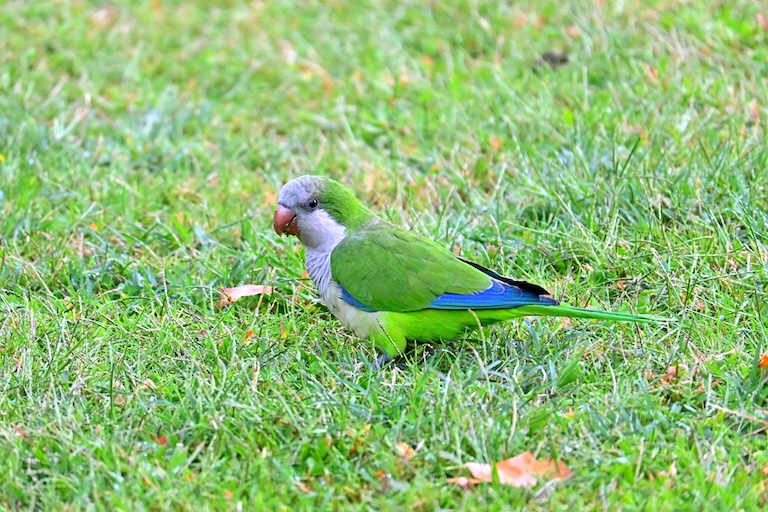
The Quaker parakeet is one of two species in the relatively recent South American genus Myiopsitta, recognised by its grey face and unusual nesting behaviour. Its adaptability is remarkable even for a parakeet, and has allowed it to spread widely beyond its native range through trade and release, where it is often considered invasive.
And so, global populations are increasing, making this little bird a clear example of a species thriving alongside – and sometimes because of – human activity.
Interesting Quaker Parakeet Facts
1. They’re half of their genus
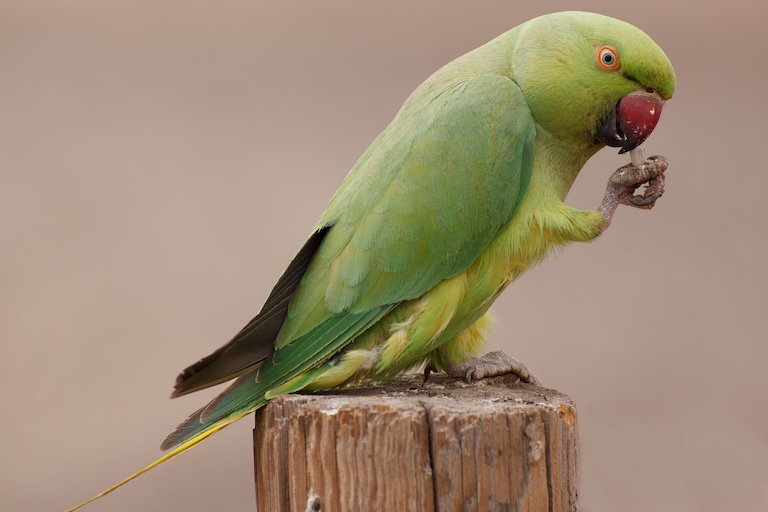
If you’re lucky enough to be walking around some London parks (in the daytime), you might spot some conspicuous green birds against the relentless grey sky that look like they don’t belong. That’s because Britain has seen an explosion of green parakeets over recent decades. There are several species, but the majority are rose-ringed parakeets in the genus Psittacula. This genus once housed the Quaker parakeets, too, and the two have many similarities that we will talk about shortly, but the Monk parakeets were eventually placed in their own genus of Myiopsitta, which they now share with only one other species, the cliff parakeet.
Myiopsitta translates to “Mouse Parrot”, and it’s said this refers to the grey underparts of the bird, but it could equally refer to its feeding choices!
While the UK’s naturalised parrot originates in Asia, the Monk parrot is a South American specialist. And it does something very few parrots do: it nests!
2. They build nests
If you ask any small child what they think a bird does, they’ll likely get to “Builds a nest” quite quickly.
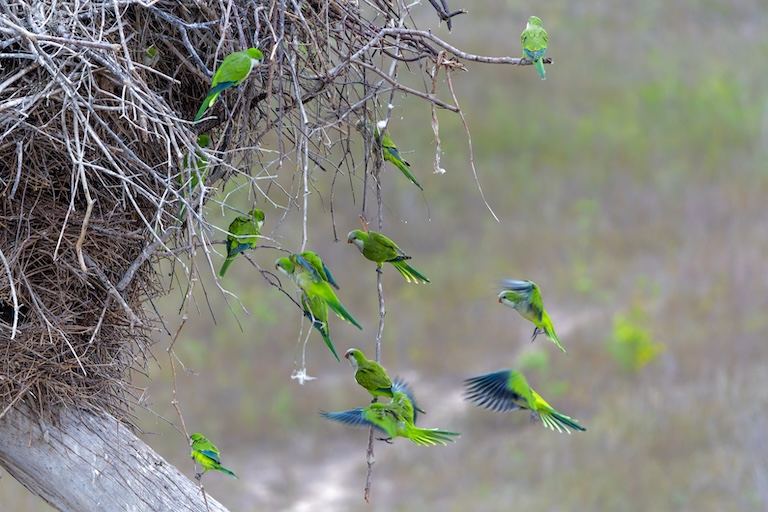
Nest building in birds is not uncommon, but in parrots, it really is. Lovebirds are tiny parrots who make the greatest exception to parrot-kind’s refusal to nest, but the only two other exceptions are the mouse parrots.
And even among the nest-building subset of parrots, these two build the biggest nests, which they share with their neighbours in large breeding colonies. Each pair has its own little apartment inside this nest, which can grow to more than two metres across.
This behaviour has significant ecological value to other species, too, which the parrots allow to live with them. This is an important part of the species’ life, especially in areas where it isn’t native, as it can provide a home for species that are, including sparrows, squirrels, and even kestrels! 1 2
3. They’re comfortable in the cold
Quaker parakeets are familiar with the high altitude regions of Bolivia, so they’re as comfortable in cold climates as they are down in the tropical heat. This hardy little bird, then, is incredibly adaptable, and not just with temperatures; the quaker parakeet will eat more or less anything, from seeds to insects, even dried meat, when it finds some.
Their big, colonial nests are sometimes built on power lines, which poses a significant fire risk, but this is one species that’s notorious as an eater of human food. 3
4. They can be a crop pest
In California, this species is considered a pest. They are illegal to keep for this reason, and it stems from their insatiable urge for cereal. Unfortunately, humans share that urge and so destroy vast swathes of bird habitat to grow it, and then get all uppity when the birds try to eat their share.
The UK has founder populations of this species, too, and they’re on the kill list of many local authorities for this reason. This is a powerful animal, despite being small and cute, and the intelligence of this species allows it to quickly invade new ecosystems from just a few small breeding individuals.
Quakers are talkative, with local dialects and accents, and they’re sharp-witted and social, and while they can be a serious threat to crops – up to two-thirds of crops have been destroyed in some cases – they are much more tolerable in public parks, where they thrive among the local wildlife. 4
5. They’re happy in parks too
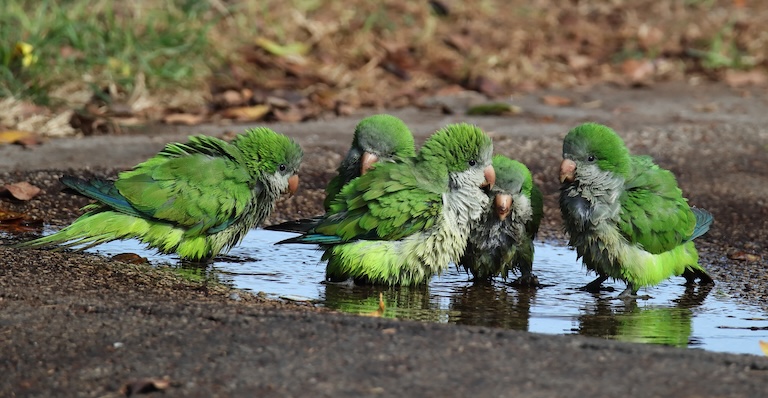
The large nests, unfussy diets, and non-predatory nature of this species serve quite a few complementary purposes to many ecosystems outside of the quakers’ native ranges. While they can become invasive, they are also often quite at home in their new location, and so, detrimental effects aren’t guaranteed.
In public parks, these birds provide homes for native species with their nests, disperse seeds, and provide food for local predators, too, and often this is more than enough to compensate for the resources they are removing. They also add a touch of tropical colour to city parks that can brighten up the place a bit.
This colour is one of their strongest selling points as a pet, too.
6. They’re often traded
There’s a large market for Quakers as pets. Fortunately, breeders don’t have too much trouble reproducing them, though, and even value some of the mutations that arise to give them quirky colour schemes, like albino or black and white.
Wild-caught birds aren’t in such huge demand, then, which is good news for any species, but considering how successful this species is all over the world, likely wouldn’t have made much of a dent in their populations anyway. 5
7. But they’re doing great
In fact, Quaker parakeets are doing so well that alongside being listed as Least Concern by the IUCN, they are also on the rise. From farmland to parks, and even city centres, this bird is thriving among human activity, and is likely going to be one of the longest-lasting species to endure the coming ecological collapse – at least as long as we do!
Quaker Parakeet Fact-File Summary
Scientific Classification
| Kingdom | Animalia |
| Phylum | Chordata |
| Class | Aves |
| Order | Psittaciformes |
| Family | Psittacidae |
| Genus | Myiopsitta |
| Species | monachus |
Fact Sources & References
- Brito et. al (2021), “The Role of Monk Parakeets as Nest-Site Facilitators in Their Native and Invaded Areas”, National Library of Medcine.
- Bucher et. al (1991), “Social behaviour and population dynamics of the Monk Parakeet”, Research Gate.
- Burgio et. al (2014), “Nest-building behavior of Monk Parakeets and insights into potential mechanisms for reducing damage to utility poles”, National Library of Medicine.
- Lin Wang (2001), “Myiopsitta monachus ”, Animal Diversity Web.
- (2018), “Monk Parakeet”, IUCN Red List.