
Quailfinch Profile
Africa is home to some truly glorious bird species. The glamorous turaco, the fearsome crowned eagle and the supremely fast-running and dangerous ostrich, to name a few.
But sprinkled about closer to the ground is an equally impressive flutter of little birds like the fire finches and waxbills, and these tiny birds are just as spectacular. Among them, the Quailfinch stands tall as proof that you don’t have to be large to be exciting.
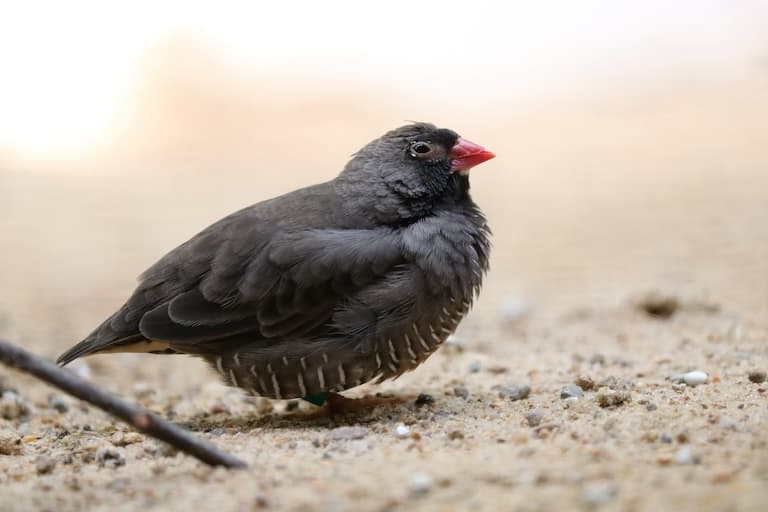
Quailfinch Facts Overview
| Habitat: | Grasslands, near water |
| Location: | East and Southern Africa |
| Lifespan: | Unknown |
| Size: | Around 10 cm (4 in) long |
| Weight: | Around 8 g – 14 g (0.3 oz – 0.5 oz) |
| Colour: | Black with white bars, a rufous belly and red beak |
| Diet: | Seeds, algae, invertebrates |
| Predators: | Snakes, cats |
| Top Speed: | Unknown |
| No. of Species: | 1 |
| Conservation Status: | Least Concern |
If you’re fortunate enough to have walked through long grass in Sub-Saharan Africa, you likely will have heard the distinctive rush of wings as large groups of tiny, seed-eating birds keep erupting out of it. The quailfinch is one such bird, and a pretty little thing that lives a hard but successful life. This is a very common bird species from a very common family, yet it is one of the most under-represented experiences of any good safari.
Interesting Quailfinch Facts
1. They’re relatives of the fire finches
Quailfinches belong to a large and wonderful family of small birds known as estrildid finches. This family, the Estrildidae, contains around 36 genera of birds, varying in quantity, ranging from tens of species to just one.
The largest of this family is only 17 cm long, and that’s pretty massive for its kind. At the other end of the spectrum, the smallest species weigh around 6 g to 12 g, and hit 10 cm or so in length. This is where we find the Quailfinch.
And the quailfinch is a member of one of those genera with just the one in it. They’re separated at the subfamily level from the bright red firefinches, but are far closer, taxonomically, to the bright red Amandavat. So, you’d think they’d be red, too. But, they aren’t. They’re certainly as, if not more, common, though!
2. They’re super common
Depending on where you look, there are between 6 and 11 subspecies listed for this one bird, and this is because of its patchy distribution. This is a species that’s found almost all the way across Sub-Saharan Africa, but not in continuous populations – they’re dotted about here and there across the continent1.
The quailfinch is most densely packed along the Southeastern corner of Africa, but there’s likely to be a sampling bias down there to consider, too. While South Africa has the king’s share, it can also be found in large concentrations in Northern Nigeria, Central Ethiopia, and from Senegal to South Sudan. So, this is a tremendously widespread species of bird, especially considering it’s not migratory2.
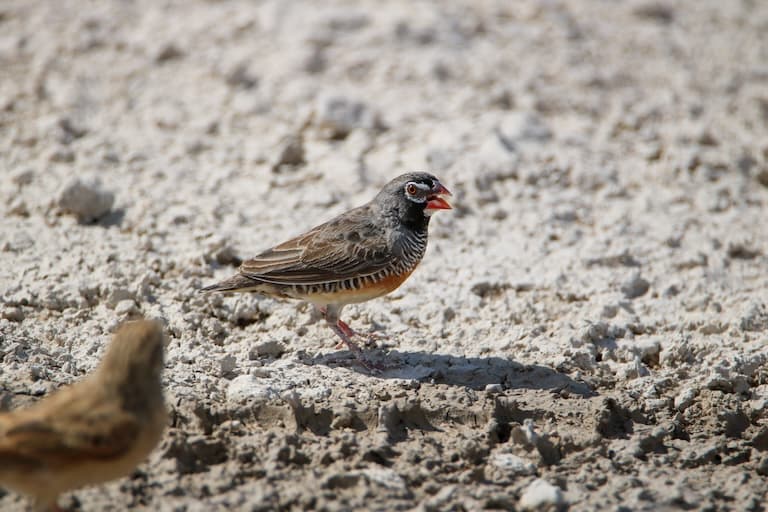
3. They’re gregarious
The quailfinch, like many in its family, is happy to feed on seeds, and typically does this while hanging out in large flocks in medium-to-long grass.
They appear to be somewhat social, but loosely, and so clusters make changes in size, come and go, and can be comprised of anything between 5 and 50 individuals.
When disturbed, they make a very charming and audible flutter out of the grass and up into branches, but the grass is their chosen home, and this is also where they make their babies.
4. They make ball nests
The quailfinch is so-called for living mostly on the ground. This species builds nests in grass and builds them in a ball shape on the ground.
Both males and females build the nest, apparently in equal measure, as do they share the incubation and care of the young.
The female will lay between three and six eggs, which will hatch after just two weeks. It’s not clear why, but the onset of incubation is not fixed – couples will choose, for whatever reason, to delay or rush forward this process, and nobody knows why3.
Chances are, it’s to account for just how dangerous this process is.
5. This is dangerous
It’s a hard life for a small bird, pretty much everywhere in the world, but the Sub-Saharan grasslands are perhaps one of the most dangerous habitats on the planet. While they provide places to hide from raptors in the sky, they expose opportunities for snakes, cats, lizards, and anything else passing through to steal eggs or adult birds, both day and night.
Then, there’s the chance of a large mammal stomping the nest, or flooding destroying it. But this is also where all the best food is for the quailfinch babies, so this is where they nest. After two weeks, and a nest attendance of over 80%, the chicks hatch, and they grow fast.
This isn’t unusual for ground-nesters for all the above reasons, but for this family of birds, it’s one of the fastest. Even so, 88% of chicks don’t make it. The majority of these failed attempts are down to predation4.
6. But They’re ok
Ecology and evolution are wonderful things. Nearly every brutal life, early death, loss, drowning or stomping is factored into nature’s economy the way shoplifting is considered an operational cost of a successful corporation.
So, despite a very low rate of breeding success, this is the optimal strategy for the quailfinch, and 12% of their attempts is plenty to keep the species going. Their immense range and large population appear to be stable, and the species, for this reason, is listed as Least Concern by the IUCN5.
Quailfinch Fact-File Summary
Scientific Classification
| Kingdom | Animalia |
| Phylum | Chordata |
| Class | Aves |
| Order | Passeriformes |
| Family | Estrildidae |
| Genus | Ortygospiza |
| Species | atricollis |
Fact Sources & References
- , “Quailfinch”, eBird.
- (2018), “African Quailfinch”, The IUCN Red List of Threatened Species 2018.
- Derek & Masotla (2020), “Breeding ecology of the Quailfinch”, The Wilson Journal.
- Derek & Masotla (2020), “Breeding ecology of the Quailfinch”, The Wilson Journal.
- (2018), “African Quailfinch”, The IUCN Red List of Threatened Species 2018.