
Quahog Profile
The US style of English is full of words that were misspoken for long enough that they became lore (that’s actually how language works). One fun one came from the word “Clamps”, which, ironically, gets its origins from the old English word “clamm”, meaning to grip.
For various forms of mollusc with paired, closing shells, the word “clamp” was fitting, and it’s still used to this day in some Scottish dialects. But clusters of European puritans fled an increasingly secular and modernising society to set up their own colonies in North America where they could be as weird as they liked. And when they did this, they took the word clamp and said it weird, too.
Clams were born. And four hundred years later, Family Guy named a town after one in particular: the Quahog. Does this seem like an irrelevant factoid and forced segue? Well, hard clams! It’s time to talk about molluscs again.
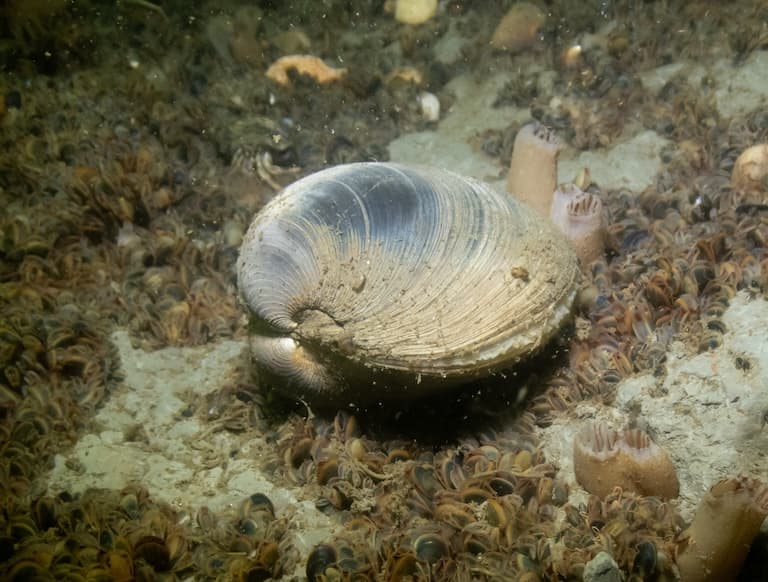
Quahog Facts Overview
| Habitat: | Coastal marine: intertidal zones |
| Location: | Along the east coast of North America from the Gulf of St. Lawrence to the Gulf of Mexico; introduced to California, England, Humboldt Bay, and southern Brittany |
| Lifespan: | 45+ years |
| Size: | Up to 13 cm (5 inches) long |
| Weight: | Up to 1100 g (2 lb 7 oz) |
| Colour: | Cream base with blue-grey hues |
| Diet: | Suspension feeders of plankton |
| Predators: | Oyster drills, moon snails, whelks, drums, skates, pufferfish, rays, and certain water fowl |
| Top Speed: | Mostly sedentary |
| No. of Species: | 1 |
| Conservation Status: | Not Listed |
The quahog, or hard clam, has a long history in North America. Once used as currency by Native peoples, they’re still worth a lot to the local economies they support as a source of protein. They’re also responsible for the repugnant concept of clam juice.
Interesting Quahog Facts
1. Venus Clams
Quahogs are bivalves. This is a large order of molluscs that includes mussels, oysters and, as you’d expect, clams.
But clams aren’t strictly a taxonomic group. This is a common word for basically anything that looks like a clam, and often restricted further to just those within that group that taste good in a Paella.
Still, clams are all within this bivalve bracket, and many of the edible ones belong to the same family: Veneridae, or the “Venus Clams”. While the name may sound like a Boston-based feminine hygiene brand, it also refers to quite a large and diverse group of little molluscs, including the Quahog.
Quahogs are also known as hard clams, round clams, and hard-shelled clams, none of which really helps identify them against their kin. And to make matters worse, they share a name with another famous clam, the ocean quahog1.

2. Not an Ocean Quahog!
You may find online that the quahog is the oldest animal on the planet! But this is only somewhat true. Ocean quahogs take the title, and they’re not all that closely related to the quahog proper. Arctica islandica, the ocean quahog, has
The ocean quahog is in the same family, and it does live a scary long time – up to 500 years by some estimates – but it’s an entirely different genus to the quahog.
The regular old quahog isn’t as fortunate, though, and is mostly considered in the context of food. Nobody seems to know how long they live, but the oldest one found was thought to be 46 years old. One reason we don’t know how long they live is that once we find them, we eat them2.
3. You may have heard of them
Another name for this species is the chowder clam, which hints at the type of attention this species mostly receives from humans. But in fish market jargon, it gets even more specific, as each life stage has its own name.
Tiny quahogs are called countnecks or peanuts, which is cute. When they’re toddlers, they’re called little-necks, and adolescents are referred to as top-necks. Cherrystones are the young adults and the name Quahog is then reserved for the fully grown clams3.

4. Quahog Parasite Unknown
With a title scheme taken straight out of the X-Files episode book, a parasite of this clam has been given the name “Quahog Parasite Unknown”.
It’s a tiny thing, made up of a single cell, and it’s seemingly native to this species of clam. Outbreaks of this parasite have caused mass deaths of the clam across various captive colonies, where they’re bred for food.
Labelled QPX for short, this little protist has caused all sorts of trouble for clam farmers, but certainly more problems for the clam itself, who can suffer from chipped shells, a swollen mantle and weird tumour-like growths that hinder its development4.
Farmers are encouraged to leave the clam farms fallow for at least a year to let the disease die out. This is essentially crop rotation for clams.
5. 23 Degrees means sex
When not riddled with parasites, healthy clams breed very quickly. But they have certain specific conditions that must be reached to get them in the mood.
Clams can take or leave Barry White and boudoir photography, but what really gets them hot is the temperature. When the water they live in hits 23°C, the clams begin uncontrollably ejaculating. Gametes from both sexes are strewn about like a Hellenistic Orgia, the suspended clam sperm triggering the release of the female’s eggs to bind in the water column.
Within 12 to 14 hours, these fertilised eggs turn into larvae with tiny cellular hairs called cilia, which beat through the water and allow the larvae to swim. They feed on miniscule diatoms in the water until they make it through day one, after which they morph into the next stage with larger swimming organs.
Over the next ten days, they grow a foot, and other clammy organs, and finally shed their swimming organs and sink to a surface to latch onto. Their shell is then secreted from their fleshy bodies to come together in two pieces, calcifies, and the clam is more or less complete5.
6. They don’t do much else
This early stage of the clam’s life is by far the most exciting. It’s filled with drama: predation, exploration and most importantly: movement. Once they form their shells and settle, this is pretty much the end of their adventure.
There is some evidence to suggest that they can ramble very slowly, and do so towards or away from some kind of chemical stimulus in the water, but for the most part, the mature clam is a sessile animal that sits on a rock and filters food out of the water6.
7. They make a lot of money
But in doing little, they provide a lot for local people, who invest up to $6 million each year into the quahog economy. They’re eaten as seafood, but also used to make something that sounds much worse than it is: clam juice. This is not likely to go down well in any summer sangria, but works a bit like oyster sauce in Asian cuisine to bring a fishy, umami flavour to dishes7.
This investment is primarily spent in their native North American states, but they have also been introduced elsewhere, such as Britain, where they have become a bit of a nuisance8.
8. They can cause damage
Britain went through waves of cold weather in 1947, 1962 and 1963, and this is said to have wiped out the native softshell clams, Mya arenaria. This species is from an entirely different family of clams, called the Myids, and even from a separate order to the Quahog, but back then, a clam was a clam and a mussel was a mussel and we’d hear no more about it.
So, quahogs were brought in as a replacement. But the quahogs proved to be larger and better at filling that niche than the native Myids, and so the softshell species never recovered. What’s worse is that their habit of ejaculating into water systems makes them quite good at spreading to other locations, and since the ’60s, the Quahog has been showing up all over the British Isles, the long-term effects of this are still to be discovered.
In Japan, though, their crusade is being welcomed, as the local food has begun to embrace the new clammy overlords in Tokyo Bay.
Quahog Fact-File Summary
Scientific Classification
| Kingdom | Animalia |
| Phylum | Mollusca |
| Class | Bivalvia |
| Order | Venerida |
| Family | Veneridae |
| Genus | Mercenaria |
| Species | mercenaria |
Fact Sources & References
- (2025), “Veneridae”, Wikipedia.
- Holmes (2020), “Meet Ming the clam – a closer look at the oldest animal in the world”, Blog Amgueddfa Cymru.
- Tomky (2023), “A Guide to Clam Types and What to Do With Them”, Serious eats.
- Coen et al (2004), “Sheet for QPX (Quahog Parasite Unknown), www.dnr.sc.gov.
- Burdette (2001), “Mercenaria mercenaria”, Animal Diversity Web.
- Burdette (2001), “Mercenaria mercenaria”, Animal Diversity Web.
- Carter (2005), “Hard-shell clam”, Tyler-Walters H. and Hiscock K. Marine Life Information Network.
- (2025), “Concern for NI waterways as invasive mussel detected”, BBC.