
Quagga Mussel Profile
The aquatic ecosystem is so awash with competitors striving to get ahead; resources are being shared, stolen, and partitioned; things are being eaten, things are being pooped out again, and so on.
There’s so much of this going on that there’s an enormous niche for animals that just want to stay put and feed on the bits and pieces floating about after all this chaos has happened. In fact, the waste products from such a hectic life support an entire universe of so-called filter-feeders.
In the marine ecosystem, the mussels do a lot of the heavy lifting in this regard. In the freshwater systems, at least in Eastern Europe, it’s the job of this little guy. The Quagga Mussel is neither a quagga, nor, quite, a mussel. In fact, it’s quite a lot more formidable than both.
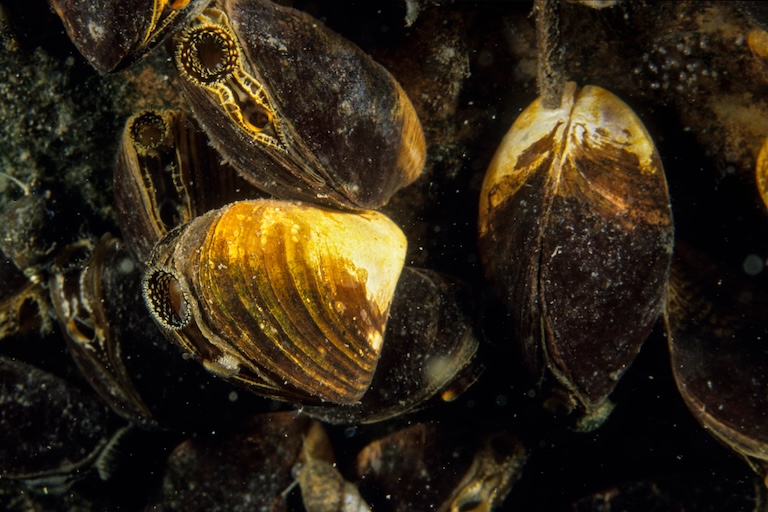
Quagga Mussel Facts Overview
| Habitat: | Freshwater lakes & rivers |
| Location: | Eastern Europe; N. America |
| Lifespan: | Up to 5 years |
| Size: | Up to 5 cm (2 in), usually around half |
| Weight: | Up to 20 g (0.7 oz) |
| Colour: | Cream to dark, banded shell that fades at one end |
| Diet: | Plankton: filter feeder |
| Predators: | Fish, diving ducks |
| Top Speed: | Sedentary |
| No. of Species: | 1 |
| Conservation Status: | Least Concern |
Quagga mussels are more closely related to certain marine clam species, but they behave and look much like the mussels we know and eat. As such, some of the attached videos in this blog will show true mussels, whose behaviours are better documented, but the principles are the same for the Quagga.
If anything, the quagga mussels do what mussels do, but better. Too well, in many instances, where they have become pests and are seriously threatening the environments they have invaded.
Interesting Quagga Mussel Facts
1. They’re Dreissenids
Mussels are molluscs, like garden snails and squid. They’re in the class commonly known as bivalves, which are characterised by paired, hinged shells, which are known as valves.
Clams, oysters and scallops are another three groups in the bivalve class, which are the Myids, who, unlike all previous examples, contain a lot of freshwater species. And this order of bivalves is where Quagga mussels are found.
This is, notably, not the same order as any of the true mussels, despite the name. In fact, Quagga mussels as a family are most closely related to a marine family of bivalves called the Venus clams.
So the Quagga family, known as the Dreissenids, contains both quagga “mussels” and the infamous zebra “mussels”, from which the quagga gets its name. That’s because, like the quagga, the quagga mussel has faded zebra stripes.
Regardless of what you call them, though, they do look and behave much like mussels. Especially in their feeding strategies.
2. They’re filter feeders
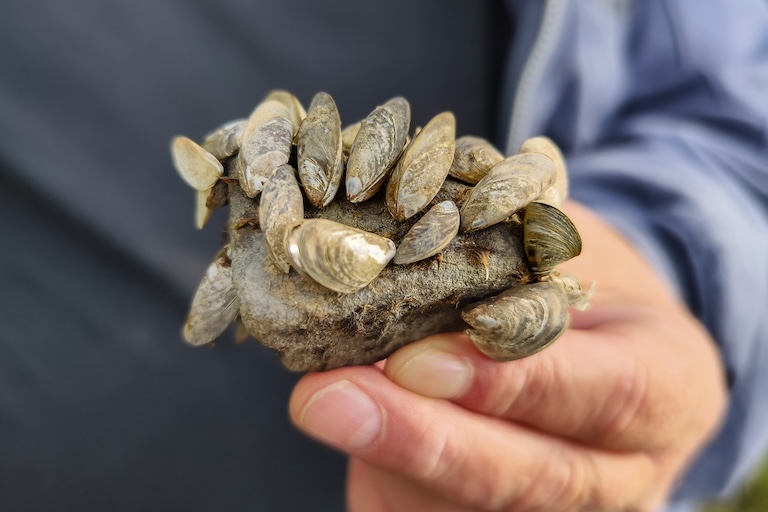
Quagga mussels don’t do much other than eat. And they don’t really have to. They occupy one of the least-respected, yet highest-priority niches in the ecosystem: the cleanup niche.
A quagga mussel, at a meagre 3 cm across, can filter up to a litre of water through its siphons per day. Anything in that water that the mussels deem fit to eat, they do. Anything undesirable is coated in mucous and rejected.
And this makes them hugely beneficial at keeping diseases and other unpleasant situations from occurring in the water. In many ways, they’re too good at this job. Filter feeding is such a lucrative strategy that these little shellfish can multiply worryingly fast. 1
3. They make a lot of eggs
In its natural habitat, this species is most vulnerable at the egg and larval stages. This is before the individual has spent time wandering the Himalayas to find itself and hasn’t really settled into being a mussel yet. As such, it has no shell, no home, and no protection.
At this stage, the vast majority of quagga mussels will become food for something larger. So, the mother’s strategy to compensate for this is to just make a million of them and hope some survive.
Literally, a million eggs. After a few days, these million – or what’s left of them – hatch and drift about with tiny, ineffectual shells, picking out food they are lucky enough to bump into on the current.
Meanwhile, they’re trying to dangle some beard threads out like sticky grappling hooks, in the hope they can grab hold of a rock and find a place to settle down. Once they do that, they harden, mature, and begin to look like what we associate with the word “mussel”.
Not many of them make it this far, at least in their native ranges. In fact, fewer than 1% do. And that’s a relief, since even 1% of 1,000,000 is 10,000 mussels, so if every female reproduced at this rate, we’d be in trouble. 2
4. They don’t move much
After settling in, they do what mussels tend to: not much. This species, like most mussels, disperses only while tiny and planktonic, and moves very little once settled onto rocks.
Those little threads they send out of their shells are commonly called “beards”, but to us biology nerds, they’re known as byssal threads, and they are incredible feats of biological engineering. In fact, they are one of the strongest materials known to biology. They are made of proteins that harden underwater and are able to stretch ten times more than the tendons in our limbs.
But they can move! The mussel also has a foot, like a snail, and the ability to detach from its beard as well. So, if it finds itself alone on a rock or upside down, it can let go, right itself, and shuffle closer to its kin for safety.
This is more or less the extent of the adult mussel’s ability to traverse distances on its own, but somehow it has managed to cross continents, regardless. 3
5. But they still get around
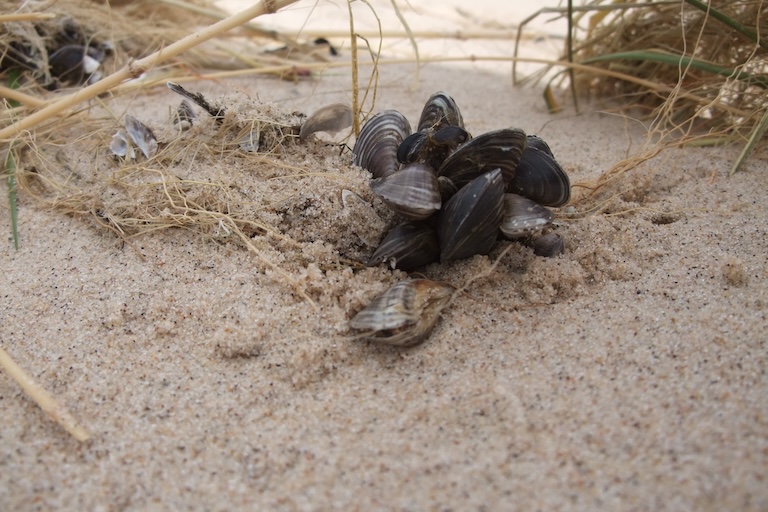
The original, native lands of the quagga mussel are thought to be somewhere around Ukraine and the Black Sea. But they have spread far and wide, since then, and not likely on their own.
Today, they’re found all the way over in Western Europe on the other side of the continent, but also appear to have hopped the Atlantic to invade North America as well.
There are Quagga mussels in the Thames in London, in the Danube, the Rhine, and in multiple systems of the Great Lakes in the Americas, among many other locations. And, while they’re very valuable to the ecosystem in their native ranges, many of these new locations are struggling to handle their arrival. 4
6. This isn’t as good as it sounds
Everything that makes this animal incredible in its own right makes it a terrific threat to ecosystems that didn’t evolve to handle it.
Where there are fewer natural predators, more of those million babies make it to maturity. The strong ropes and tight bivalve shells allow the animal to survive outside of water for days, so they can spread on cargo from one place to another with ease. In environments where the water is supposed to be mucky, these outstanding filter feeders are clearing it up and creating a sort of blank slate for diseases.
You’d think keeping the water clean would be good news to everyone, but much in the way that a nice cup of sterile urine becomes rapidly unpleasant to drink, this very clean foundation, when also full of nutrients, can provide the perfect real estate for dangerously unsavoury growth.
And in habitats that have evolved alongside mucky water, this favours non-native species or blooms of such aquatic nasties as blue-green algae. Ironically, the zebra mussel – another invasive species – is outcompeted by the quagga mussel in this regard. 5
7. They’re doing too well
So, this is a species of least concern to conservationists on one hand – they aren’t likely to go extinct any time soon – but on the other, they are a serious threat to a bunch of other species.
With any luck, the Western half of Europe will pick up a culinary preference for more invasive species like this and become a natural predator of their kind, but in the meantime, watch out for quagga infestations and algal blooms! 6
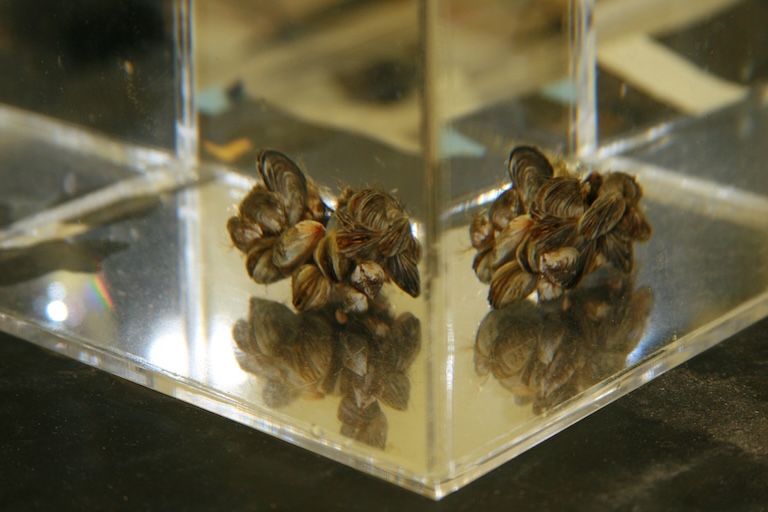
Quagga Mussel Fact-File Summary
Scientific Classification
| Kingdom | Animalia |
| Phylum | Mollusca |
| Class | Bivalvia |
| Order | Myida |
| Family | Dreissenidae |
| Genus | Dreissena |
| Species | bugensis |
Fact Sources & References
- Minnesota Department of Natural Resources, “Freshwater Mussel Filtration Timelapse”,YouTube.
- Iowa PBS, “Mussel Reproduction Process | Iowa Land and Sky ”, YouTube.
- Deep Look, “How Does the Mussel Grow its Beard? | Deep Look”, YouTube.
- TVO Today , “Quagga Mussels: The Great Lakes’ Unwanted Guests | The Agenda”, YouTube.
- Pheobe Weston (2025), “‘It’s an open invasion’: how millions of quagga mussels changed Lake Geneva for ever ”, The Guardian.
- Burlakova et. al (2022), “Quagga Mussel”, IUCN RedList.