
Qinling Panda Profile
Pandas are renowned for being the cuddliest of all bears other than the teddy bear. But this is a misleading principle, as, unlike the farcical koala, they are real bears, and real bears can all rip your face off.
Still, pandas pose a strange contradiction, don’t they? They are enormous, powerful carnivores who have apparently chosen the way of the buddha. At least, for now. And one subspecies, the Qinling Panda, takes the subversion of expectation even further by sometimes being brown.
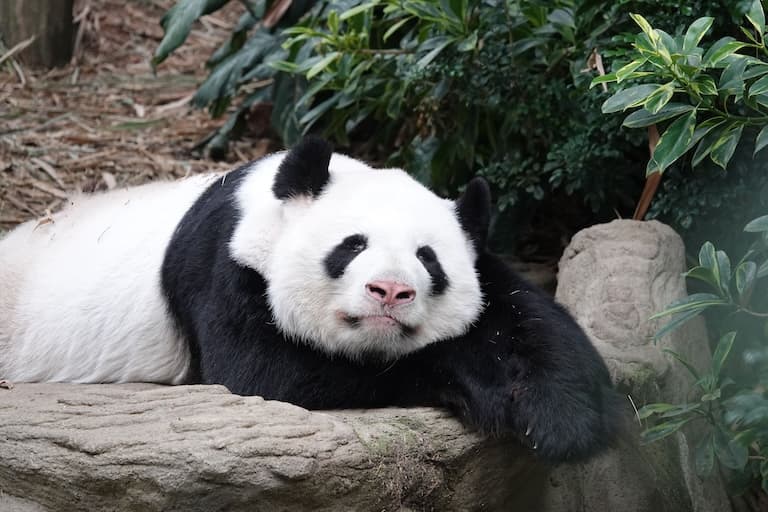
Qinling Panda Facts Overview
| Habitat: | Montane forest, up to 3,000 m |
| Location: | China, Qinling mountains |
| Lifespan: | Possibly up to 38 |
| Size: | Up to 1.8 m (5 ft 11 in) long |
| Weight: | Up to 190 kg (420 lb) |
| Colour: | Mostly panda coloured, but can also be brown and white |
| Diet: | Bamboo |
| Predators: | Humans |
| Top Speed: | Slow |
| No. of Species: | 1 |
| Conservation Status: | Vulnerable (under giant panda) |
The Qinling panda is a powerful, bamboo eating bear. So, basically: a panda. But it’s also the subspecies responsible for demonstrating to researchers that there are even subspecies, having been the first discovered to be genetically distinct enough to earn the title.
This is on the larger side of the panda size spectrum, but looks almost identical to the rest, with a couple of differences. Their teeth are bigger, their heads are smaller, and they are sometimes – though, rarely – brown.
Interesting Qinling Panda Facts
1. They’re carnivores
Pandas are mammals, and like all bears are in the order Carnivora, with wolves and lions and so on. Within this, they belong to the Ursidae family with the rest of the true bears, so they are real, legit bears, with almost everything that comes with that (Even the Tainan fake pandas, which were sun bears, painted to look like pandas, were real bears!).
Unlike some of the grumpier bears, though, they usually don’t like to attack people and eat their faces, and instead prefer to sit on their big butts, eating bamboo.
That’s weird for a bear, and it gets a little weirder when you look inside the panda. Because the panda’s herbivorous diet isn’t matched perfectly to its physiology, and it still retains a lot of its carnivore physiology – not just relating to the order Carnivora, but also to a hyper-carnivorous diet.
Their gut microbiota and digestive tracts seem to still be designed for meat, and they are able to extract protein-to-fibre ratios from their food that resemble those of the hypercarnivores.
But in the head and mouth, they are highly adapted to herbivory.
2. That don’t eat meat
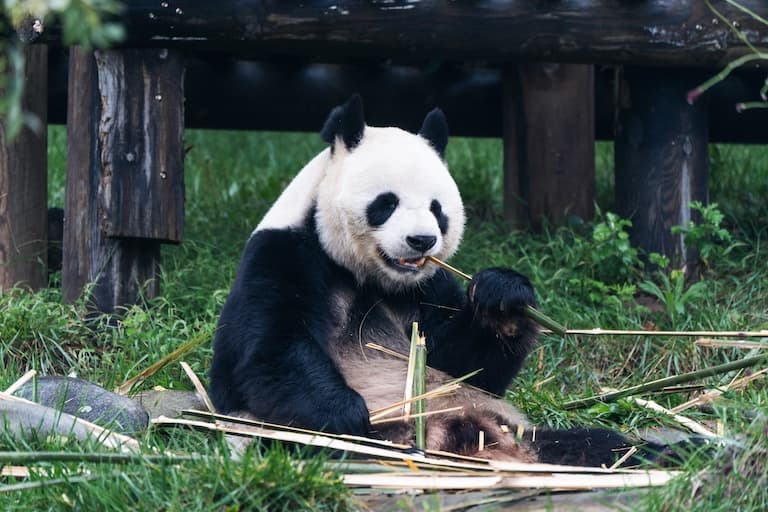
Their teeth, skull and jaw muscles have all evolved for chomping down on roughage. Bamboo, to be more specific. In fact, there’s very little else this panda eats. They have evolved a special thumb-like appendage to help them manipulate this food, too, and their genes seem to show a lack of tastebuds for meat.
So, despite having a carnivore ancestry and carnivore gut flora, they have herbivore heads, teeth and diets. All giant pandas do, so this applies to giant pandas in general, but the Qinling panda isn’t just a giant panda, it’s a subspecies of its own1.
3. They’re a subspecies
The Qinling panda was most recently discovered in 2005. Of course, it had been well known for thousands of years, but it was only in 2005, around the time Angela Merkel was campaigning for election, that researchers realised this was no ordinary panda, and was genetically distinct enough to be considered a subspecies of the giant panda.
It’s unlikely that the two events are related in any way, but regardless, this new subspecies was quite unusual, even for a panda.
The significance of its identify as a subspecies goes well beyond updating the taxonomic records, too. With its new ranking, this subspecies is entitled to a more bespoke conservation approach and its own specialised protection2.
4. They’re bigger
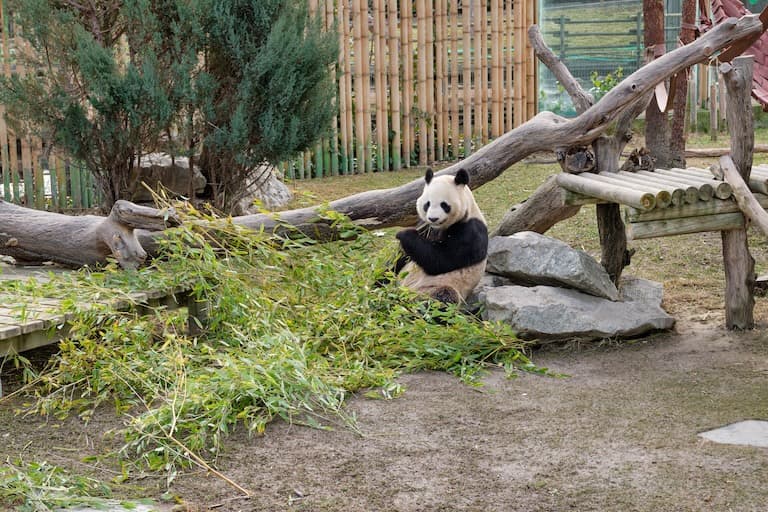
The Qinling panda has a smaller skull than the general population of giant pandas. “Well, then it’s probably got smaller teeth!” You almost certainly just shouted at your computer, but no, silly person! This panda actually has bigger teeth than its closest subspecies and this tracks with its larger overall size.
But it’s not a very significant difference. Giant pandas of all types are all within a similar size range, this one is just a little on the wonk. And that could have something to do with it being a bit inbredQiu-Hong et al (2005), “A New Subspecies of Giant Panda (Ailuropoda melanoleuca) from Shaanxi, China”, Journal of Mammalogy.[/note].
5. They’re a bit inbred
This subspecies has a very limited range, being primarily a high altitude, mountain population, cut off by deforestation in the lowlands and separated from its buddies elsewhere in panda country.
This is probably the main pressure that created the genetic differentiation from the other subspecies in the first place, but with a historical decline in habitat, it has resulted in some level of inbreeding. Population decline began thousands of years ago, and really only stopped very recently.
One quirk of this inbreeding is the retention of mutations we don’t often find, if at all, in the general population3.
6. They’re sometimes brown
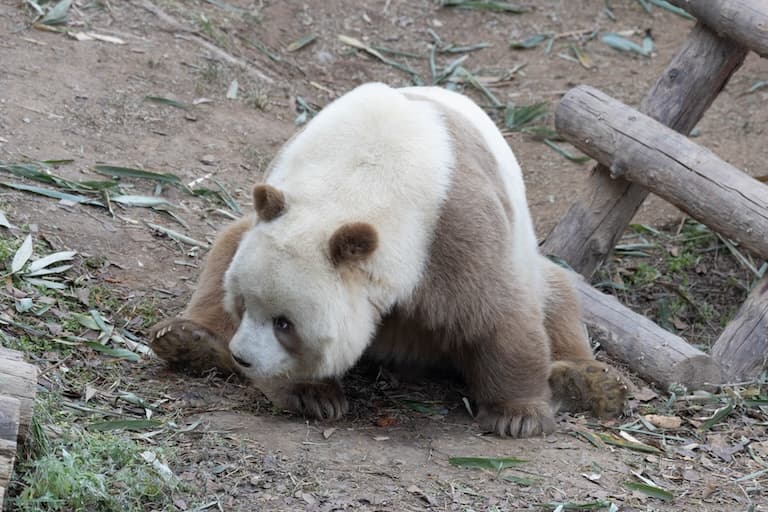
If you Google Qinling Panda you’re likely to come to the conclusion early-on that this is a brown version of the giant panda.
But brown fur is still incredibly rare, even within the subspecies known for it, and for the most part, Qinlings are the same size and colour as any other giant panda.
Still, this subspecies is the one from which we occasionally get brown pandas, and there appears to be one – if only one – in captivity from the Qinling line.
7. They’re doing better
Giant pandas got a whole bunch of attention in the ’80s for being in need of conservation and also very cute. This attention has curbed and even reversed their decline, which is great, and while the Qinling panda populations are smaller, they, too, are improving their situation4.
In 2001, there were said to be only 100 left, but more recent estimates suggest they have grown to two or three times this many as of 2017, and have hopefully continued this trend since5.
Qinling Panda Fact-File Summary
Scientific Classification
| Kingdom | Animalia |
| Phylum | Chordata |
| Class | Mammalia |
| Order | Carnivora |
| Family | Ursidae |
| Genus | Ailuropoda |
| Species | melanoleuca qinlingensis |
Fact Sources & References
- Yonggang et al (2019), “Giant Pandas Are Macronutritional Carnivores”, Current Biology.
- Qiu-Hong et al (2005), “A New Subspecies of Giant Panda (Ailuropoda melanoleuca) from Shaanxi, China”, Journal of Mammalogy.
- Zhang et al(2007), “Genetic Viability and Population History of the Giant Panda, Putting an End to the “Evolutionary Dead End”?”, Oxford Academic.
- (2021), “Qinling panda”, Bear Conservation.
- Swaisgood (2016), “Giant Panda”, The IUCN Red List of Threatened Species 2016.