
Pyjama shark Profile
We all know from the song that bananas prefer to descend steps wearing striped nightwear. But in the ocean, it’s not just fruit that wears the pyjamas – fish do, too.
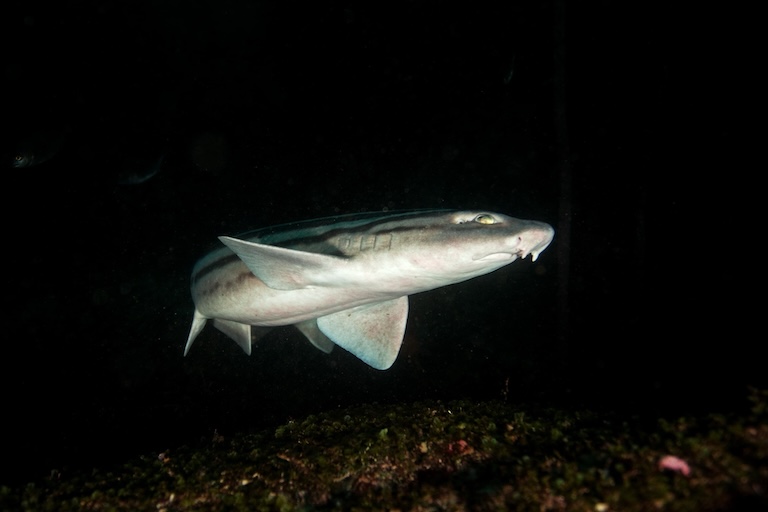
The so-called striped catshark, or “Pyjama shark” is one of several such animals named for its sleepy getup, and this one is a lot cuter and much less upsetting than a banana in human clothes.

Pyjama shark Facts Overview
| Habitat: | Benthic, shallow marine |
| Location: | South African coast |
| Lifespan: | At least 25 years in the wild |
| Size: | Up to around a metre (3.2 ft) |
| Weight: | 7.9 kg (17 lb.) |
| Colour: | Grey base colour with black stripes from head to tail |
| Diet: | Opportunistic predator, though prefers cephalopods and crustaceans |
| Predators: | Mostly larger sharks |
| Top Speed: | Not very fast |
| No. of Species: | 1 |
| Conservation Status: | Least Concern |
Sharks are up there with cows and rhinos for animals you don’t really think of as puppy-like until you get to know them. At least, sharks like this one are. Pyjama sharks are at the cuddly end of the shark spectrum for being too small to threaten us, derpy-looking at the danger end, and covered in pretty stripes that make them look even softer than they already are.
But these are still sharks, and therefore, they’re top marine predators in their niches.
Unfortunately for the sharks, they also prefer shallow water where our human nets keep dragging them up into the air. So far, though, this hasn’t put them into a category of concern for conservationists.
Interesting Pyjama shark Facts
1. They’re ground sharks
Sharks are pretty ancient and pretty diverse. They occupy a substantial number of top predatory niches in the ocean, and that’s saying something in a world where almost everything is a predator.
There are at least eight orders in the shark group, one of which stems from the late Jurassic, long before T-rex, Triceratops and is called Carcharhiniforms. This word might be familiar from an infamous species of shark, Carcharodon carcharias, who frightened a lot of people in a book known as Jaws.
Ironically, though, the Great White shark isn’t a member of this order, and is instead now placed in the underwhelmingly-named mackerel shark order.
The ground sharks have several families, most notably, the stunningly attractive requiem sharks, the goofy but incredible hammerheads and the notoriously hungry tiger sharks.
And a lesser-known group called the cat sharks.
2. They’re Catsharks
A smaller, humbler, and much more cuddly family of ground sharks is the Scyliorhinidae family, commonly known as catsharks.
Confusingly, some members of this family are also called dogfish, but this common name is generally reserved for another taxonomic group.
Catsharks are benthic – that is, bottom-feeding – sharks, and are shaped accordingly, with wide bodies, flat heads, and barbels. This family is a loose grouping, though, and is not considered strictly accurate. It’s likely there will be some shuffling around in the future, but for now, this is the family that the pyjama shark belongs to. 1
3. They’re cute
Catsharks, including this one, are not to be considered dangerous to humans at all, and this is for the same reason they have so many enemies of their own: they’re small and meek.
This is a shark with a lot to worry about. Being at the smaller end of the size spectrum for sharks, it falls prey to its far scarier brethren, especially the broadnose sevengill shark, who consistently seems to prefer eating pyjama sharks in particular.
They’re slow-swimming animals, too, and so prefer to remain secretive in the daytime and come out at night to hunt. They like to eat molluscs and cephalopods, but are opportunistic and will chow down on anything small enough.
But it’s their patterned skin that gives them the name, and adds a layer of cuteness to an already rather pleasant animal to behold. This striped pattern is great camouflage in the dim evening light or moonlight of the nocturnal shallows, where the shark feeds.
Still, for as cute as it is, to animals small enough, this is still a formidable killer.
4. Death Roll
Classically, sharks have big teeth for murdering big things like naked Chrissie Watkins in Jaws. But the pyjama shark has small teeth for small things, and doesn’t shear in the way its more powerful relatives might, by clamping down and shaking.
Instead, it employs the way of the crocodile, and on grabbing a squishy victim, like an octopus, for example, will do a death roll to tear into it and dismember it.
So, this is a cuddly shark if you’re big enough, but it’s still a top predator! 2
5. They mature slowly
This slow-moving animal is slow-living, too. It takes its time growing up on the continental shelf and among the kelp beds, where it’s hidden from larger animals and among other prey items it can feed on.
Ageing sharks is notoriously hard, but estimates set the longevity for similar species at a highest recorded figure of around 21 years, and this has resulted in an estimate of 25 years of more for the slightly larger pyjama shark.
But it’s thought to spend at least 9 of these years as a juvenile, making its reproduction quite a lengthy process. And when an animal breeds slowly, it’s always vulnerable to being removed from the ecosystem by our destructive harvesting processes. 3
6. They’re often bycatch
Pretty much all forms of commercial fishing result in sharks of this species being dragged up by mistake. Countries are slowly rolling our restrictions on the most damaging of strategies, but for many, it’s too little, too late, and sharks are some of the most devastated communities in the ocean across the board.
To make matters worse, fishermen consider this shark a pest, on account of the belief that it feeds on their target fish stocks (which isn’t usually the case, but even if it was, technically makes them the pest anyway, since the shark lives there). Pyjama sharks are often killed by fishermen when brought up for this reason. _Still, this species seems to be holding out surprisingly well, despite this impact.
[7] But they’re doing pretty well for now. A tragically high percentage of fish don’t survive being thrown back in the water. This is a little-known fact that really needs to be repeated as often as possible. The rate varies tremendously between species, with some fish around 90% or more likely to die, and others more than 90% likely to survive.
Overall, there’s around 20% of fish lost to this effect, and among those that survive, a large proportion will be injured or otherwise less likely to survive the next season.
Fortunately for the pyjama shark, this is one species that has a high survival rate (if the fishermen don’t bash it death before throwing it back) and it’s not a popular food fish, so when released without harm, it’s likely to survive.
This may explain why the species is now listed as Least Concern by the IUCN, though a lot of the figures in its assessment are quite dated. 4 5

Pyjama shark Fact-File Summary
Scientific Classification
| Kingdom | Animalia |
| Phylum | Chordata |
| Class | Chondrichthyes |
| Order | Carcharhiniforms |
| Family | Silorhinidae |
| Genus | Poroderma |
| Species | africanum |
Fact Sources & References
- Karla D. A. Soares(2020), “Comparative anatomy of the clasper of catsharks and its phylogenetic implications (Chondrichthyes: Carcharhiniformes: Scyliorhinidae)”, Wiley Online Library.
- , “The Pyjama Shark”, Shark Divers.
- Pollom et al (2019), “Pyjama Shark”, IUCN RedList.
- Hartill et al(2020), “Recommended release mortality estimation methods for species commonly caught by recreational fishers in New Zealand”, Fisheries New Zealand.
- (2019), “Pyjama Shark”, IUCN RedList.