
Pygmy Shark Profile
Sharks are popular for their extremes. The largest shark is the whale shark, and this is the largest fish in the world. Even the second-largest is infamous: the Great White is the largest shark that sometimes eats people in Spielberg movies. There are extremely small sharks, too, though. The dwarf lantern shark is a hand-sized, puppy-like fish that holds the title of smallest shark.
So, what of the second-smallest shark? Number two from this end rarely gets any attention, but today we’re going to go against that trend and champion a cute little squaliform shark called the Pygmy Shark.

Pygmy Shark Facts Overview
| Habitat: | Shallow to Deep Ocean |
| Location: | Globally, in tropical and temperate seas |
| Lifespan: | Unknown |
| Size: | Up to 27 cm (10.6 in) |
| Weight: | Not Known |
| Colour: | Dark brown; black ventrally |
| Diet: | Small fish, squid, crustaceans |
| Predators: | Larger sharks & fishes |
| Top Speed: | Unknown |
| No. of Species: | 1 |
| Conservation Status: | Least Concern |
The pygmy shark isn’t the biggest, but it isn’t the smallest, either. What it has on its side is obscurity! This makes writing a whole blog about it quite challenging, but fortunately there are clues about it from its relatives and a whole bunch of direct observations, albeit scattered, to draw upon.
So, here’s a shark that is probably in the Euprotomicrus genus; probably a diurnal, vertical migrant; glows in the dark; and could probably punch a neat little circular hole in your meaty bum (though it likely won’t).
Interesting Pygmy Shark Facts
1. They’re Squaliformes
Deep sea shark taxonomy is one of the most fun mysteries within taxonomy. This is, of course, a low bar, but even with this in mind, it’s quite intriguing! There are over 120 species documented within the Squaliformes order of sharks, which are spread out across seven or so families.
These are primarily quite small sharks, the Dalatiidae family, also known as the kitefins, where we find the pygmy shark, are all less than 2 metres long.
This much is not entirely certain about the pygmy shark, which is often also listed in the Squalidae family, where it once was placed, but it’s at the genus level at which the real debate begins, and it’s not clear which genus this one should belong to.
To make matters even more complicated, there is the so-called spined pygmy shark, in the genus Squaliolus, while the pygmy sharks currently sit in Euprotomicrus.
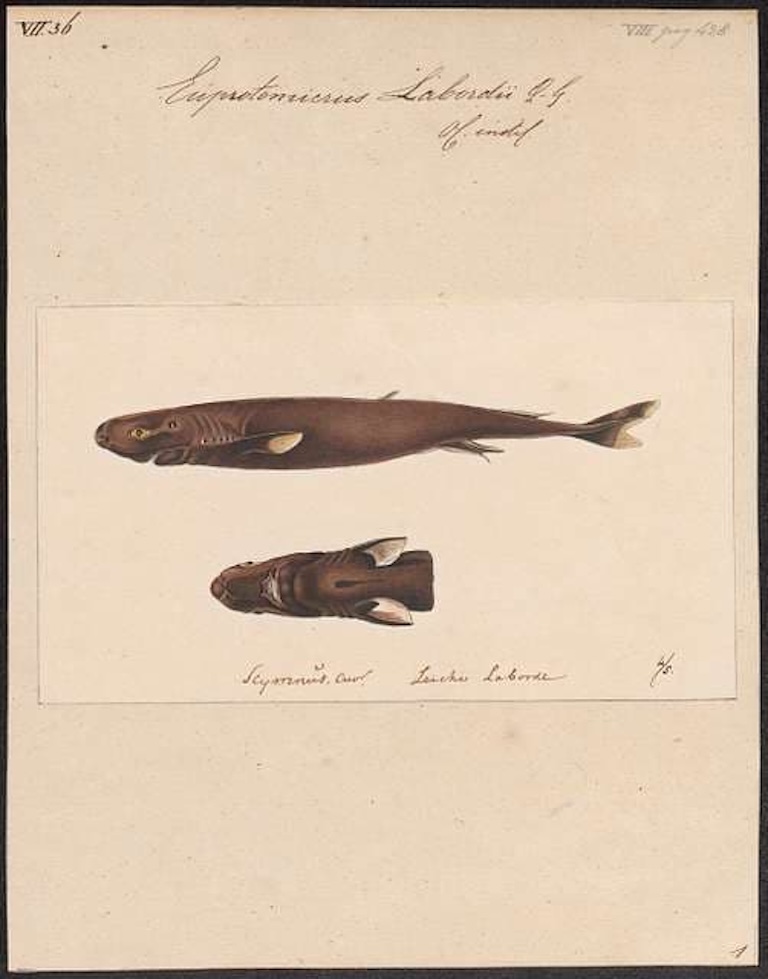
What we know, then, is that it’s a member of the kitefin family, and a small dogfish-like species with a cigar-shaped body. Beyond this, there’s a lot of “probably” going on. Part of this is because of how hard they are to find.
2. They’re pretty tiny
Before we get to the “probably” facts, one other thing is certain – this is a very small shark!
At maturity, this animal reaches around 23 cm long in males, and even smaller in females, who reach no more than about 19 cm. The highest documented value for length was 27 cm, and this nets the pygmy shark the number 2 spot on the list of smallest shark species known.
Their size, and the fact they spend a lot of time in the deep ocean, means there’s still so much to unpack about them!
3. They probably migrate vertically
This species has been found near the surface, and all the way down to blow 1,500 metres beneath it. This suggests strongly that it’s one of the many species in the ocean that migrates vertically each day.
This is essentially a daily grocery run for an animal like this, who is so small and vulnerable that the shallows are a dangerous place in the daytime. Instead, they dwell in the murky depths, waiting for the light to wane, then emerge from the deep to feed in secrecy. 1 2
4. They probably glow in the dark
This species, along with many others in its family, are spotted on the underside with dark patches, which are places at irregular intervals over its body.
It’s unclear whether the function of these spots has been confirmed in this species precisely, but in its relatives, they’re known to produce light. This makes for a tiny, glow-in-the-dark, cigar-shaped fish, and creates more questions than it answers.
So why would a shark so well adapted at hiding have glowing side markers? Ironically, this, too, is a way of hiding.
In the deep water, there is almost no light. But almost is more than none, so an object that’s totally dark will be silhouetted against the background glow from other organisms and whatever miniscule amount of surface light gets through. So, the trick to hiding isn’t to turn off the lights but to dim them to precisely the level of the background light and blend in.
The underside light organs are described as obvious “dark specks,” and at least one detailed morph study notes photophores sitting on or beside dermal denticles in an irregular pattern.
All this is highly likely in this species, but the how is entirely unknown. It appears to be an intrinsic chemical to the shark, rather than a bacterial reaction, but this has not been determined to any degree yet. 3 4
5. They probably don’t cut cookies
The cookie-cutter shark is a close relative of the pygmy shark, and this one is named for its nasty habit of punching holes in larger animals. Cookie-cutters are from a different genus in the same family, and probably have different feeding habits, too, but from the teeth of the pygmy shark, it’s clear they aren’t designed for the sort of chomping of the larger sharks, and are likely better at grabbing and removing little chunks, instead.
But the diet of this little shark is one thing we can reliably infer from its stomach contents, and unlike the cookie-cutters, this one seems to prefer to eat smaller fish and squid. Another clue to the differences comes from the lack of suction lips, which are present on cookie-cutters to latch onto their prey before biting.
So, while this little shark might be able to leave a hole in your glute, it’s probably not going to want to.
6. They’re poorly known (and could be in serious trouble)
So, lots is left to know about this species, and much is still being inferred from other, similar ones. And while what is known suggests that it’s a species of Least Concern, this could change very quickly with the advent of deep-sea mining.
Already, surveys for mining locations are one of the best ways to identify new deep-sea species, and these discoveries are both enthralling and alarming – each survey comes back with literally hundreds, sometimes thousands of new species, showing that mining in the deep ocean will threaten animals we have never even seen before with extinction.
The deep sea is harder to get to than the surface of the moon, and it contains infinitely more aliens, as well. This is the most exciting frontier of animal discovery, and we should be focussing more on exploring it and less on destroying it, so that animals like the pygmy shark can continue their weird existences in harmony with ours. 5 6
Pygmy Shark Fact-File Summary
Scientific Classification
| Kingdom | Animalia |
| Phylum | Chordata |
| Class | Chondrichthyes |
| Order | Squaliformes |
| Family | Dalatiidae |
| Genus | Euprotomicrus |
| Species | bispinatus |
Fact Sources & References
- Love et al (2021), “Checklist of marine and estuarine fishes from the Alaska–Yukon Border, Beaufort Sea, to Cabo San Lucas, Mexico”, Zootaxa.
- Kyne et al(2023), “Pygmy Shark”, IUCN RedList.
- Helen Scales (2012), “Glowing Pygmy Shark Lights Up to Fade Away”, National Geographic.
- (2024), “Species: Euprotomicrus bispinatus, Pygmy Shark”, Smithsonian Tropical Research Insititute.
- Eva Cahill(2026), “Hundreds of new species found in Pacific face deep-sea mining destruction”, Oceanographic Magazine .
- University of Hawaii at Manoa(2025), “Mining the Deep Sea Could Erase Sharks We’ve Only Just Discovered”, SciTechDaily.