
Pygmy Owl Profile
There’s nothing more ubiquitous in nocturnal mysteries than the owl. Throughout history and across multiple cultures, they are regularly perceived as large, wise, and silent animals, guarding the secrets of the night.
Pygmy owls flip the script on all of this. Not only are they tiny, they’re also dumb (because all owls are dumb), and some hunt in the daytime and make a lot of flappy noises.
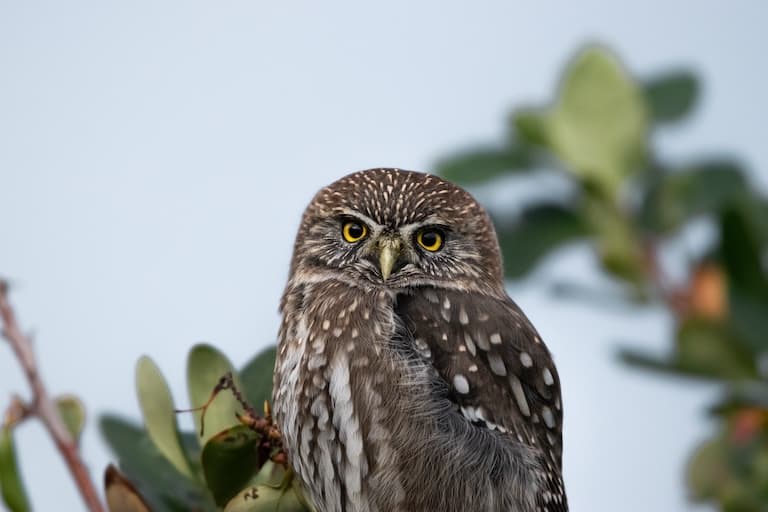
Pygmy Owl Facts Overview
| Habitat: | Woodlands |
| Location: | Eurasia and The Americas |
| Lifespan: | Around 4 years in the wild, up to 13 in captivity |
| Size: | Around 18 cm (7 inches) |
| Weight: | Around 70g (2 oz) |
| Colour: | Usually, mottled brown |
| Diet: | Birds, beetles, other invertebrates |
| Predators: | Larger birds, snakes |
| Top Speed: | Unknown |
| No. of Species: | 29+ |
| Conservation Status: | Least Concern to Critically Endangered, One Possibly Extinct |
Pygmy owls are remarkable for several reasons. The first is their size: they’re close to the smallest animals in the world; but they make up for it by being ferocious slaughterers of songbirds and rodents.
They can be found almost everywhere with trees, and while most are nocturnal in the classical owl sense, a few are day walkers, and wear the insignia on the backs of their heads to prove it.
Interesting Pygmy Owl Facts
1. They’re true owls
Owls are more convoluted as a group than they seem to be, at first glance. Barn owls, for example, are probably the most iconic of all owls, and certainly the most widely known, as they occupy habitats almost all over the world. There are barn owls in Arctic conifers, barn owls in Australian eucalyptus, and barn owls sitting in hedges on volcanic lakes in Africa.
Yet, barn owls are not, as they are known, “True” owls. They’re the “other” family of owls, the Tytonidae. This is the smaller of the two families, the other containing the true, or typical owls of the Strigidae family.
So, despite being far more obscure than barn owls, pygmy owls are more deserving of the title. They are a single genus of generally rather petite murderers, containing just under 30 species.
2. They’re little
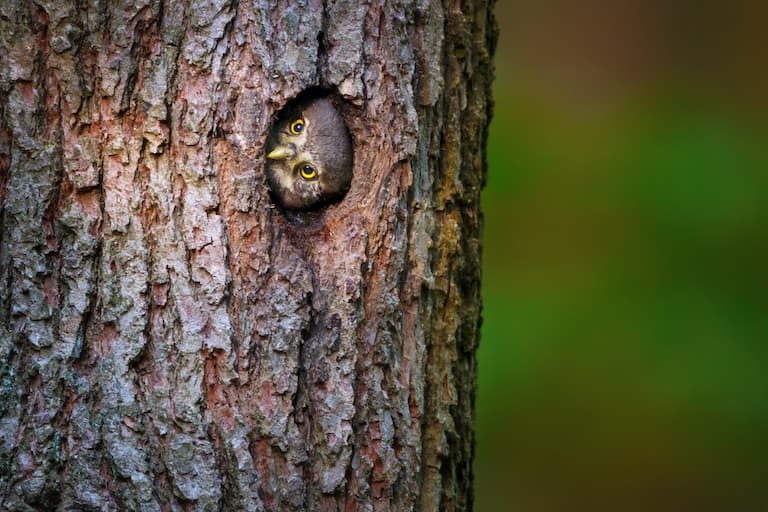
There are at least 29 species of pygmy owl, but they do all suit the name pretty well. They’re not the smallest of owls – that title goes to the Elf owl: a mere 15 cm long and about 40 g in weight.
But they are pretty hootin’ close. The Eurasian pygmy owl is the smallest owl in Europe, and only a few centimetres more than the elf owl, at around 18 cm long, and marginally heavier at around 50 to 60 grammes. The cloud forest pygmy owl is even smaller (but denser) than this, reaching up to around 16 centimetres and 80 grams.
We can’t seem to find any species that reach more than 18 cm long, and they are pretty much all around or below 70 grams in weight. But this little bird packs a serious punch1.
3. But mighty
Small owls typically get assessed by investigating the little pellets full of beetle shells that they cough up. These “owl pellets” say a lot about an animal whose nocturnal habits are otherwise hard to determine with our limited monkey eyesight.
But there are no beetle leftovers among the pygmies! At least, when there are, they’re mixed with the remains of much larger animals. These are stone-cold killers of vertebrates.
Birds typically store their food in a special pouch in the throat called a crop. These owls don’t have one of these, so their spoils are hung and stashed in forked branches and little cubbyholes in trees, in a morbid larder.
Different species have different preferences, but the pygmy owls typically take on rodents and birds, as well as insects, and often prey that’s even bigger than they are. Pygmy owls are aggressive hunters with a scary reputation among the forest community, and this reputation means they need to have eyes in the backs of their heads2.
4. They have eyes in the back of their heads
Dangerous animals usually have their weapons quite close to their eyes, so when fighting one, their eyes are a good indicator of where you don’t want to be.
This near-universal law has been exploited by various animals, whose evolution has favoured individuals with big, eye-like markings on their vulnerable areas. These are known as ocelli, and they’re what we find on butterfly wings and the juicy rumps of some caterpillars.
Even humans, working with tigers and other dangerous animals, have worn masks with eyes on them, strapped to the backs of their heads, to help keep them safe. And some species of tiny owl use them, too.
The Northern pygmy owl, despite being a hunter, is still vulnerable to attacks. But more so from its prey than its predators. When birds see a potential threat, they tend to mob it, attacking in large numbers to drive it away from them and their young.
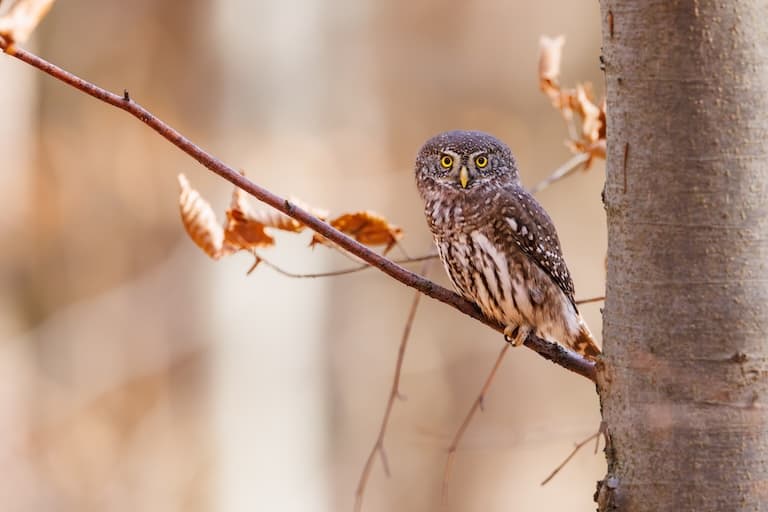
These mobbing events can be annoying at best, and lethal at worst, so it helps to have some kind of defence, and it appears that the Northen pygmy owl has gone the way of the butterfly for this, sporting two large, brown, fake eyes on the back of its head that would make any attacker think twice before lunging in from behind3.
5. Many are diurnal
Eye spots are a visual deterrent, and vision is a tool that requires light, so species with eye spots are more likely to be found hunting at brighter times of day than those without.
And this tracks! The Northern pygmy owl is different from most of its kin, in that it is diurnal, rather than nocturnal.
This is how it finds and kills birds, and generates such a worrisome reputation among them in the first place. For the same reason, it’s also different than most owls in that it doesn’t fly like a silent assassin – instead, its feathers do make sound.
This little bird can be heard buzzing around on little wings, darting about like a woodpecker in the daytime4.
6. Many are doing very well
The Eurasian pygmy owl, along with the majority of other pygmy owl species are of Least Concern to the IUCN, globally5.
The genus as a whole is also incredibly widespread and pygmy owls can be found on all continents outside of Antarctica.
They’ve done very well for themselves for the most part, but there are some species that are in serious trouble, too.
7. Some are Critically Endangered
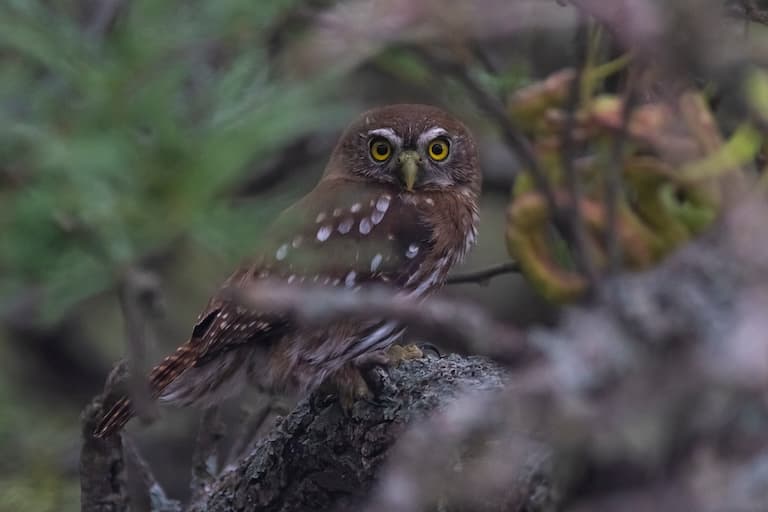
The Pernambuco Pygmy-owl is a Brazilian species, known only from two disconnected locations on the Easternmost point of the country.
This species was not assessed until 2007, when it immediately went into the Critically Endangered category and has unfortunately never left this ranking. It’s said to contain a maximum of only 49 individuals, and the species is thought to be in decline.
Every assessment since 2007 has said the same thing: 0-49, in decline. It is thought to have an extremely small range and its habitat is rapidly reducing. At a glance, this seems like there’s been some kind of mistake, but as estimates draw upon new and improved methods, the 0 in that range is looking like the more accurate end than the 49.
This species may now be extinct, and it’s up to conservationists to find any alive at all if they are to prove otherwise
6.
Pygmy Owl Fact-File Summary
Scientific Classification
| Kingdom | Animalia |
| Phylum | Chordata |
| Class | Aves |
| Order | Strigiformes |
| Family | Strigidae |
| Genus | Glaucidium |
| Species | 29+ |
Fact Sources & References
- (2024), “Eurasian Pygmy-owl”, The IUCN Red List of Threatened Species in 2024.
- “Northern Pygmy-owl”, The Peregrine Fund.
- Mock (2019), “These Birds of Prey Have Eyes in the Backs of Their Heads”, Audubon.
- “Northern Pygmy-owl”, The Peregrine Fund.
- (2024), “Eurasian Pygmy-owl”, The IUCN Red List of Threatened Species in 2024.
- (2019), “Pernambuco Pygmy-owl”, The IUCN Red List of Threatened Species 2019.