
Pygmy Hippopotamus Profile
Africa has over 1.5 billion people in it, and counting. Yet somehow the entire continent is still stereotyped as the most treacherous of realms. And that is, to a large degree, thanks to it being the last bastion of the mega beasts: enormous animals from ancient times that are still heavy enough and angry enough to remind us that we are small with their teeth and feet.
And of these large animals, few have a reputation as monstrous as the hippo. This is partly deserved and largely imagined, but for one species of hippo, at least, no such fuss warranted. This tiny cousin of the 4-tonne Nile hippo isn’t strong enough to snap you in half, but it is more than capable of breaking your heart. This is the Pygmy Hippo.
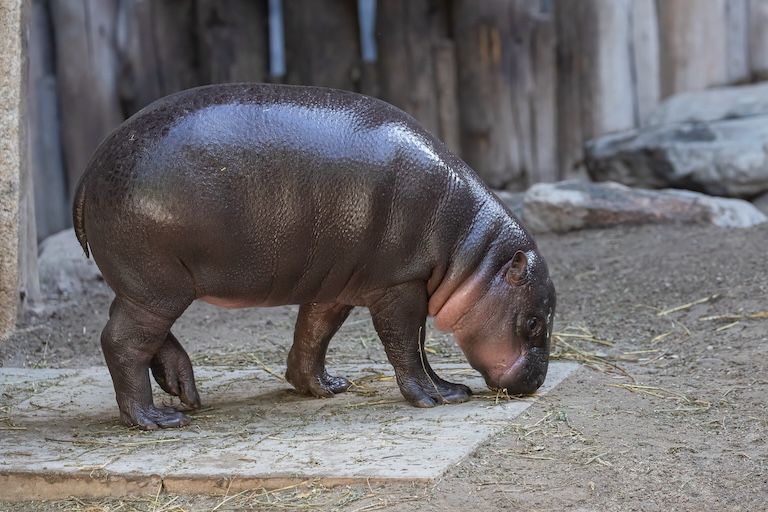
Pygmy Hippopotamus Facts Overview
| Habitat: | Low-lying, forested areas |
| Location: | Mainly Liberia, with smaller populations in Sierra Leone, Guinea, and Côte d’Ivoire |
| Lifespan: | 35 in the wild, 45 in captivity |
| Size: | Around 1.75 m (5.7 ft) long, no more than a metre (3.3 ft) tall. |
| Weight: | 180–275 kg (400–600 lb) |
| Colour: | Dark brown to blackish-grey, often with a greenish sheen; skin secretes a reddish protective fluid |
| Diet: | Leaves, ferns, grasses, fruits, and aquatic plants or roots |
| Predators: | Leopards, crocodiles, and occasionally large pythons, humans |
| Top Speed: | Unknown |
| No. of Species: | 1 |
| Conservation Status: | Endangered |
Common claims about the capabilities and danger of hippos are greatly exaggerated, and that’s even with the Nile hippo being one of the most populous wild mammals in Africa. The pygmy hippo, being solitary, greatly restricted, elusive and endangered, is even harder to get an accurate read on!
What we do know is that they’re small, shy, adorable and in serious danger of soon going extinct.
Interesting Pygmy Hippopotamus Facts
1. They’re unique
Hippos are remnants of the world before humans took over. They are one of the groups of animals that stem from the early, post-dinosaur periods and peaked during the Pleistocene, once covering Eurasia as well as Africa.
There are seven or more hippo genera described, all but two of which are now considered extinct. One of those genera is the ancient Hexaprotodon, which is where this pygmy hippo once was placed, but before that it belonged to Choeropsis.
And it is Choeropsis that this hippo has been returned to in recent years, on the assumption that it is a unique species and deserves its own genus.
While this is very important to figure out, it’s also remarkably boring, so we are all very grateful to those who sacrifice all social life and self-respect to dedicate their lives to taxonomy.
2. They burrow, sort of
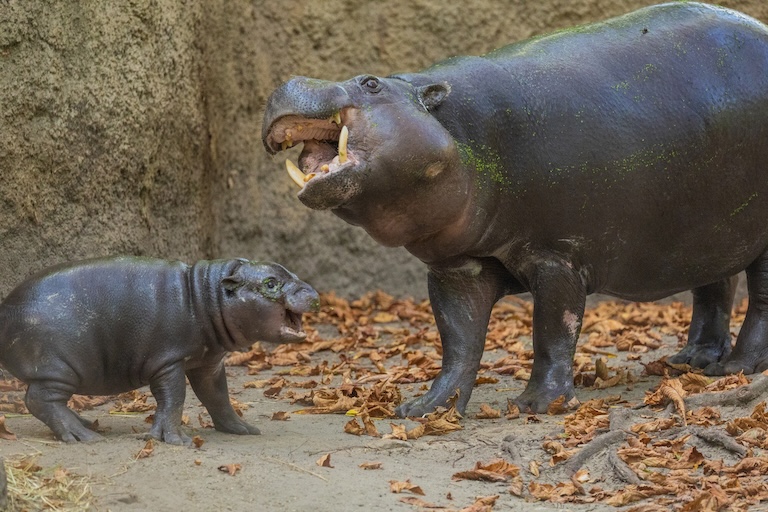
This little hippo is a bit of a mystery, as we’ll expound upon further in this post. One cool characteristic of this species, though, is that it can sometimes be found in burrows.
This isn’t a habit that’s traditionally associated with hippos, but there they are, stuffed like a boiled sausage into a tunnel in the muddy bank of their local waterways.
It’s not clear if they dig these burrows, though it’s thought that they probably don’t, and are just modifying burrows made by other animals. But the discovery of evidence to the contrary would make a fantastic PhD thesis!
The burrows that pygmy hippos prefer seem to open at the water’s edge and then descend away from it, lower than the water level, which allows them to shoot out like Thunderbird 4, which is a reference you’re probably going to have to Google if you’re under 50.
3. They’re smaller
Obviously, this hippo isn’t going to win any eating competitions against its larger relatives. The pygmy hippo tops out at around 250kg, which is an eighth of the mass of a big Nile hippo, and explains why it’s so much better at tunnelling.
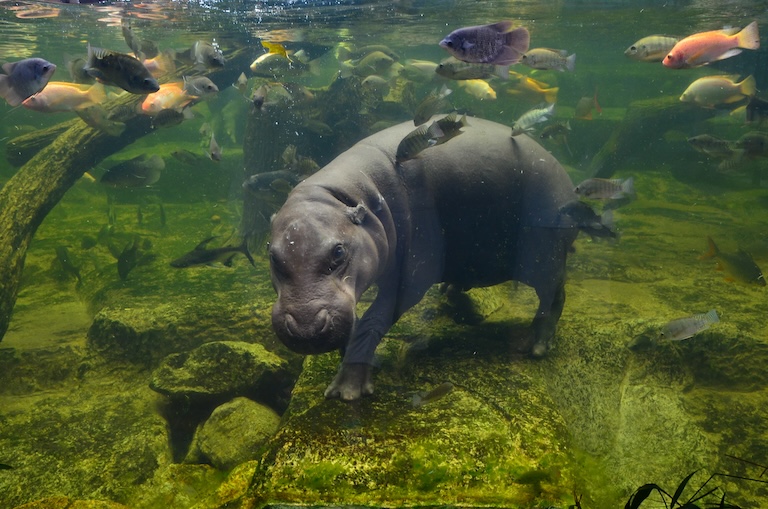
But there are other differences, too. It has longer legs and a longer neck, but its head is relatively small compared to its body, which also contributes to its popular, derpy look. Their eyes are placed more to the side of the head, too, which is a terrestrial adaptation and in contrast to the more aquatic hippo species, whose eyes are more on top of their heads for peeking out of the water.
Like other hippos though, they can close their ears and noses to help them run beneath the surface of the water. And like the big boys (and girls), they have four stomachs!
4. They’re pseudo-ruminants
Pygmy hippos are said to be strictly herbivorous (but that’s what they said about Nile hippos until they caught them eating gazelles and people). They eat some of the lowest-quality roughage around, and in order to extract anything of value from such poor food, they need very special guts.
Like bovids (and for the same reason), they have evolved chambered stomachs. They’re not as advanced as the ruminants with this design, and they don’t chew the cud, but the principle is the same: the first three chambers are pre-processing departments and are thickly lined with keratin, likely to act as abrasive surfaces and a way to work bacteria into the food to break it down.
The fourth chamber is likely more absorbent, but food still comes out the back end not so dissimilar to the condition it was in when it entered the mouth. And, like larger hippos, they like to fling their poo with their tails. 1
5. They’re mostly cute
Pygmy hippos aren’t just smaller than Nile hippos, they’re sort of… rounder too. Both their small size and the fact they won’t eat a person make them a safer choice when thinking of cuddling up to a hippo.
But they aren’t pure cuteness. Like their larger relatives, they do sweat blood. At least, that’s what people used to think. Pygmy hippos have thick, but very sensitive skin, and so have evolved to produce their own sun protection and moisturiser, which is secreted as a thick, red fluid.
This is so convincingly similar to blood that it’s thought to have inspired the ancient Egyptians to invent blood-letting, as they believed that unhealthy hippos would make themselves bleed to recover from their ailments. 2
6. They may have secret relatives
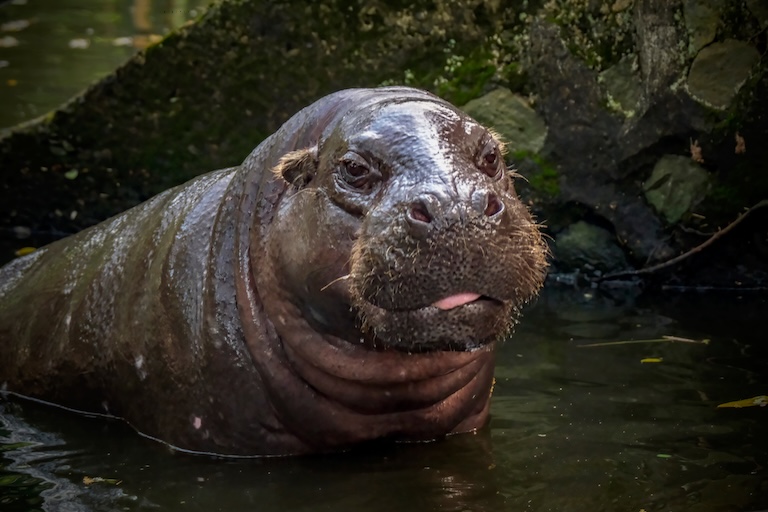
There was once a subspecies of this pygmy hippo in Nigeria, called Hexaprotodon liberiensis liberiensis. Today, it would be called Choeropsis liberiensis liberiensis, and in 1943 estimates placed their population at around 30 individuals around the Niger Delta.
Unfortunately, no confirmed sightings have been reported since then, though unsubstantiated claims have been made. So, it’s thought to likely be extinct, and sadly, if it does exist, it would probably be critically endangered and on the way out.
But it’s hard to know for sure! Because this little hippo is hard to find. 3
7. They’re elusive
Unlike the Nile hippos, this smaller species is entirely solitary. They can be seen in mating pairs and with offspring, but unless companionship is serving some essential reproductive need, they prefer to be alone.
They’re also primarily nocturnal, small, and hide very well in the undergrowth. This combination of characteristics makes them remarkably hard to study, which is why so little is known about the species.
One cool note from the dearth of literature suggests that they have been spotted standing on their back legs while reaching up to feed, which is decidedly unhippo-like behaviour! 4
8. They’re in trouble
Unfortunately, this little animal is having its entire habitat reduced at an alarming rate. Deforestation is rampant, and palm and rubber plantations seem to be the largest drivers of this in the pygmy hippo’s range.
Some commercial hunters are also harvesting this species, and their tusks and skulls are said to be used in rituals and traditional medicine.
Due to a combination of factors, then, the population is in sharp decline and the pygmy hippo is now listed as Endangered. 5
Pygmy Hippopotamus Fact-File Summary
Scientific Classification
| Kingdom | Animalia |
| Phylum | Chordata |
| Class | Mammalia |
| Order | Artiodactyla |
| Family | Hippopotamidae |
| Genus | Choeropsis or Hexaprotodon (synonyms) |
| Species | liberiensis |
Fact Sources & References
- Conservsyndicate, “Pygmy Hippopotamus marks its Territory”, Youtube.
- Daniel Fredrickson (2009), “AHexaprotodon liberiensis”, Animal Diversity Web.
- S. Keith Eltringham , “The Pygmy Hippopotamus ”, Internet Archive.
- Ransom et al (2015), “Pygmy Hippopotamus”, IUCN Red List.
- (2015), “Pygmy Hippopotamus”, IUCN Red List.