
Purple Tree Tarantula Profile
Spiders aren’t as worrisome as many like to think. Sure, there are a handful that could kill you, but the vast majority are entirely harmless, and those sitting between these two antipodes are generally not very dangerous, either.
But they really look scary, don’t they? Especially when huge, covered in thick, bristly hairs, and capable of dropping in from above.
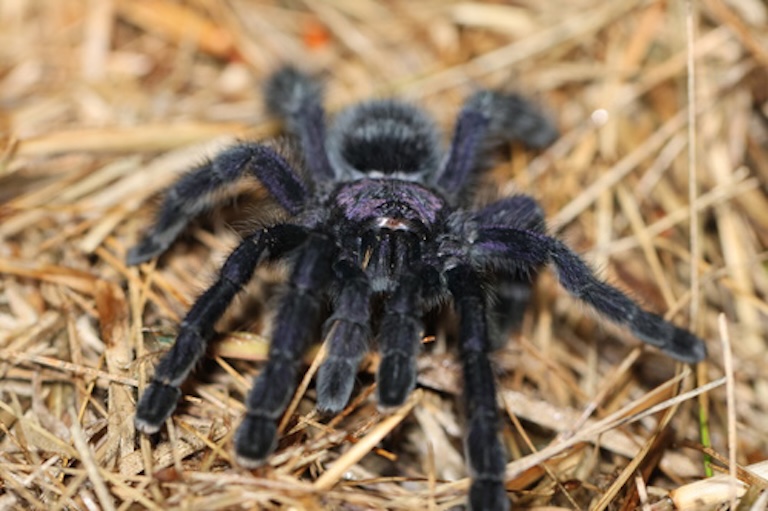
And the Purple Tree Tarantula, sometimes known as the purple pinktoe, ticks all the right boxes in this regard, despite being one of the most harmless spiders there is.
Purple Tree Tarantula Facts Overview
| Habitat: | Arborea, tropical forest |
| Location: | Ecuador |
| Lifespan: | Up to 12 years in females, around 4 in males. |
| Size: | Up to 13 cm (5 inches) |
| Weight: | Up to 85 g (3 oz) |
| Colour: | Black or dark purple |
| Diet: | Insects, other inverts, mostly beetles |
| Predators: | Birds, reptiles |
| Top Speed: | Can ping off branches/hands quite fast, but generally docile and slow-moving |
| No. of Species: | 1 |
| Conservation Status: | Not Listed |
Interesting Purple Tree Tarantula Facts
[1] They’re Purple, they’re Arboreal, and they’re Tarantulas
Spiders are a truly ancient line of arthropods, somewhat more closely related to prawns than to the insects with which they share their terrestrial habitats. They are an order of arthropods known as Aranaea, which contains well over 50,000 species in around 140 families.
All tarantulas are in just one family called Theraphosidae, and this includes the African tarantulas, which are often also known as baboon spiders.
So, the purple tree tarantula is a true tarantula, in the Theraphosidae family, and its name sticks with this level of accuracy throughout.
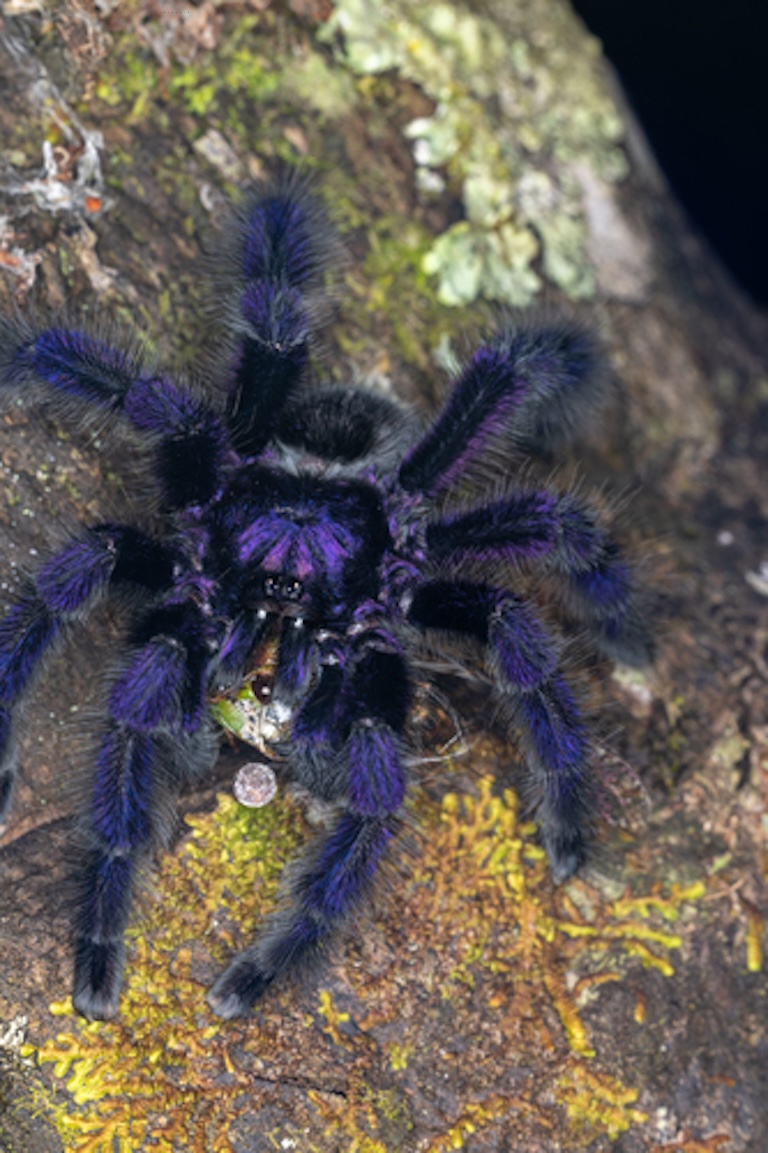
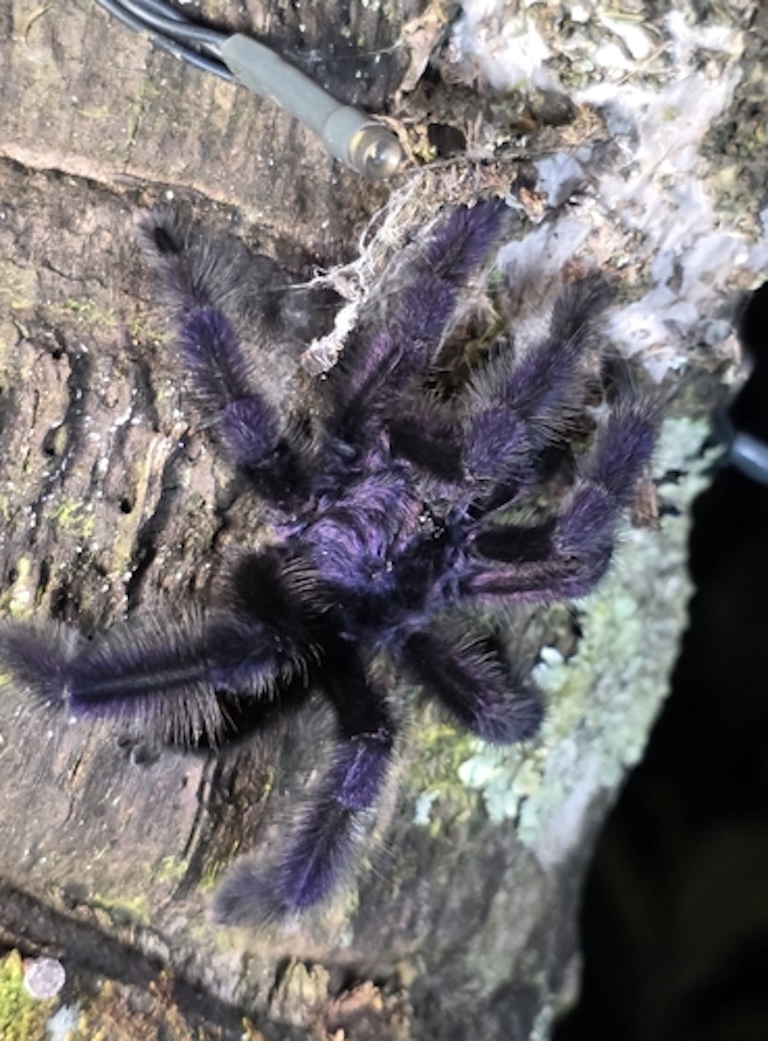
The purple part of the name is probably the least reliable, though this is still true in many cases. The species has various morphs, both in the wild and in captivity, but most are somewhere between black and dark purple in colour, with a reddish-pink on the toes. There are lighter, darker, and browner variants available, but these are all well within the same species.
So, it’s purple, at least quite often, and it lives in trees.
[2] They’re Arboreal
This tarantula family contains over 1100 species so far described, and are common in most parts of the world that aren’t too cold. But a huge proportion of these are found in the Americas. Here, there are desert tarantulas, forest floor tarantulas, burrowing tarantulas, tarantulas that live in your shoes, tarantulas that live in your bath, and a large number of tarantulas that live in trees.
Lots of tarantulas are expert climbers, including the infamous “bird-eating” branch that roam the branches looking for snacks. Arboreal tarantulas are typically endowed with large, clawed pads on their toes for grip. They’re also lighter than terrestrial spiders, who have a tendency to explode if dropped from any meaningful height.
The purple tree tarantulas have no such worries.
[3] They can jump
Lots of arboreal animals have discovered that gravity can save on resources when in need of escape. If you ever become nerdy enough to try to collect rainforest beetles, this will come up a lot. Beetles on leaves don’t often need to waste their energy opening their wings or running for cover; they can just let go and let gravity pull them into the understory, never to be seen again.
This pinktoe species is similar in its efficiency, but can put in a little more effort, as-needed, to leap from its current position and hope for the best. They can drop, just like the beetles, but they also go one further and spring from a surface using their legs to cover surprising distances, though with no discernible attention to direction.
They are easily startled and will do this quite a lot, especially when young, as they are both highly vulnerable and much lighter, so less likely to be harmed in the fall.
[4] This means they are hard to handle
Being enormous, fluffy and purple would make pretty much anything popular among the easily amused apes that wander the globe. This species is a pretty one to keep in captivity and lives for a long time, so is often kept as a pet, but they are not considered a good one to handle.
Their skittish nature and the fact that they can run really quite fast make them better seen than touched, and certainly not one to get out and play with.
[5] But they’re harmless
But for all their triggering adaptations, these spiders are some of the least dangerous you can find. There are some exceptions, but almost all tarantulas are either harmless or as dangerous as a bee, and this one is considered to have very weak venom indeed. To top this off, their fangs are quite small and not very strong for a spider this large.
A bite from this huge spider will do more damage simply from the piercing nature of its large fangs than from any venom that gets in, though there is always a chance of infection with spider bites, and MRSA is one such infection to take seriously.
There is also the possibility of an allergic reaction to factor in, so, best not to get bitten at all, but if you do, it likely won’t be the venom that kills you.
[6] They are fluffy!
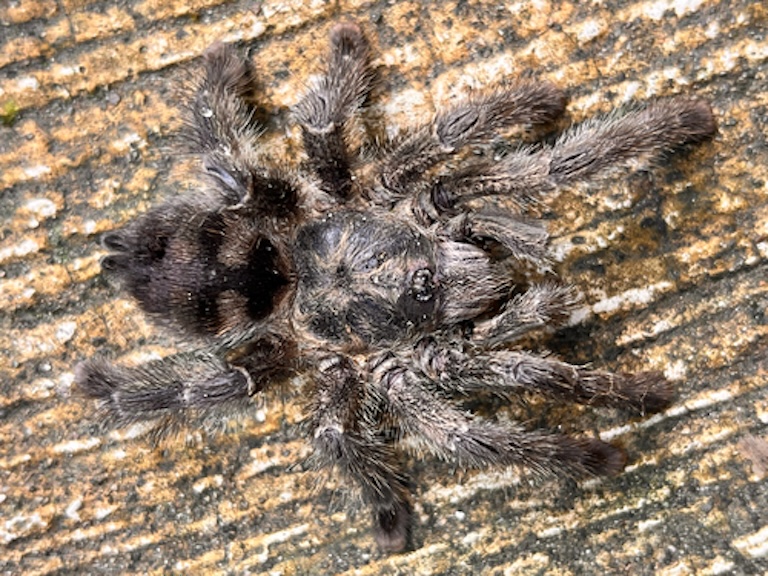
Now, about that fluffiness. It’s not typical for evolution to create something simply for making us humans go “aww”, especially not among arthropods (though baby mammals are designed this way in many aspects), so the cuddly/horrifying appearance of this species of arboreal leaping spider has to come from some other need.
New World tarantula species like this one are well known for releasing annoying hairs that get stuck in your skin and cause irritation, called urticating hairs, but while the purple tree tarantula does have stinging hairs on its abdomen, this species is not fluffy for that reason alone.
It’s not fully understood why some species are quite this bristly, but recent research has suggested that it evolved as a defence against ants. Much like the really fuzzy caterpillars, the purple tree tarantula has a thick fuzz defence against these tiny predators, with whom it shares the trees.
Hairs like this have been shown to provide an impenetrable defence against ants, who in other species were even seen clearing out the mess from the tarantula’s burrow. Army ants are a big deal in the rainforest, and there are few animals on earth as formidable, so this might be a necessity.
Another observation stated that cats and dogs seem to react negatively when sniffing a big fuzzy tarantula, so these hairs could also transmit some kind of glandular scent defence, too.
So, to all spider-loving students out there: this is a brilliant opportunity to contribute to science and get a university to send you to Ecuador at their expense, if you can persuade them! Find out why they’re so cuddly, and then let us know! 1
[6] They’re not listed
It’s also quite hard to find out information on their conservation status, as this species doesn’t appear to be listed on the IUCN Redlist at all.
This suggests another opportunity for research in Ecuador, and would be a case of urgent concern if the species weren’t so widely bred in captivity, as the pet trade can be one of the most devastating to wild populations of animals like this. Fortunately, captive breeding does appear to be straightforward and worldwide, so with any luck, the species is doing quite well, hiding in webbed burrows in bark cervices in the Ecuadorian Amazon. 2
Purple Tree Tarantula Fact-File Summary
Scientific Classification
| Kingdom | Animalia |
| Phylum | Arthropoda |
| Class | Arachnida |
| Order | Aranaea |
| Family | Theraphosidae |
| Genus | Avicularia |
| Species | purpurea |
Fact Sources & References
- (2024), “Tarantulas have surprising partnerships with other species and their hairiness may be a defense mechanism ”,EurekAlert.
- Fukushima (2017), “Avicularia”, Luxe Tarantulas.