
Purple Gallinule Profile
Bird colouration is some of the most diverse in the animal kingdom, and it’s certainly hard to find any animals out of water that can pull off such spectacular visuals. There are blue ones, yellow ones, purple ones, yellow ones, and green ones, and some pick one or two of these colours to mix and match.
Then, there are birds like the purple gallinule, who just tick “Yes” to all of them.
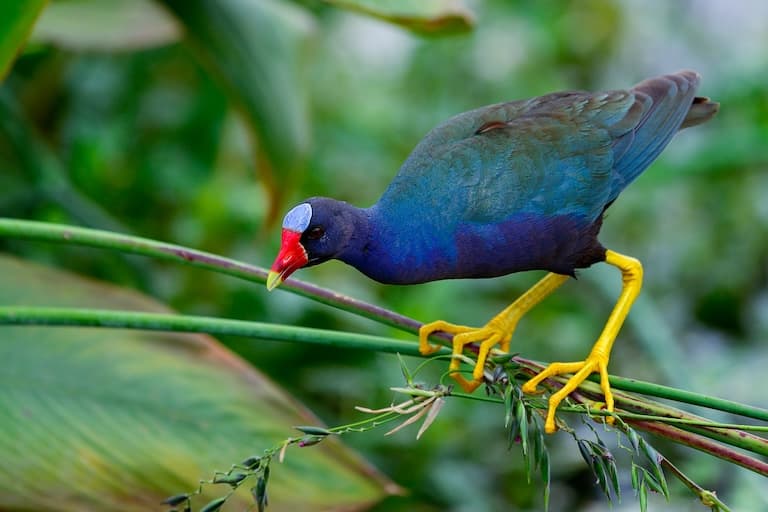
Purple Gallinule Facts Overview
| Habitat: | Semiaquatic, still, freshwater: ponds, rice fields, etc. |
| Location: | Tropical and subtropical Americas |
| Lifespan: | Possibly up to 22 years in captivity, 6 in the wild |
| Size: | 26–37 cm (10–15 in) long |
| Weight: | 257 g (9.1 oz) |
| Colour: | Vibrant, mostly iridescent green and purple, with red and yellow |
| Diet: | Omnivorous: a variety of plant and animal matter |
| Predators: | Snakes, cats, raptors, snapping turtles, alligators |
| Top Speed: | Unknown |
| No. of Species: | 1 |
| Conservation Status: | Least Concern |
Purple gallinules belong to the wonderfully-named swamp hen group of birds, but they don’t subscribe to the subdued, algal colour schemes associated with that name. These are incredibly colourful relatives of the Moorhens, and share their habitats with birds like the jacanas. Unlike many bird species, this one shares its colour between the sexes, and this provides a surprising clue as to their mating and breeding habits.
Interesting Purple Gallinule Facts
1. Purple Swamphens
Gallinules look a lot like the temperate regions’ resident lake dwellers, the moorhens and coots. And there’s a good reason for this.
They’re in the order Gruiformes, which is where coots belong (and cranes, too, interestingly enough). Coots and moorhens belong to the family Rallidae, which they share with gallinules, who are commonly known by a name that would be great for a feminist punk band: the Swamphens.
But unlike the relatively drab image of a moorhen and a coot – and, indeed, the image conjured by the term “swamphens” – these birds are really rather glorious in appearance. As rails, they are water birds, and as tropical birds, they are imbued with the kind of vibrance our overcast societies in the North erased.
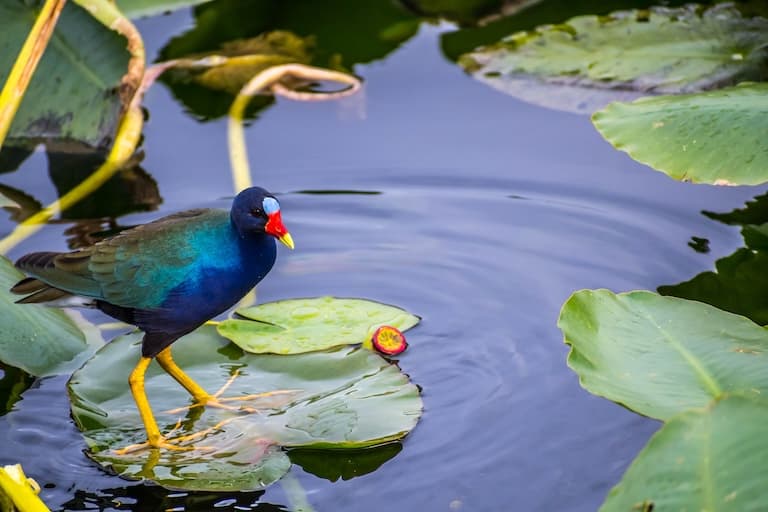
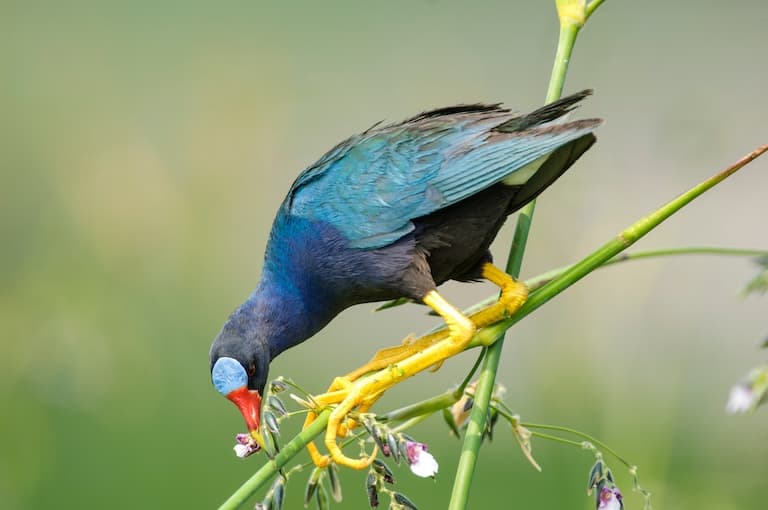
The result is a yellow-legged, purple-breasted, red-nosed, blue-foreheaded, iridescent green-backed bird with a yellow tipped beak, that can more or less walk on water. And it has a little tufty white bum to top all that off with. These are purple swamphens, which are a group of species in the genus Porphyrio.
In many, many bird species, this extravagance would be exclusive to the males, and the female would be a demure, dull brown. But not the purple gallinules! Males and females look more or less alike, and this tells us something about their mating strategies.
2. Sexual Dichromatism
Sexual dimorphism is the sciency word for when an individual of a species looks different depending on whether it’s a male or a female. Humans are sexually dimorphic just a bit, with female humans being smaller on average, and usually smelling a bit better too1.
In other animals, especially birds, dimorphism is often colour-based. Females and males are commonly the same size, but entirely different in their plumage. Peacocks are a good example. This is a subcategory of dimorphism known as dichromatism.
But this isn’t a given for birds, and some are colourful in both sexes. The Purple gallinule is an example of this, and it’s more than just a curious phenomenon, it’s a clue to their lifestyles.
When males are brightly coloured and females are drab, one of the things this signifies is a stark separation of roles in breeding and parenting.
With high dimorphism, the trend is for females to mate with many males. The male’s colouration, then, is a competitive strategy to stand out among the crowd. Males put all their energy into this, and much less, if any, into rearing the young or even helping to build the nest. High dimorphism is also associated with more extra-pair mating; females may socially bond with one male but have flings with more colourful ones to make sure she’s getting the best genes into her eggs.
To add another layer of fascination to this, extra-pair bonding is highest in dimorphic species whose colours are structural – that is, caused by the microstructure of feathers, such as iridescence. When the colour comes from pigment, like in the robin, the association relates to parental care.
Purple gallinules have both structural and pigment-based colouration but very low dimorphism, and this suggests a more equal role in the whole process between the male and female.
3. This tracks with the purple gallinule
Gallinules usually form steady pairs, though some males take more than one mate occasionally. In a few cases, a female will share a mate and even a nest with her daughter, and they’ll raise the chicks together. Unpaired youngsters sometimes stick around and help brood or feed their younger siblings.
So, the roles are less strict in the gallinules, and this begins sooner than nesting, at the mating stage, too.
Purple gallinule courtship happens on foot and either sex can initiate it. When a separated pair comes back together and drifts close, they perform a shared display. After that, one or both birds may strut across the other’s path and give a deep bow as they approach.
Their floating nest is hidden along the shallow edges of lakes, rivers, and marshes and the bonded pair defends the territory, and older juveniles often remain to help rear the next brood2.

4. They walk on water
Like the famous Jesus birds, the Jacanas, gallinules have enormous toes, widely spaced to spread their load over unstable substrate. This substrate is made up of aquatic plants, and so the gallinule can, essentially, walk on water wherever there is enough growth.
This serves two purposes. First, it allows them incredible security from terrestrial predators, who can’t walk on water to get them, and secondly, it brings them into close contact with the eggs of the jacanas.
5. They’re fearless Jacana Hunters
Purple gallinules are omnivores. They will eat plant matter and insects, and 20% of their diet comes from seeds. But they also eat eggs.
And this species is the most common predator of the eggs of the northern jacana, leading to a fierce rivalry between the species.
Adults of the northern jacana will, understandably, attack the gallinules on sight, and try to drive them away. This process is said to be loud and involve swopping and shouting3.
6. They’re doing well
Both the Northen jacana and the purple gallinule have evolved amid this contest, and neither appears to be negatively affecting the other to the overall detriment to its species.
Both are of Least Concern on the IUCN Red List, and the purple gallinule was recently assessed in 2025, estimated to have around 40,000 individuals in a healthy population4.
So, this is a species that’s still doing very well.
Purple Gallinule Fact-File Summary
Scientific Classification
| Kingdom | Animalia |
| Phylum | Chordata |
| Class | Aves |
| Order | Gruiformes |
| Family | Rallidae |
| Genus | Porphyrio |
| Species | martinica |
Fact Sources & References
- Owens & Hartley (Year), “Sexual dimorphism in birds: why are there so many different forms of dimorphism?”, PubMed Central.
- “Common Gallinule ”, Cornell Lab.
- Rutherford (2008), “Jacana spinosa”, Animal Diversity Web.
- (2025), “Purple Gallinule”, The IUCN Red List of Threatened Species.