
Purple Finch Profile
Finches are some of the most famous of songbirds in ecological circles (thanks, Darwin!), yet the vast majority don’t even have “finch” in their name.
There are well over 200 species of these little birds, and their taxonomy is still a work in progress. But in the US, there’s no doubting the purple finch. This is one of North America’s most richly coloured songbirds, a flash of raspberry-red among dark conifers and winter branches.
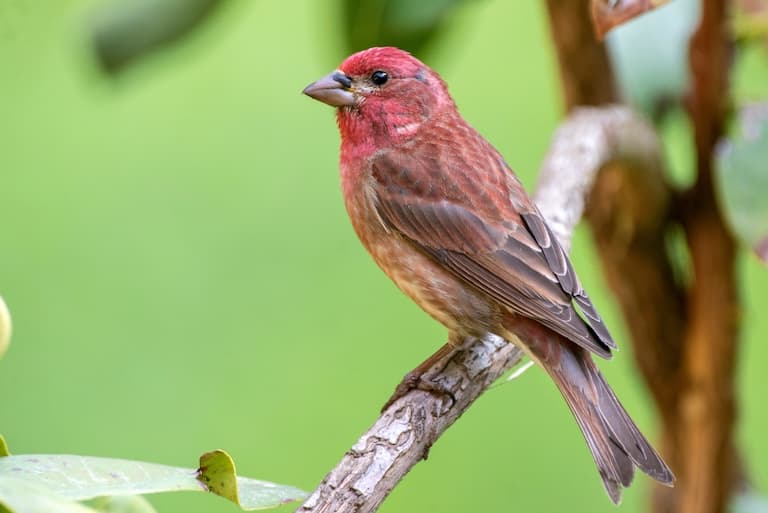
Purple Finch Facts Overview
| Habitat: | Lowland coniferous and mixed forests, some urban |
| Location: | North America |
| Lifespan: | Up to 14 years |
| Size: | 12–16 cm (4.7–6.3 in) |
| Weight: | 19.8–28.4 g (0.7 – 1.0 oz) |
| Colour: | Males are almost all reddish-purple, females are browner with colour concentrated at the head end. |
| Diet: | Seeds, berries and insects |
| Predators: | Corvids, squirrels, raptors, cats and dogs |
| Top Speed: | Unknown |
| No. of Species: | 1 |
| Conservation Status: | Least Concern |
The purple finch is a North American member of the finch family Fringillidae, whose name may echo a mediaeval rhyme.
Now classified in the genus Haemorhous alongside the house and Cassin’s finches, it has had several former scientific names and shows a distinctive horseshoe-shaped distribution across the continent, with both migratory and resident populations. Although it faces competition from the introduced house finch, it remains widespread, can live surprisingly long lives, and periodically erupts when food supplies are abundant.
Interesting Purple Finch Facts
1. Dilly dilly
There’s a centuries-old nursery rhyme about lavender and roses, padded out with a cheerful “Dilly dilly.” Whether this has anything to do with the purple finch is a fascinating musing, but the connection is quite strong.
Finches belong to the family Fringillidae, named after the chaffinch. The root of this name likely traces back to a Proto-Indo-European word, relating to sounds. So, it’s likely onomatopoeic, and could be echoing the birds’ bright, musical calls.
Once you establish that, it’s hard not to imagine a medieval garden thick with roses and lavender, filled with the lilting notes of finches like this one. Could dilly dilly be layered imagery of birdsong over the spoken description of a flower garden?
For the finches as a whole, very possibly! For the purple finch specifically, no.
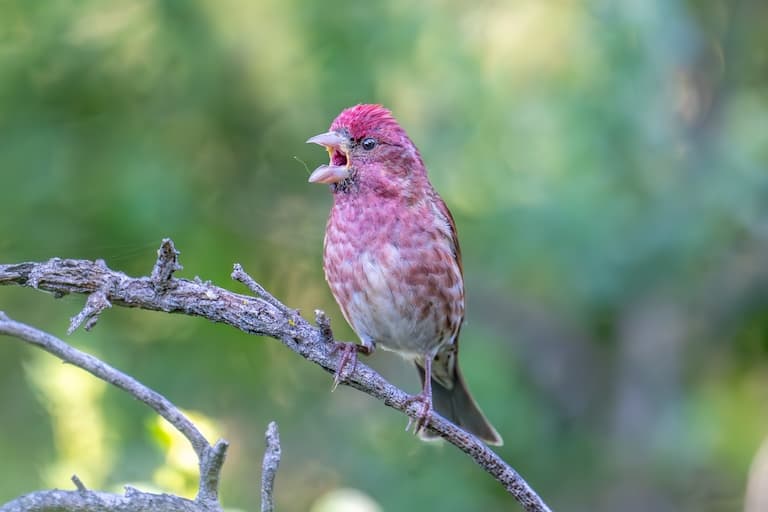
2. They’re American
The Purple finch was likely not the bird that inspired the rhyme, though its cousins in Europe may well have been.
This species is found over much of North America, migrating from Canada down to the East and West edges of the US for the Summer, and has permanent residency around the Great Lakes and the West Coast.
This bird was once listed as a member of the musical Fringilla genus, but has since been moved to a small genus known as the rosefinches, called Haemorhous. There are only two other species in this genus, being the house finch and the Cassin’s finches, and these, as the name suggest, are all a bit pinkish.
Note: This species has a couple of other genus names that refer to the same thing. Burrica purpurea and Carpodacus purpureus both also refer to the purple finch.
3. They have a strange distribution
These little birds are quite wild, and their preferred habitat of coniferous forest keeps them more or less away from urban environments.
This specificity plays a role in their unusual, upturned-horseshoe distribution across North America, but they are also behaviourally diverse, and so there is a mix of sedentary and migratory populations on the continent.
Residents appear to stay put around the Great Lakes region and along the West Coast, all the way down to Mexico. This is the starkest difference within the species, and reflects the two recognised subspecies1.
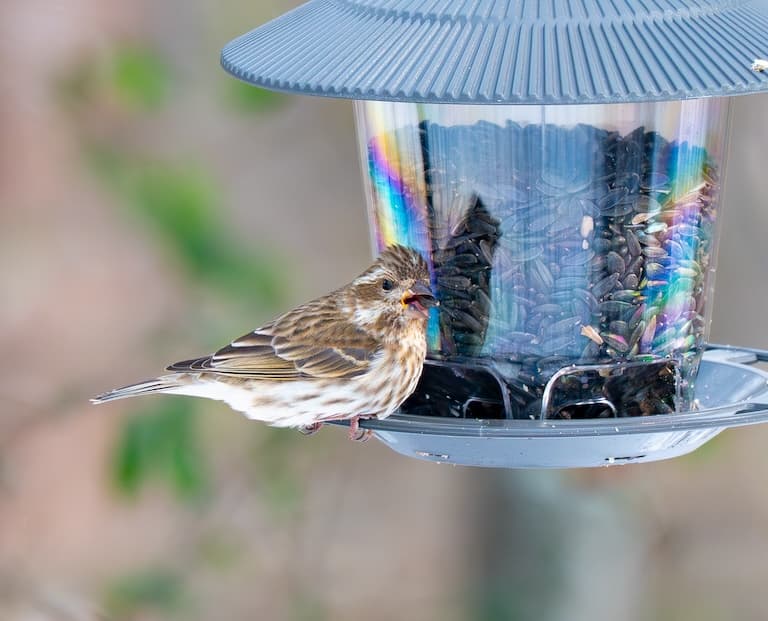
4. They compete with the house finch
The purple finch’s closest relatives in the genus include the house finch, which looks remarkably similar to the purple finch, and indeed is, in enough ways for the two species to ruffle one another’s feathers.
The house finch is native to the West and Mexico, but has been introduced into some of the range of the purple finch and has caused some competition as a result.
Despite being a bit more robust than the house finch, the poor purple finch has been bullied out of its native breeding grounds by this smaller relative, but this pattern doesn’t seem to have been fully explored again since it was identified in the ‘80s, so how they’re doing by now is harder to know2.
5. But they’re winning
The purple finch may have lost some battles in its time, but it’s definitely winning the war. This is a hugely populous species, and even more: it’s on the rise!
By IUCN’s count, there are at least 6.5 million of these little pink birds flitting about in the New World, and counting. It goes without saying, then, that this is a species of least concern, in terms of conservation3.
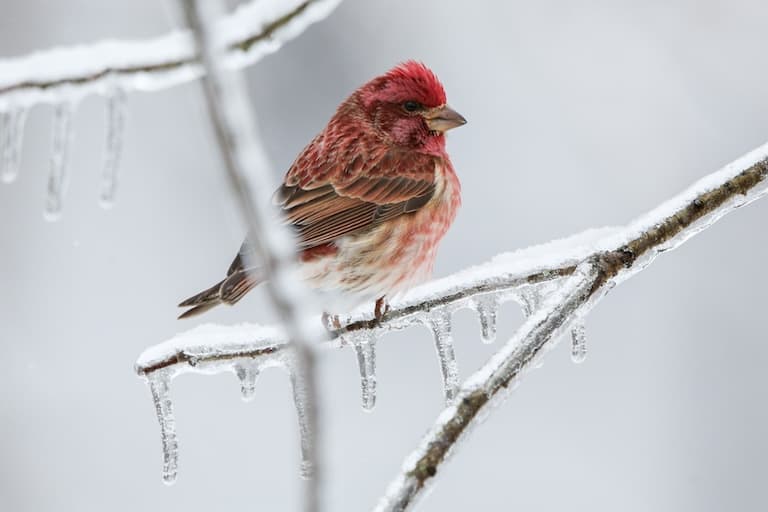
6. They’re long-lived
Some of this success comes from just how tough they are. Purple finches are intelligent, long-lived birds, able to rock on for more than 14 years in the wild, though this is not to be expected.
A life expectancy for this species is in the low single digits, but the fact that they survive for much longer shows how well equipped they are for a hard life.
Aside from the coastal residents, this is primarily a migratory bird, breeding in Southern Canada, flitting very far South for the Winter, and then returning.
But their populations, while on the rise in general, are by no means stable.
7. They erupt
This species is said be one that’s prone to “erupting” when conditions are right. This is the bird equivalent of the “blooms” we see in ocean animals like jellyfish, and is characterised by a sudden surge in their numbers.
Purple finches are gregarious animals, especially during this time, and flocks of 200 or more can be common. It’s thought that these eruptions are caused by yearly climate cycles bringing surges in their food supply and spelling good years for their reproductive success soon afterwards4.
Purple Finch Fact-File Summary
Scientific Classification
| Kingdom | Animalia |
| Phylum | Chordata |
| Class | Aves |
| Order | Passeriformes |
| Family | Fringillidae |
| Genus | Haemorhous |
| Species | purpureus |
Fact Sources & References
- Sterling (2011), “Carpodacus purpureus”, Animal Diversity Web.
- Wootton (1987), “Interspecific competition between introduced house finch populations and two associated passerine species”, Springer Nature Link.
- (2025), “Purple Finch”, The IUCN Red List of Threatened Species 2025.
- Sterling (2011), “Carpodacus purpureus”, Animal Diversity Web.