
Pumpkin Patch Tarantula Profile
So much about tarantulas is known not from the safari-hat-wearing explorers of lost jungle realms but by the beardy, tattoo-clad enthusiasts who keep them as pets. But both of these contributors to knowledge have their own significant contributions, and in Central and South America, there’s a species of spider who’s benefiting from both sides.
Small, cute, and with characteristic genitals, this spider is far less scary than the cabbage patch babies: it’s the Pumpkin Patch Tarantula.
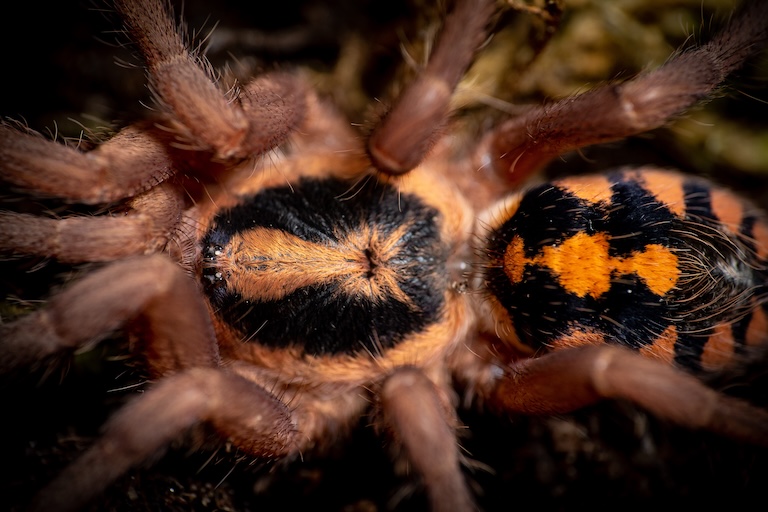
Pumpkin Patch Tarantula Facts Overview
| Habitat: | Terrestrial: warm, humid rainforest environments |
| Location: | Native to Central America and northern South America |
| Lifespan: | Females 8 to 10 years, males 2 to years |
| Size: | 6–10 cm (2.5 to 4 inches) |
| Weight: | Around 30 g |
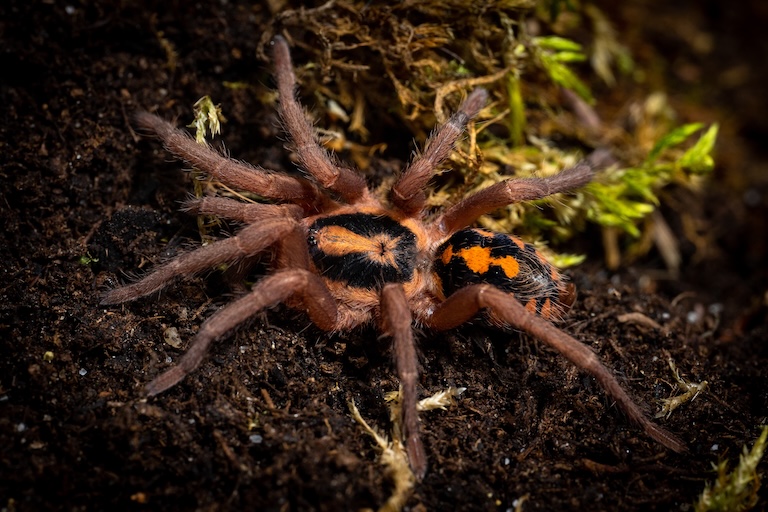
| Colour: | Brown base colour with orange spots and patches |
| Diet: | Smaller invertebrates |
| Predators: | Birds, |
| Top Speed: | Skittish |
| No. of Species: | 1 |
| Conservation Status: | Not Listed |
Pumpkin patch tarantulas don’t live in pumpkin patches. They’re “dwarf tarantulas” in appearance only, but they are true tarantulas, and popular ones at that. These pretty, pumpkin-coloured friends are commonly found in hobbyist set-ups, and are valued for their appearance and docile nature.
But, they’re not strictly beginner spiders – these are fast-moving, skittish and shy tarantulas that grow quickly and reproduce readily in captivity!
Interesting Pumpkin Patch Tarantula Facts
1. They’re New World Tarantulas
Spiders form an order of arachnids known as Araneae. Beneath this, there are over 135 families of spiders, and tarantulas are just one: Theraphosidae.
This single family contains all tarantula species, and there are quite a few of them: likely over 1,200 in around 200 genera. These species are still being identified and new genera are arising, and once you get down to this level, the best way to tell them apart is to look closely at their genitals.
Because evolution works quite separately on genitals than anything else, species that look almost identical will often have stark differences in their love trumpets, and this is precisely how the pumpkin patch tarantula lost a lot of friends in 2024.
New research (into their genitals) has identified at least two interlopers in the pumpkin patch tarantula’s genus and moved them to Notahapalopus and Jambu. But the same people found two new friends to replace them with.
So, as of 2024, the Pumpkin Patch tarantula remains in Hapalopus as the type species, H. formosus.
This is a species found entirely in the New World, specifically in Central America and northern South America, into Brazil. But it is quite different from the stereotypes in a couple of ways.
First, this is no bird-eater. 1
2. They’re dwarves
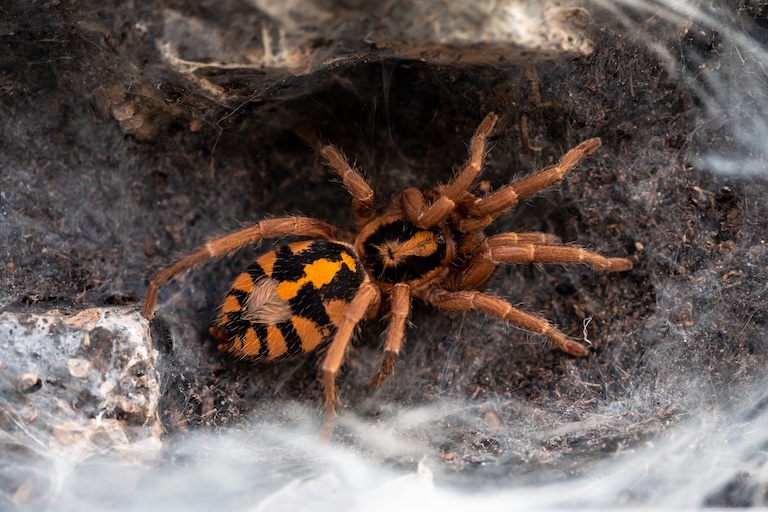
Hapalopus formosus is a very small member of the tarantula family. It’s said to come in two morphs, with the larger being only 10 cm across, and the smaller being around 6 cm in leg span.
Compare this with the infamous 30 cm New World giant, Theraphosa blondi whose body length alone is larger than the entire span of the large pumpkin morph, and you can see that this little pumpkin is a real cutie pie.
This is commonly known as a dwarf species on account of its size.
They share the label with species like the Trinidad Dwarf Tiger, but this isn’t a taxonomic link, only a morphological one, and neither should be confused with the Mecicobothriidae family of spiders known as “dwarf tarantulas” which are not tarantulas at all! 2
3. They’re popular as pets
Being very small and very pretty gets you a long way in certain circles. Tarantulas also benefit from this, and the pumpkin patch is a great example.
Not all species are as lucky as this one, which breeds readily in captivity, grows fast, is low maintenance and hardy. So, there’s very little demand for wild-caught individuals and the native populations can be left to do their thing.
Breeding in this species happens by way of a very short gestation of a month or so, followed by a sac of up to 400 eggs. These hatch into very tiny, very cute babies, often with the same orange colouration as the adults.
So cuteness is in abundance with this species, and even better, they don’t have the same level of irritating hairs that the New World spiders are commonly known for. 3
4. They don’t irritate as much
Tarantulas are loosely grouped into Old World (Eurasia and Africa) and New World (the Americas) species. Both branches separated when South America split from Africa, carrying species off on an isolated journey of over 30 million years to do their thing.
In South America, that thing became growing special hairs called urticating hairs. These are similar in their microstructure to the annoying seeds that get stuck on your soft pants in the summer. Only, they’re tiny enough to get stuck in your eyeball skin and up your nose.
This is a good reason to leave New World tarantulas alone, and that’s not a coincidence – urticating hairs are a fantastic defence for what is a very soft and very vulnerable animal. Spiders typically rub them loose with their legs when they’re upset. Yet, this particular very soft species doesn’t appear to really use them. 4
5. But they can be skittish
By most accounts, this is a good pet species, but with the caveat that they are faster than most beginner tarantulas. Spiderlings – that is, the tiny babies – can bolt out of the gate and disappear under the sofa if you’re not careful, so some suggest this is not the type of spider for an inexperienced keeper.
Being so small and with little in the way of physical defenses, it’s likely that being nimble is how they stay alive. 5
6. Bites are rare
All spiders are venomous, that’s sort of their thing (Ok, almost all – there is a genus of non-venomous orb-weavers, but they’re considered pretentious and aren’t taken seriously).
The question of danger comes down to how much, how strong, and how injectable this venom is. With tarantulas, it’s typically very injectable. They have enormous fangs that pierce downwards rather than across, so act like paired hypodermic needles.
But tarantulas also have very weak venom in general (not a hard and fast rule, don’t sue us), and few are considered medically significant. None are considered lethal, with the exception of allergic reactions and secondary infection risks that come with all spider bites. New World tarantulas are also thought to have generally weaker venoms than the African species, whose bites can be very painful.
The pumpkin patch tarantula is also not inclined to attack. This is said to be a non-aggressive species that prefers to run away. And if it does bite, the venom is said to be mild.
So, being a small dose of relatively weak venom that is unlikely to be administered in the first place, this all makes the pumpkin patch tarantula a very low-risk species. 6
Pumpkin Patch Tarantula Fact-File Summary
Scientific Classification
| Kingdom | Animalia |
| Phylum | Arthropoda |
| Class | Arachnida |
| Order | Araneae |
| Family | Theraphosidae |
| Genus | Hapalopus |
| Species | formosus |
Fact Sources & References
- (2024), “Old Word vs. New World Tarantulas”, Tom’s Big Spiders.
- Tim Surman (2017), “The Pumpkin Patch Tarantula (Hapalopus sp Colombia)”, Ultimate Exotics.
- (2025), “Pumpkin Patch Tarantula”, Tarantula Collective.
- Kaderka et al (2019), “Urticating setae of tarantulas (Araneae: Theraphosidae): Morphology, revision of typology and terminology and implications for taxonomy”, Research Gate.
- Tarantula Collective , “Pumpkin Patch Tarantula (Hapalopus formosus) Care & Husbandry”, YouTube.
- (2015), “A Word about Tarantula Bites”, Tom’s Big Spiders.