
Puli Profile
There are well over 300 internationally-recognised dog breeds, and countless hundreds of common crossbreeds, too. But while it can be tricky to tell apart fox terriers and Cairn terriers, or beared collies from the English sheepdogs, there are some breeds that are so unique you’ll never forget what they look like.
The Puli is one of these. This is a fairly uncommon Hungarian sheepdog that really went more towards sheep than dog when picking its outfit.
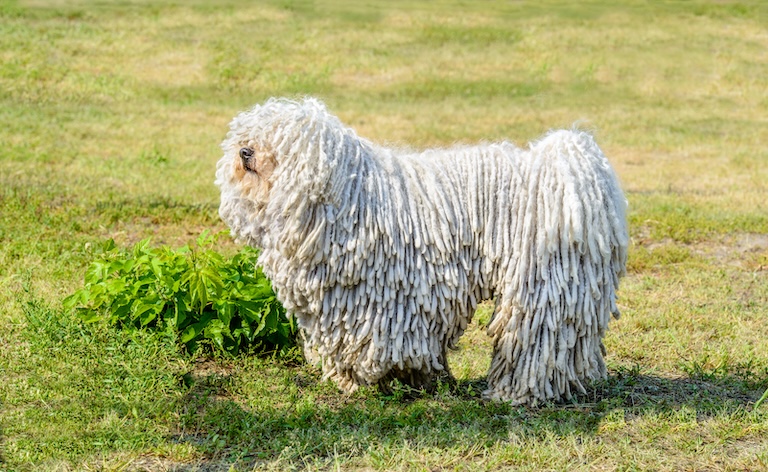
Puli Facts Overview
| Habitat: | Domestic |
| Location: | Worldwide |
| Lifespan: | Up to 16 years |
| Size: | Up to 45 cm (18 inches) at the shoulder |
| Weight: | Up to 15 kg (33 lb) |
| Colour: | Black, White, Brindle, Cream, Silver, or Brown |
| Diet: | Doggy treats |
| Predators: | None |
| Top Speed: | Not fast |
| No. of Species: | 1 |
| Conservation Status: | Not Listed |
Pulis are historic Hungarian working dogs, and like all working dogs, they bring their ancestral intelligence, toughness and intelligence along with them into domestic settings around the world.
But unlike most, they also have an incredible, double-layered, corded coat that makes them stand out among other mid-sized breeds and contributes tremendously to their inherent cuddly nature. It is a healthy and reliable dog, good with other pets and people, but remains high maintenance on account of its high work drive.
Interesting Puli Facts
1. They’re ancient.
Pulis, or pulik in the local pluralistion, are members of the herding dog group, which is a subset of working dog, bred to manage – you guessed it – herds. This could be sheep, cattle, or reindeer, or anything else we feeble bipeds can’t otherwise keep up with.
It seems to be of Asiatic origin, and has been among Hungarian shepherds for at least a thousand years. Within the closely-related group of Puli relatives, there are the larger breeds like the Komondor, which looks like a giant mop; and the South Russian Ovcharka (not the same as the Caucasian Ovcharka, which was apparently bred from Soviet tanks).
Its larger relatives act as livestock guardians, and the Puli itself, also very moplike but far smaller, functions well as a shepherd.
The United Kennel Club recognized this breed officially in 1923, but as stated, it goes much further back, and is still present in the pastoral lands in and around Hungary. 1
2. There were once four types
Fortunately for breed lovers, this one was rescued from near extinction around that time, following several wars in the region, by the Belgian institution, The Fédération Cynologique Internationale, which is “the largest international federation of national kennel clubs and purebred registries”.
They identified three forms of Puli and essentially picked the one they liked the best, identifying the middle-sized Puli as their chosen morph, leaving the large, the small and the miniature to disappear into obscurity.
The remaining puli itself isn’t all that well known outside of the Hungarian region, but it gains popularity for its very memorable appearance. 2
3. They’re curly
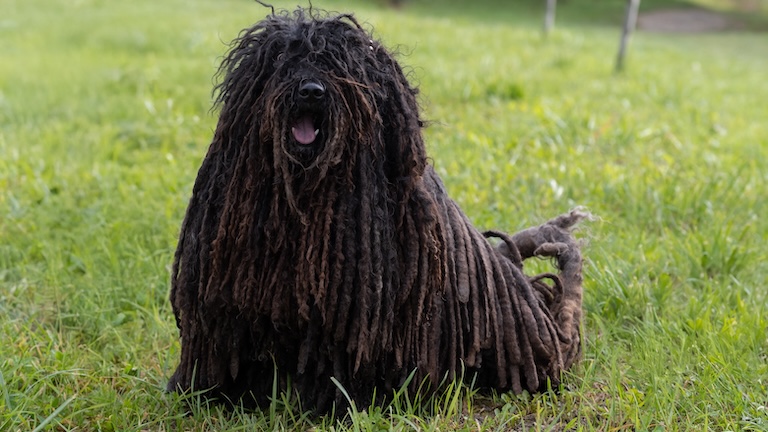
The Puli is a dog whose size and coat are more or less unique in combination. Like the larger “mop dog”, the Komondor, this breed has long, coiled “cords” of fur which seem to serve several, almost conflicting purposes.
The cords are densely wound and woolly, keeping the dog warm, but they’re also discrete enough to allow the skin to cool and breathe when it’s hot.
Some say that the fur allows them to surprise predators like wolves and bears without being spotted prematurely, which applies to the Komondor as well, and may prevent predators from sneaking into the herd at unprotected points.
It certainly does look a lot like the Hungarian sheep, and so this is likely not a coincidence. Thicker cords like this will also make it harder for a wolf to get a solid grip on its throat, too.
So, as much as this looks like a novelty breed, it very much isn’t, and that’s what makes the Puli so healthy. 3
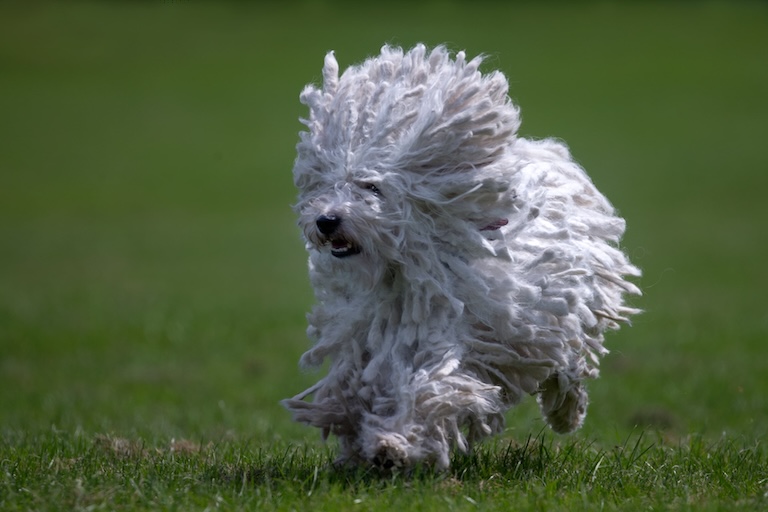
4. They’re pretty healthy.
Purebred dogs are notoriously prone to horrible genetic predispositions on account of their limited gene diversity. Essentially, when you try to maintain a breed to look a certain way, you greatly restrict the animals it reproduces with, and this restricts the genes that get passed around. When this happens, bad genes start to accumulate, and instead of being diluted around the wider population, you end up with diseases and bone issues, or pugs.
This is of huge ethical importance when designing a dog, as it is unconscionable to breed animals to suffer for our benefit, but with many working dog breeds, they are chosen to work, not just to look how we want them to, and so are selected to be as healthy as possible.
So, the puli is one of the healthier of the purebreds, and while it does suffer from a predisposition to him dysplasia, it doesn’t struggle with as many issues as some.
And while they are working dogs, they’re pretty friendly, too, by all accounts.
5. They’re cuddly
The puli is a mid-sized, mop-looking, cuddly animal. Not just in appearance, but in personality, too. Sheep dogs are bred to work in close contact with people, so they’re smart and generally pretty friendly animals, too. They have much less of the suspiciousness of the guardian breeds, and so often make outstanding pets.
Pulik are fluffy balls of cuddly energy, so they suit their fur very well. But being cuddly is not a reason to get a pet, and there are plenty of ways a puli can live a miserable life if not looked after properly.
7. But they can be high maintenance
These are said to be very intelligent dogs, and that’s quite likely, considering their origins as a herding animal. Herding dogs also come with immense stamina and a high need for stimulation, all of which make them fantastic company if you can keep up.
Being cuddly should always be a bonus and never a primary concern in a pet, and if you’re thinking of getting a puli, it’s important to know how to keep them happy, too.
Lots of high-energy, high-cognition tasks will keep a pet puli mentally and physically stimulated and keep your upholstery intact. They are probably not a good breed for an absolute novice, but they do seem to make a fairly strong all-rounder as a pet for those who know how, and have the time to manage dogs.
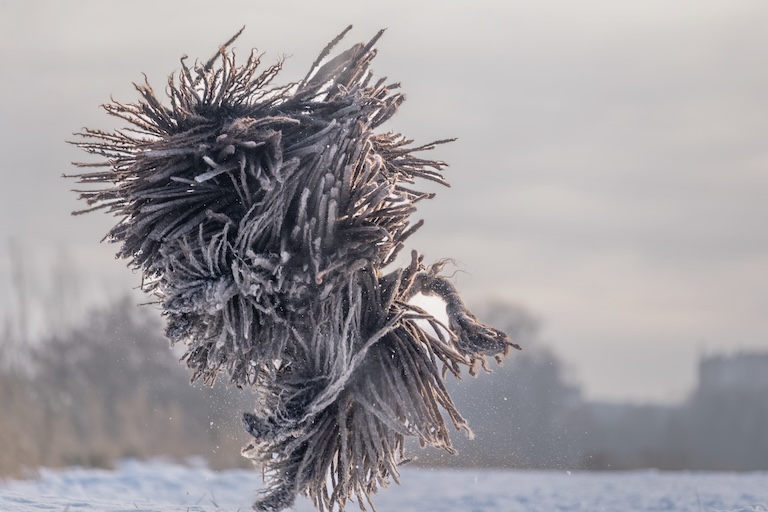
Puli Fact-File Summary
Scientific Classification
| Kingdom | Animalia |
| Phylum | Chordata |
| Class | Mammalia |
| Order | Carnivora |
| Family | Canidae |
| Genus | Canis |
| Species | lupus (familiaris) |
Fact Sources & References
- (1991), “Puli”, United Kennel Club.
- (1996), “Puli ”, Continental Kennel Club.
- NathanBuildsDIY, “Puli dog tricks – my Puli Data is awesome!”, Youtube.