
Puggle Profile
In the 1986 Jim Henson movie Labyrinth, David Bowie continually misnames his dwarfish assistant, Hoggle. Some of the names offered include Hedgewart, Hogwart, Higgle, Hogra, Hogbrain and Repulsive Little Scab.
But little did he know that around the same time, somewhere in Wisconsin, a master of imagination had conjured a moniker so profound, it would put the Hensen legacy to shame. This was the puggle. A small, wrinkle-faced assistant that would have made a fantastic addition to the Goblin kingdom, had it been invented just a few years sooner.

Puggle Facts Overview
| Habitat: | Domestic |
| Location: | Worldwide |
| Lifespan: | 10 to 15 years |
| Size: | Up to 38 cm (15 inches) at the shoulder |
| Weight: | Up to 14 kg (30 lb) |
| Colour: | Usually fawn to tan, with darker muzzles |
| Diet: | Dog food |
| Predators: | None |
| Top Speed: | Moderate |
| No. of Species: | 1 |
| Conservation Status: | Not Listed |
Puggle is a portmanteau of “pug” and “beagle” – two rather different breeds of dog whose combination provides some hybrid vigour and a generally more healthy outcome than either of its parents are.
Puggles have a mix of characteristics that make them very popular as designer pets: they’re small with great noses, dorky personalities and a loyal family drive. And they’re a more ethical way to get some pug in your life.
Interesting Puggle Facts
1. They’re new
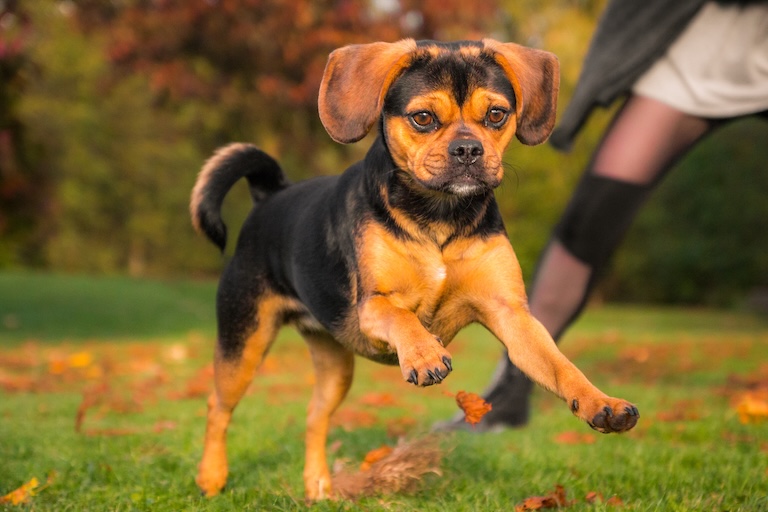
Puggles appear to have happened by accident, sometime in the ’80s. Quite obviously, they result from the sordid and ungodly coupling of two different breeds of dogs: the pug and the beagle. It’s said that a person named Wallace Havens from Wisconsin was the creative genius who came up with the name, but whoever it was, it stuck, and by 2005 they were rated as one of the most popular dog breeds around.
Puggles are typically bred from a male pug and a female beagle, as the beagle is large enough to carry the litter safely.
2. They’re a designer breed
Today, they’re far from an accident and are bred with purpose. This is now considered a designer breed, and one that’s still incredibly popular.
However, since they’re not part of the Kennel Club’s portfolio, they’re not all that restricted in appearance, and there is a decent variety in morphology for the puggle, still. While the first generation puggles come from a female beagle and are more consistent in their appearance, the second generation, stemming from paired puggles, is more variable.
What they tend to be consistent with is the wrinkles and curled tail of the pug, with the longer legs and snout of the beagle. And this latter trait is one of the major reasons a puggle is likely to be better off, health-wise, than a pug. 1
Coat type is strongly affected by which generation the puggle is, so this is something to consider for people allergic to dogs or who just want to avoid too much shedding.
3. They’re healthier than pugs
Beagles and pugs are two purebreds that have a long history, and purebreds are typically reservoirs of genetic defects, to varying degrees, that on average, make them more prone to health problems than a dog whose family tree resembles dropped spaghetti.
Beagles are the healthier of the two breeds, with poor pugs being notorious for their breathing difficulties and other issues caused by their flat faces, but beagles, too, are prone to their own set of conditions, including obesity, ear infections, epilepsy, and hypothyroidism.
So, puggles, being a mix of these two breeds, come with some pretty dodgy stock, but genetic diversity is higher in cross-breeds, and this tends to dilute the problems quite a bit. As such, puggles are, on average, said to be healthier than either of their parent breeds. 2
4. But can still run into issues
Puggles do get their share of health conditions from their parents, though. Most of the things that come up with puggles are directly linked to the genetic abnormalities in their parent breeds, and for the most part, these are less than either.
Puggles are said to sometimes exhibit breathing issues, protruding lower jaws, eye problems and joint issues, as well as skin irritation from the wrinkles inherited from the pug line.
But puggles appear to have a few of their own, too, not present in either of the parent breeds. One such issue is an inflammation of the third eyelid, which is partially present in dogs and spreads sideways across the eye from the snout side. This is called the nictitating membrane and it’s something that’s more prevalent in birds and other reptiles, but in puggles, it can become very red and infected, causing an issue known as “cherry eye”. 3 4
5. They make good pets
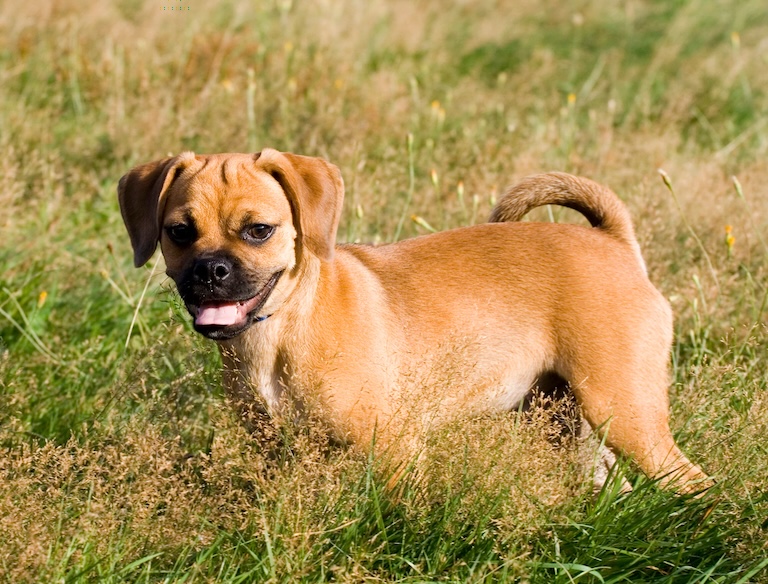
Overall though, a puggle might be the best way to get the cute derpiness of a pug in a body that isn’t completely falling apart. Beagles bring a lot to the table, too, with their sharp senses and strong loyalty, and this seems to rub off on the puggle, who is commonly said to be a strong family member with a lot of character.
Their attitude and goofiness is quite piggish, and they are said to be quite stubborn and highly strung if they aren’t exercised enough, but puggle ownership has a bit of a cult following by now, and they are still immensely popular.
6. Hybrid Vigour
In the wild, hybrids are usually pretty runty things. A pairing between two different species often results in absolutely nothing, but sometimes offspring can emerge. These are usually sterile at best, and often deformed, or otherwise unfit to survive – it’s one of the loose definitions of a species that it can’t readily breed with another species.
But every now and then, two species will breed and the offspring won’t just be free from sterility and deformation – they’ll be better.
This is called hybrid vigour, and in in one study, it showed up in 13% of hybrid cases among mammal species.
In dogs, though, we’re not dealing with inter-species hybridisation. Dogs are all the same species, they’re just bred in funny ways. And when two breeds are crossed, they’re often starting from a pretty dodgy and deformed position, such as the poor pug. So, hybrid vigour is more common, and breeding two types of dog does usually result in a healthier outcome than any purebred.
Mongrels, then, are usually the healthiest, since they have a more diverse gene set. And puggles are somewhere along the way to being mongrels, but not quite.
So, puggles are a product of hybrid vigour for now, but continued inbreeding to recreate the “ideal” puggle will necessarily result in a similar accumulation of deleterious genes that their ancestors have been cursed with. For now, though, puggles are a great way to experience pug (and beagle) energy with a lot less of the tragic wheezing. 5

Puggle Fact-File Summary
Scientific Classification
| Kingdom | Animalia |
| Phylum | Chordata |
| Class | Mammalia |
| Order | Carnivora |
| Family | Canidae |
| Genus | Canis |
| Species | lupus (familiaris) |
Fact Sources & References
- (2020), “Poodles and doodles with their F1, F2, F3, and occasionally a “b”. What does it all mean?”, Puppy Steps Puppy Training.
- Nicole Cosgrove (2025), “Puggle (Beagle & Pug Mix): Info, Pictures, Facts & Traits”, Hepper.
- Sarah Mouton Dowdy (2023), “Puggle”, PetMD.
- Janelle Leeson(2025), “Puggle: Dog Breed Characteristics &Care”,TheSprucePets.
- Adavoudi et al (2021), “Consequences of Hybridization in Mammals: A Systematic Review”, National Library of Medicine.