
Pug Profile
Human selective breeding of animals has provided a full spectrum of creatures, ranging from phenomenal, through questionable and well beyond unconscionable. The pursuit of fashion at the expense of an animal’s health and well-being is definitely on the dark side of the pet breeding industry, and if there could be a mascot for this sort of thing, it may well be the adorable genetic tragedy that is the pug.

Pug Facts Overview
| Habitat: | Domestic |
| Location: | Worldwide |
| Lifespan: | 12 to 15 years |
| Size: | Around 30 cm (1 ft) at the shoulder |
| Weight: | Healthy weight of 6 – 8 kg (14–18 lbs) but can become obese |
| Colour: | Usually fawn brown with a darker muzzle, sometimes completely black |
| Diet: | Dog food |
| Predators: | None |
| Top Speed: | Up to around 16 km/h (10 mph) |
| No. of Species: | 1 |
| Conservation Status: | Not listed |
The pug is the epitome of Marlon Brando’s utterance in the Godfather: “Look how they massacred my boy”. Here’s an animal that began as a wolf, went through centuries of being a charismatic companion to royalty and has ended up as a bug-eyed, wheezy joke of a dog whose entire existence is a testament to human oblivion and the self-absorbed nature of fashion.
It’s one of the unhealthiest breeds of dogs, and that’s really saying something. Bred to be a bundle of energy, joy and mockery, some countries are wising up to the cruelty of all of this and putting restrictions in place around their continued abuse.
Interesting Pug Facts
1. They’re wolves
Being domestic dogs, pugs are the exact same species as the grey wolf. Dogs are considered by many to be a subspecies known as Canis lupus familiaris. Some contest this and suggest that dogs may now qualify as their own species, Canis familiaris, but either way, they are the closest living relatives to the wild grey wolf populations.
So how did we go from Akela in jungle book to Frank in Men in Black? Well, with lots and lots of selective breeding. For pugs, it appears as though breeders selected the runts of the litter for ten thousand generations, but there’s a little more to it than that, as we’ll discuss.
What has happened, especially more recently, is that the image of this breed of dog has been

2. They’re derpy
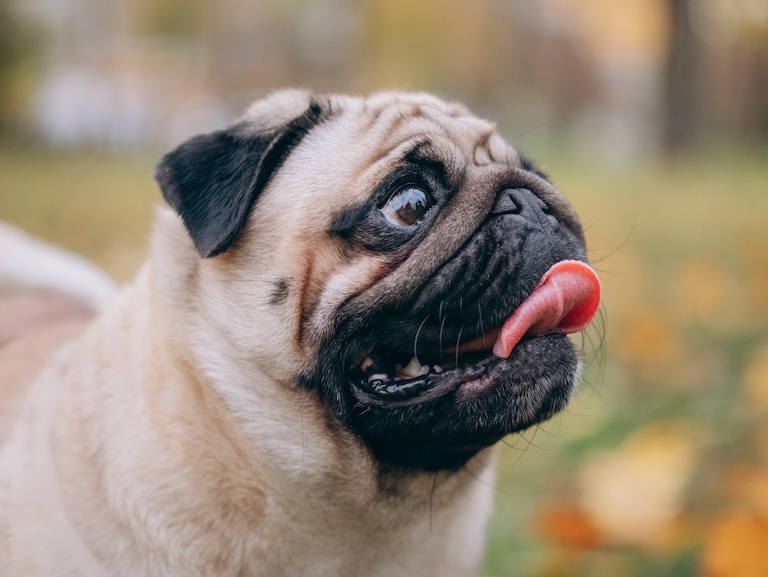
Pugs are notoriously silly animals; it’s one of their main draws. They’re small, they have flat faces, their teeth often jut out and they’re not the most scholarly of dog breeds. They have eyes that can be bulging out of their heads and seem to point in two different directions.
But a healthy pug has a lot of energy! And they have a long reputation as being small dogs with a lot of character. In recent centuries, they have been bred as compact companion animals and fashion accessories, and this is what has caused their exaggerated and strange appearance, but they were once far more handsome and respectable animals.
3. But they weren’t always this way
Pugs seem to have originated in China, where they were the comfort animals of emperors as far back as 400 BC. They were fashion accessories then, too, but healthier ones, with longer legs, longer faces, and fewer embarrassing YouTube compilations of them in hilarious distress.
Queen Victoria picked up the trend for Britain during her reign. 19th Century pugs were still handsome little devils, still long-legged and while the muzzles may have been getting shorter, they were still looking pretty healthy and dog-like.
So, it was relatively recently that the pug became what it is today, and as it moved from a long, lean, dapper little fellow to the compact, bulgy, short-mouthed breed that we’re familiar with, it unfortunately became quite a lot less reliable, biologically. 1
4. They can be very unhealthy
Pugs, like all purebred dogs, tend to have more health complications than mongrels simply by way of a more limited gene pool. But on top of this, they have their own set of ailments directly predisposed to them by their “design”.
As their faces got shorter, their breathing apparatus did, too, and much of this apparatus is there to protect them from infections from the air. So, pugs are more prone to these infections. But even the manual act of breathing can be a struggle, and if things aren’t aligned up perfectly from birth, their own tissues can get in the way. Pugs are 54 times more likely to suffer from severe breathing diseases than average, including Brachycephalic Obstructive Airway Syndrome (BOAS).
Their wrinkled skin harbours bacteria, too, and so pugs are at higher risk of skin infections. They also get fat quite easily, and while it’s common for people to find this cute, it is a form of socially-acceptable animal abuse, given that owners control pretty much all the calories a dog takes in (some sneaky cupboard raids excluded).
Pugs are far less likely to get heart murmurs or exhibit aggression, though, which is quite nice. Unfortunately, for pugs, their overall condition is, on average, poor when compared with other breeds. This could be dismissed as a sad fact of life if it weren’t for the fact that they are being deliberately bred this way. 2
5. Some say they should be banned
There’s nothing inherently wrong with having a disability. And looking after a dog who struggles to breathe, think straight, and/or eat properly, might well be a virtuous act. But only if these conditions aren’t deliberately created by breeders appealing to a market of people willing to do so.
The fact that pug breeding selects for these dangerous physical characteristics in the first place makes the practice inherently unethical, and for every “healthy” pug, there are plenty in the litter who aren’t.
Pug lovers rightfully point to how cute and sappy these little dogs are – and, of course, to the exceptions in which a happy pug can live for up to 15 years – but critics of the breeding of pugs would argue that this superficial appeal is not enough to justify the countless animals whose suffering is a product of their continued breeding.
There is, unquestionably, a lot of cruelty involved in animal breeding in general, but when unhealthy animals are the end goal, and not simply an opportunity cost, it’s hard to justify their existence merely because they’re cute.
Very short snouts are inherently unhealthy, and as such, countries like the Netherlands have banned pug breeding and are even going as far as to consider banning pet breeds like pugs, or hairless cars, whose desired appearance causes them to suffer in life.
This is a great step towards highlighting the personhood of our pets, and hopefully moving away from treating them as fashion accessories. 3
6. They make good pets
Pugs have always been good as companion animals. They’re intuitive, relatively non-aggressive and have bundles of personality. These are all characteristics that make us happy.
And more than this, they can be healthy. Likewise, we occasionally get a centenarian who’s smoked a pack a day since Neville Chamberlain resigned, but we shouldn’t be pointing to exceptions to excuse bad practices.
Still, pugs are great company and very cute animals, so rescuing one from a shelter might be one of the kindest things you could do, and wouldn’t contribute to the demand for more pug breeding. 4

Pug Fact-File Summary
Scientific Classification
| Kingdom | Animalia |
| Phylum | Chordata |
| Class | Mammalia |
| Order | Carnivora |
| Family | Canidae |
| Genus | Canis |
| Species | lupus familiaris |
Fact Sources & References
- , “19th century Pugs, 1. Paintings”, Pug Dog Passion.
- (2022), “New research shows Pugs have high health risks and can no longer be considered a ‘typical dog’ from a health perspective”, Royal Veterinary College.
- Alessandra Pacelli (2023), “The Dutch ban on flat faced dogs: what it’s all about”, DogsToday.
- (2022), “New research shows Pugs have high health risks and can no longer be considered a ‘typical dog’ from a health perspective”, Royal Veterinary College.