
Pudu Profile
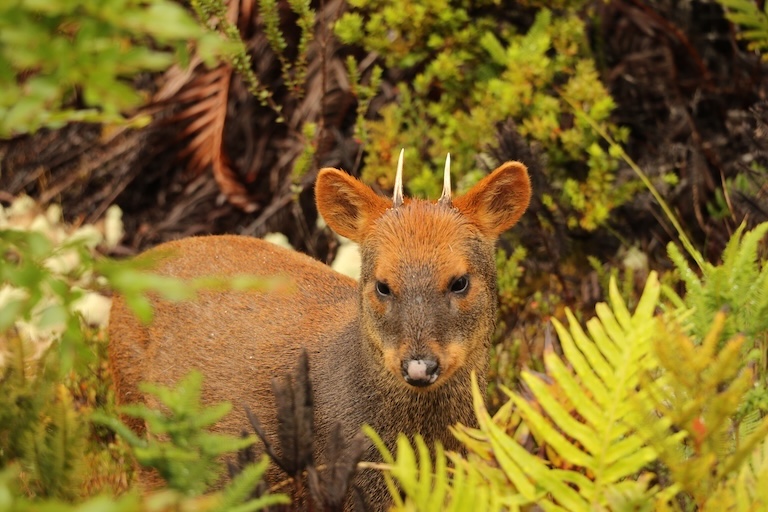
Deer have colonised almost all land outside of Africa. They range from the Alaskan moose, which has been known to top 800 kg in mass, to the northern Pudu, the smallest deer in the world. This tiny deer has evaded researchers by being small, solitary, nimble and altogether harder to access than some of thre more exciting species in its South American range.

Pudu Facts Overview
| Habitat: | Humid temperate rainforests |
| Location: | Chile and southwestern Argentina |
| Lifespan: | 10 years in the wild, 18 in captivity |
| Size: | Top out at 44 cm (17 inches) tall at the shoulder |
| Weight: | up to 13.4 kg (30 lb) in the larger species, and 6 kg (13 lb) in the smaller |
| Colour: | Fawn |
| Diet: | Generalist omnivore: leaves, roots, tubers, fungi, bark, seeds, fruits |
| Predators: | Pumas, foxes, spotted cats, kod-kods, humans and dogs |
| Top Speed: | Undefined but capable of bursts of high speed |
| No. of Species: | 2 |
| Conservation Status: | Near Threatened and Data Deficient |
Little is known about the pudu, other than that one species is the smallest deer on record. The rest is inferred by woefully outdated research papers, DNA studies, and what we know about other, similar animals.
There are two known species: the northern pudu lives at high altitude, and the southern pudu prefers to stay well below the snow line. Other than that, this is a genus of mystery deer that deserves more focus among zoologists!
Interesting Pudu Facts
1. They’re Related to Reindeer
Around two million years ago, a group of deer evolved in Greenland that were basal to many of the modern species of deer around the world today. These deer would descend to become the modern day Rangifer reindeer, and reindeer are now the earliest members of this group.
All true deer are in the Cervidae family, but this subfamily, the Odocoileinae, is quite a diverse lot that includes the reindeer, roe deer, water deer, and even the moose.
And this is where we find the pudu, as well. And in contrast with the moose, which is the largest deer currently on the planet, the pudu is the smallest!

2. They’re small
The chevrotains, or mouse-deer, are commonly handed the tiny crown for being the smallest deer, but they are not true deer, and occupy a unique spot in their own infraorder of ungulates that diverged from the true deer quite some time back.
So, among the true deer, the Northern Pudu gets the title. This little guy grows to a maximum. of 35 cm tall at the shoulder and no more than around 6 kg in weight. It’s lighter than your average Jack Russell, about a third of the weight of the burger-sized muntjac, and still less than half the size of a petite yet terrifyingly fanged water deer.
So, the Northern pudu is a very small deer! In fact, the smallest true deer known. But it’s not the only pudu. 1
3. There are two of them
The Northern pudu gets first mention, but it’s not alone in the genus, which it shares it with the predictably-named Southern pudu, who is just a little bit bigger. The northern pudu occupies higher altitudes, too – up to 4,000 metres – whereas the southern pudu gets a bit tired and chilly anywhere above 1,700 m up.
The southern pudu likes primary and secondary forest, as well as bamboo thickets, and this brings them into competition with the human populations, but the details and intricacies of this relationship are yet to be understood. This is, in part, because puds are hard to find. 2
4. They’re elusive.
Being small, brown and solitary, the chances of spotting a pudu in the forest are slim, at best. On top of this, they’re mostly active during periods in which we are mostly blind: at night.
They are occasionally found in small groups of up to three, but are usually on their own. They are very wary, very anxious and territorial animals who will hide and flee before they can be reliably logged by any damp behaviourist with a clipboard.
And this is a problem not only for the behaviourists, but for the pudu too, who, in doing what the pudu do, make it hard to know how to protect them. 3
5. Data Deficient
The southern pudu is thought to have enough data behind it to be able to establish it as Near Threatened, at least according to the IUCN. That’s not the worst ranking, but it’s a sign that habitat fragmentation is likely creeping into its realm.
The northern pudu, on the other hand, may well have similar challenges to its survival, but the elusive nature of this animal and the higher altitudes it occupies mean there isn’t enough data to know for sure.
Pudu studies are few and far-between, and cloud forests, humid grasslands and other spectacular habitats are often the location of more charismatic species that are easier to catch in a net or on a trail cam. So, there’s a vacuum of information right there for any aspiring researchers to take on! 4
6. This can cause problems to the puma populations
Across the range of the southern pudu, which is known to be in decline, its reduction is having a cascade of effects, most noticeably on the puma populations. Pumas down there subsist primarily on the pudu, as it’s just the right mix of bite-sized and delicious to a puma.
So not only does the reduction in pudu cause a reduction in puma, the remaining cats shift to other prey sources and start causing their own destructive effects on the populations around them. 5
7. They may be vertical migrants
What is available in terms of research on southern pudus seems to suggest they might prefer living close to water. There’s also a paper from all the way back in 1982 that suggests populations of southern pudu living at the higher end of their altitude range might migrate to lower altitudes during the winter to occupy warmer valleys.
This would be critical information for their conservation, and the fact that we’re citing papers from over 45 years ago shows how little there is to go on for this deer. Another suggestion is that the consistent snow cover in pudu land above 2,000 metres is one of the reasons it stays at altitudes below this, and again, this is quite important information relevant to its conservation.
If climate change alters the snow line, we could see the two species interacting where they haven’t before. Whether this results in competition or hybridisation, or any number of other outcomes, good or bad for the species, is still a mystery!
It could be that it creates more habitat for the species, 6
8. Their habitats are fragmented
One thing seems certain: the pudu’s range is being restricted.
This is not something gleaned from geographical scans, but from genetic ones! DNA studies on the southern pudu in Chile show that different populations of the same species are exhibiting quite different markers, and this shows that they are not coming together to mate and pass these markers evenly between one another.
This is a sure sign of habitat fragmentation, and adds a layer of concern to the conservation issue, as the species may have a wide range, but if populations aren’t able to mix, they are still restricted and could be in trouble.
Habitat fragmentation makes each population more vulnerable than the whole, and this is something very serious to consider going forward. 7

Pudu Fact-File Summary
Scientific Classification
| Kingdom | Animalia |
| Phylum | Chordata |
| Class | Mammalia |
| Order | Artiodactyla |
| Family | Cervidae |
| Genus | Pudu |
| Species | pudu and mephistophiles |
Fact Sources & References
- , “Pudu”, Chester Zoo .
- Rodríguez et al (2016), “Southern Pudu”,IUCN Red List.
- (2016), “Southern Pudu”, IUCN Red List.
- Barrio et al (2018), “Northern Pudu”, IUCN Red List.
- Meagan Robidoux (2014), “Pudu puda”, Animal Diversity Web.
- Jaime E. Jiménez (2010), “Southern Pudu Pudu puda”, Research Gate.
- Colihueque (2022), “Genetic divergence and demography of pudu deer (Pudu puda) in five provinces of southern Chile, analyzed through latitudinal and longitudinal ranges”, Neotropical Biology and Conservation .