
Procoptodon Profile
Kangaroos are already pretty weird, but what we see today is the loose end of hundreds of thousands of years of kangaroo evolutionary experiments.
Over the course of their existence, they have climbed, burrowed, swum, and – of course – hopped across Australia. And it looks as though, in at least one instance, they might have walked. Procoptodon was a genus of experimental kangaroos that tried multiple things not seen in any other branch. And some of them got huge!
Procoptodon Facts Overview
| Habitat: | Moist forest, possibly near water. |
| Location: | Southern Australia |
| Lifespan: | Unknown |
| Size: | Up to 2.7 metres |
| Weight: | Possibly over 250 kg |
| Colour: | Unknown |
| Diet: | Roughage, low quality, saltbushes |
| Predators: | Marsupial lions, thylacines and other marsupial predators |
| Top Speed: | Unknown |
| No. of Species: | 8+ so far recognised |
| Conservation Status: | Extinct |
Procoptodon was a short-faced, salt-eating, fat-arsed ‘roo with a penchant for grinding its teeth into grasses and saltbush.
This was a genus of remarkably diverse and fascinating macropods with lots left for us to discover, but unfortunately there are none around today to ask.
Interesting Procoptodon Facts
1. They were Pleistocene Kangaroos
The fauna of Pleistocene Australia was as outrageous as Australian fauna still is, multiplied by how outrageous Pleistocene fauna was in general. There were two-tonne monitor lizards bigger than any Komodo dragon, three-tonne wombats and armoured Nintendo-esque turtles with dragon horns on their heads. And that’s just a sprinkling of a few highlights!
Among these mythical beasts were kangaroos, some of which are still around today, such as the Eastern Gray, Macropus giganteus. All modern kangaroos, wallabies and their weird intermediates like the wallaroos, are contained in the subfamily Macropodinae.
But Procoptodon and its relatives belonged to a different subfamily entirely, known as the Sthenurinae. And this branch of now-extinct kangaroos was probably just as diverse, if not moreso, than modern ‘roos.
2. They were Diverse
There are around 12 recognised species in the Procoptodon genus alone, all very dead, and this goes to show how much diversity you can expect from a genus – fossils represent a small fraction of what was once there, so it’s a reasonable assumption that there would have been many more, and perhaps there are many more to discover over time.
The Sthenurinae subfamily as a whole contains around 8 genera so far, and Procoptodon is just one of these, but the Procoptodon genus contains both the smallest and the largest of the Sthenurinae subfamily.
Procoptodon gilli is the smallest species known from this genus, thought to have been about the size of a wallaby, at around a metre tall.
But at the other end of the spectrum was not only the largest Sthenurinae kangaroo, but the largest macropod ever known: Procoptodon goliah.
3. They were enormous
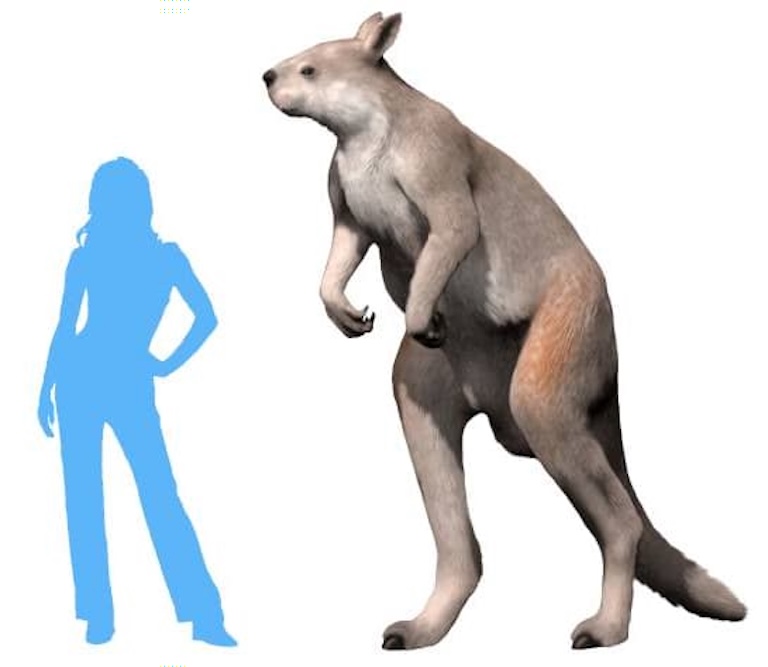
The largest member of the Procoptodon genus, P. goliah, was an absolute monster. This was a 250kg kangaroo that stood almost three metres tall.
And what a beast! This kangaroo was so large and heavy that it’s speculated to have been incapable of doing what kangaroos are known to do so well: hop.
Hopping is one of the most efficient forms of locomotion over long distances, but it’s limited by the material properties of tendons, and the more weight involved, the more strain is required. So, it’s possible that P. goliah couldn’t hop, and would instead have walked.
Another clue to this form of locomotion comes from the bakery section, the largest macropod was carrying around behind it. 1
4. They had junk in the trunk
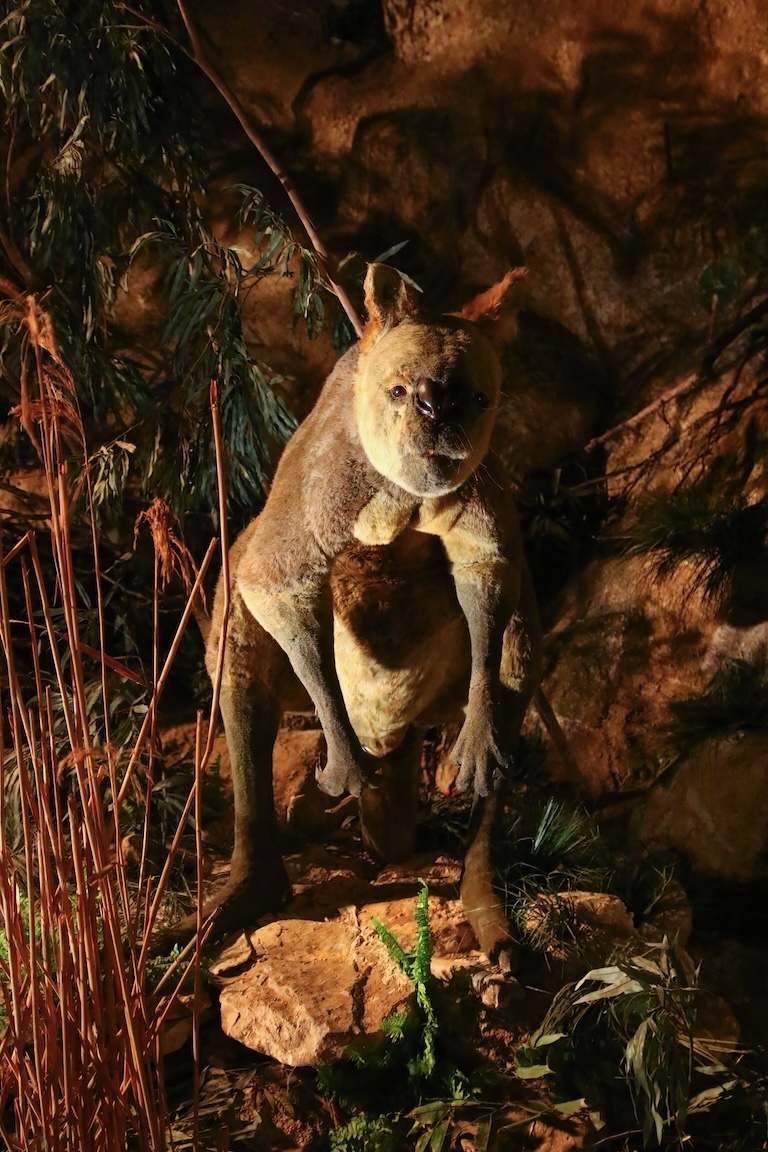
Bones of P. goliah show that it had wide hips, thick ankle joints and a lot of muscle attachment surfaces at the rear. In technical terms, it was bootilicious. Humans (some more than others) have very similar adaptations at their back ends for the same reason. These are adaptations to bipedal walking.
So, the largest macropod may have moved quite similarly to a human, making it look like a person in a kangaroo suit. And the lack of a snout would have further enhanced this illusion. 2
5. They were short-faced
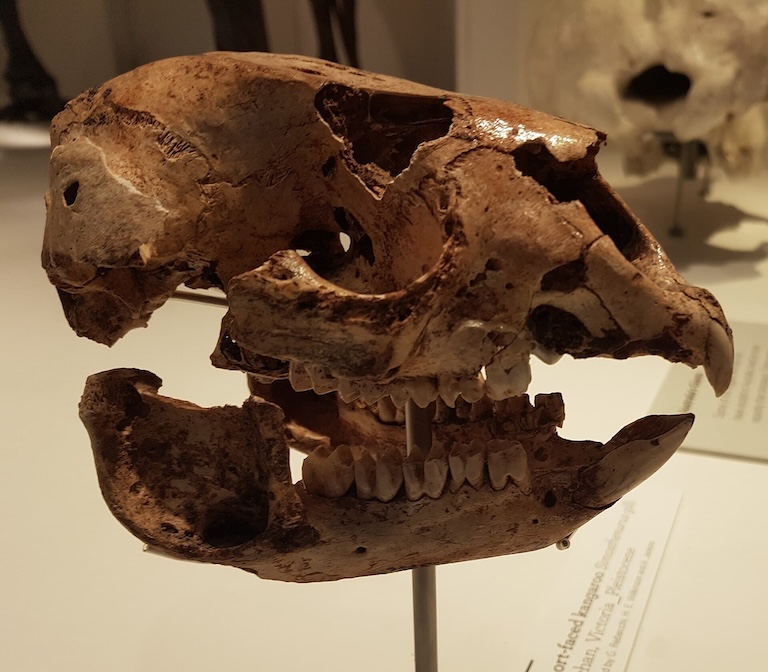
Another name for the Sthenurine subfamily of kangaroos is the “Short-faced” kangaroos. This is pretty self-explanatory, but very unusual for a kangaroo.
Short faces are generally associated with a stronger bite force, as we see in different breeds of dogs, cats or hyenas. In herbivores, it is more commonly found in animals that eat very rough food, and so Procoptodon probably had to gnaw on bark and other low-quality plant sources that were hard to chew.
6. They took in a lot of salt
The teeth of P. goliah indicate that it had a tremendous ability to break down leafy and rough fodder and could have fed on grasses. As the climate shifted into the Pleistocene, this would have changed to more dry vegetation, and studies also suggest that there was a large amount of salt in this animal’s diet.
The mosaic of various habitats across its range perhaps led to it needing to traverse great distances in search of new food, but the high salt intake would likely have required it to stay close to water.
7. Humans might have wiped them out
A lot of things died at the end of the Pleistocene. Until very recently, the humans investigated themselves and found no wrongdoing, but that narrative is shifting. It’s very coincidental that the moment our species arrived on every landmass throughout history, the large animals began to leave, and Procoptodon is one such example.
Perhaps its lumbering, bipedal gait made it easy to catch, though there is no fossil evidence of human predation upon them yet.
Another cause of their extinction could have come from a change in habitat, where the faster, hopping ‘roos were able to thrive across longer distances and on a wider variety of foods, than the slower, more specialised grazers.
Either way, Procoptodon, along with all other of the short-faced kangaroo genera, went extinct. It seems that they were well on their way by 40,000 years ago, and perhaps a dwindling few held out until 18,000 years ago, but today, there are none left.
Procoptodon Fact-File Summary
Scientific Classification
| Kingdom | Animalia |
| Phylum | Chordata |
| Class | Mammalia |
| Order | Diprotodontia |
| Family | Macropodidae |
| Genus | Procoptodon |
| Species | 8 to 12 species |
Fact Sources & References
- McGowan (2008), “Hind limb scaling of kangaroos and wallabies (superfamily Macropodoidea): implications for hopping performance, safety factor and elastic savings”, National Library of Medicine.
- Karl Gruber (2014), “Giant prehistoric kangaroos walked, not hopped”, Australian Geographic.