
Prawn Profile
With names like Giant Tiger, King, and Vampire, you’d expect this group of animals to have a better status in the social consciousness.
This is a delegation of delectable Devonian decapods, who have spanned over half a billion years only to be relegated to the frozen isle of the supermarket. Well, not any more! Today, we’re talking all things Prawn.
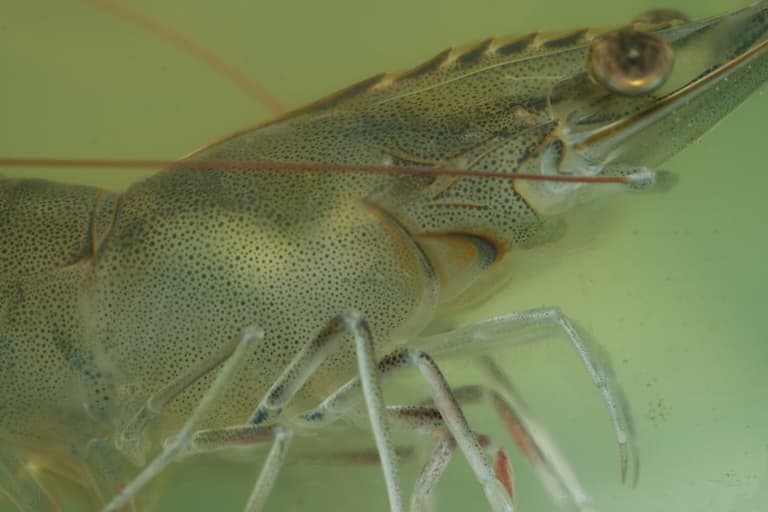
Prawn Facts Overview
| Habitat: | Marine and freshwater systems |
| Location: | Worldwide |
| Lifespan: | Many live for around one year, some live for 5+ years |
| Size: | Up to 30 cm (12 in) in largest species |
| Weight: | Up to 450 g (1 lb) in largest species |
| Colour: | Variable, often clear or opaque grey. Sometimes red, sometimes blue, striped |
| Diet: | Algae, smaller animals |
| Predators: | Basically everything |
| Top Speed: | Often planktonic or slow moving, but some can snap their limbs faster than almost anything else in the animal kingdom |
| No. of Species: | 540 + |
| Conservation Status: | Most listed are Least Concern |
Prawns are some of the most disregarded animals on the planet. They’re diverse, widespread, communicate with sound and visuals, and they are one of the largest sources of nutrients in the ocean. But as we start to unravel the secret lives and minds of marine crustaceans, we are also uncovering something very sinister with it: our relentless harvesting of food from the ocean is one of the most potent sources of ecological damage there is.
Interesting Prawn Facts
1. Is a shrimp a prawn?
Crustaceans are an immense clade of arthropods, particularly with the relatively recent addition of insects to their ranks, which is a hypothesis that’s headed towards a consensus as of the 2010s.
While insects are the largest class of crustaceans in the world, they have failed to dominate the oceans, and in the water it’s the Malacostraca who rule. There are 40,000 or so described species in this class, in 16 orders, and they contain all the lobsters, crabs, krill, isopods, amphipods and so on that we commonly consider crustaceans. This includes prawns!
The order Decapoda, meaning ten-footed, contains the classic familiar crustaceans: lobsters, crayfish, prawns and shrimp, but the words prawn and shrimp are commonly used interchangeably.
Prawn is traditionally the common name for various unrelated animals in this class of crustaceans, defined by a sort of elongated appearance.
One step down the taxonomic ladder, we come to Dendrobranchiata, a suborder of decapods, and probably the closest thing we’ll get to a taxonomic ranking of prawns. And if we go by this ranking, it does separate prawns from “true” shrimp, who form a suborder called Caridea.
But even with true shrimp and true prawns representing their own suborders, there are many other animals outside of both suborders that are commonly called either prawn or shrimp or both. So, whether you consider a shrimp to be a prawn, much like whether you consider a tomato to be a berry or a vegetable, depends on whether you’re talking food or biology.
In this blog, we’ll cover some of the 540+ species of “true” prawns in the suborder Dendrobranchiata. And there’s plenty to cover!

2. They can be enormous
Confusingly, the Asian tiger shrimp is a taxonomically prawn, and what a prawn it is!
Females can grow to more than a foot (33 cm) long and weigh over 450 grams (16 oz). As the name suggests, these originate in Asia, specifically, Southeast Asia, around the Philippines, but they have been introduced to American waters and can now be found there, maturing in lagoons and coastal estuaries and burrowing into sandy or muddy beds during the day.
These are more predatory prawns than the native species they share their new homes with, which may or may not prove a problem. On one hand, this might keep them out of direct competition with the native detritivores; on the other, they may end up eating some of the locals1.

3. They can probably see you
One of the coolest features on a prawn are the eyes on stalks that stick out of their heads. These may look simple, but research is slowly unravelling just how incredible these eyes can be. In fact, prawns, shrimp and their kin are now considered to have among the most complex visual systems in the world.
Mantis shrimp, which are neither true shrimp nor true prawns, are the most commonly studied in this regard, but it’s thought that this exceptional vision has some spillover into their relatives, especially those who inhabit clear, well-lit waters.
So, chances are, when you’re looking at the face of a prawn, it’s looking right back at you. Unless, of course, it’s a farmed prawn, as these often have their eye stalks pinched off in a miserable process called eye stalk ablation, which is said to make them breed faster.
With the ever-developing understanding that lobsters and crabs likely experience pain, this may well emerge as one of the most brutal practices in agriculture2.
4. They’re loud
Another thing our species has been woefully slow on the uptake of is the understanding of just how important sound is to animals in the ocean.
Prawns, as well as pretty much everything else in the sea, respond to, produce, and communicate with sound, which makes our use of noisy ships and boats quite disruptive to their lifestyles3.
Again, it’s a non-prawn, non-shrimp that’s responsible for a lot of the literature on this – the mantis shrimp snaps its claws so fast it is one of the loudest animals in the sea, and prawns, likewise, contribute to the cacophony of clicks and ticks and knocks in the reef and beyond, all of which serve a purpose.
Prawns have also been shown to express more stress proteins after exposure to 30 minutes of boat sounds, suggesting that it’s a very upsetting experience for them!4
5. They’re diverse
It’s hard to state any sweeping generalisations about a group of animals with such diversity. Sure, all prawns are naturally wet, but there is a huge range of ecological positions that these animals can occupy.
As we touched on earlier, some are predators. Others are detritivores, meaning they sift through the mud looking for scraps.
Most are purely marine animals, but some also live in freshwater. There are lots of prawns in rockpools, but there are plenty in deep water, too.
But for all the things that prawns eat, there are plenty of larger things that eat them. Prawns are a huge source of biomass for oceanic predators and in fact have a higher energy content than most animals their size. Their larvae support jellyfish and the mature animals support pretty much everything else, including birds.
But it’s hard to find a single species that eats more prawns than we do.
6. We eat them. A lot! And that’s a problem.
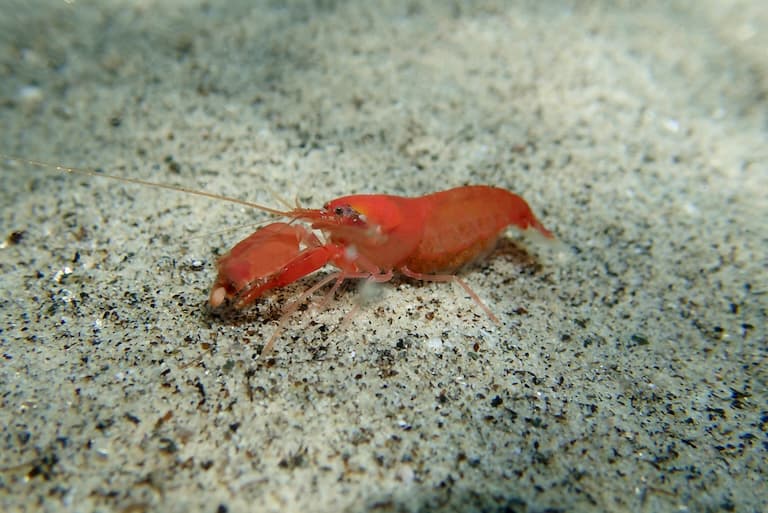
In 2006, the annual world harvest of “shrimp” (this includes prawns) was six million tonnes. A single species of prawn, the Chinese white shrimp, Fenneropenaeus chinensis, makes up over 100,000 tonnes of this, likewise for the Argentine red shrimp (another prawn). Being small animals, they require small holes in large nets to catch them. Benthic, or bottom-dwelling, species require trawlers5.
Sadly, trawlers with huge nets and tiny gaps mean that prawn harvesting is one of the most destructive forces on the planet in terms of ecosystem damage. Not only does it shred coastal ecosystems to pieces, it catches indiscriminately, killing anything in its wake.
This includes many of the 100,000 or so cetaceans and 250,000 or so turtles killed each year by fishing nets. This is how consumers in countries like the UK are quietly contributing to the decline in tropical vertebrate species all over the world6.
Prawn Fact-File Summary
Scientific Classification
| Kingdom | Animalia |
| Phylum | Arthropoda |
| Class | Crustacea |
| Order | Decapoda |
| Family | 7 + Families |
| Species | 540 + |
Fact Sources & References
- “Biological Info: Giant Tiger Prawn (Penaeus monodon) ”, Louisiana Fisheries
- (2024), “GSA Survey Explores the Prevalence of Shrimp Eyestalk Ablation and Challenges to Adopting Alternative Practices”, Global Seafood Alliance.
- Sarah (2016), “Eavesdropping prawns get more than they bargained for”, Oceanbites.
- David (2022), “Why the US military is listening to shrimp”, BBC.
- (2017), “UK’s hunger for prawns is killing thousands of turtles a year”, NewScientist.
- Carolina & Joel (1888), “SUBORDER DENDROBRANCHIATA BATE”, nhm.