
Prairie Rattlesnake Profile
The iconic rattlesnake is notorious as the sniper of all lost cowboy ankles in old Westerns. And while diamondbacks get the coolest name, the most recognition and the widest infamy, there’s a species that can be just as big, strike much harder, has a far more potent venom and is found in more places than any other species.
So why is nobody talking about the Prairie Rattlesnake? Well, we are, right now!
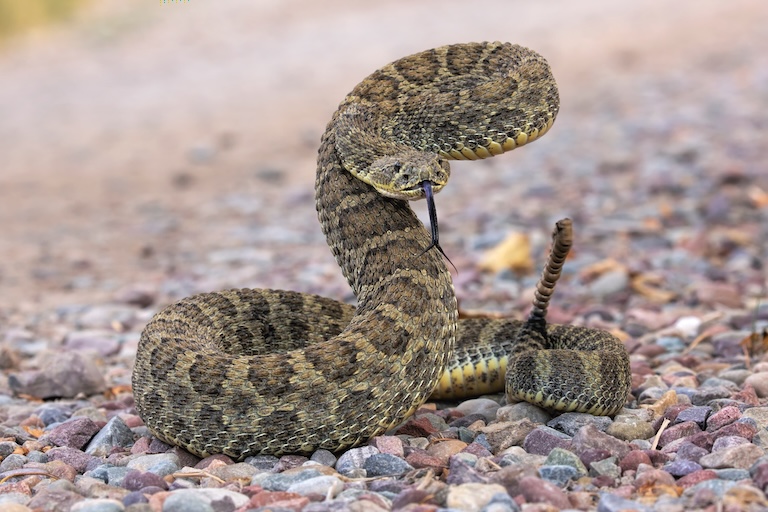
Prairie Rattlesnake Facts Overview
| Habitat: | Grassland and forest |
| Location: | Central North America, from the Rockies to northern Mexico |
| Lifespan: | Up to 20 years in the wild, up to 24 years in captivity |
| Size: | Up to 1.7 m |
| Weight: | Up to 360 g |
| Colour: | Tan with darker brown markings |
| Diet: | Mostly small mammals, but also amphibians, reptiles, insects, birds, eggs, and even carrion |
| Predators: | Raptors, roadrunners. |
| Top Speed: | Usually quite slow to move but with lightening fast strike |
| No. of Species: | 1 |
| Conservation Status: | Least Concern |
The prairie rattlesnake comes in two factory settings. There’s the Arizona and New Mexico variety, sometimes called the Hopi rattlesnake or Arizona prairie rattler, and the subspecies that spans a wider range than any other, simply known as the prairie rattlesnake. Both represent the same species in the most notorious of viper genera. Both hit very hard and very fast, and both have immensely potent and uniquely toxic venoms.
Fortunately for our cowboys, though, as dangerous as their bites can be, they don’t appear to inject enough venom to kill a person directly. For now! Both subspecies are in decline, and while the species as a whole is safe by IUCN standards, local conservation bodies do have concerns about some populations.
Interesting Prairie Rattlesnake Facts
1. They’re true rattlers
There are a lot of pit vipers! By some estimates, over 260 species. Pit vipers are a subfamily of vipers, and the largest in the family, known as Crotalinae. They’re found all over the world where it’s warm enough, but in the New World – that is, the Americas – many of these pit vipers are called rattlesnakes.
Rattlesnakes are, of course, named after the way they use the dry skin at the end of their tails as a way to deter predators.
There are two genera in this subfamily. One is Sistrurus, a small genus of three species of pygmy rattlesnake, and the other is Crotalus, where all the big boy (and girl) snakes hang out. And this latter group is exactly where we find this big boy (or girl): the prairie rattlesnake.
2. They’re big.
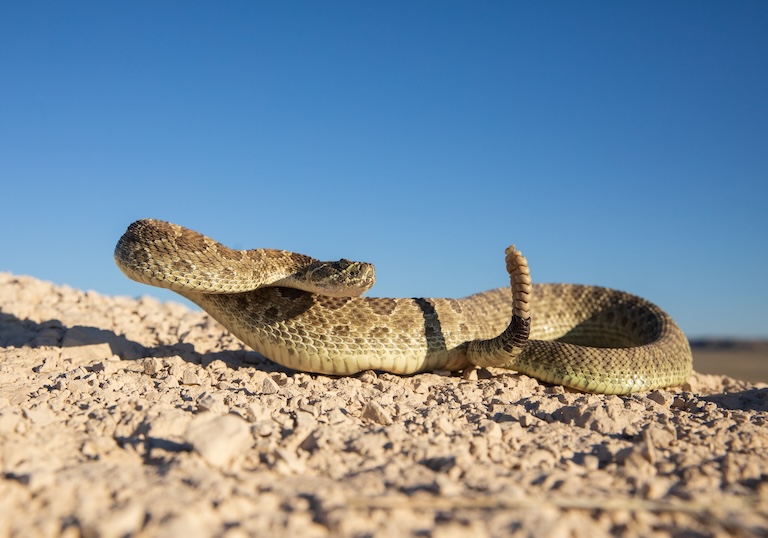
Crotalus snakes generally range in size from half a metre to a metre and a half, with the largest being the enormous diamondbacks. Rare cases have seen the diamondbacks crossing the two-metre mark, but they’re generally around 1.3 metres long.
So the prairie rattlesnake, with its maximum recorded length of around 1.6 metres, is well up there in the largest category of rattlesnake. And they’re surprisingly common!
3. They’re widespread
There are two subspecies recognised in the prairie rattler, and both occupy a very wide range. Crotalus viridis nuntius is known as the Hopi rattler, and inhabits much of the plains of the Central US; Crotalus viridis viridis, on the other hand, spans all the way from Canada to Northern Mexico.
This is the most widespread rattlesnake in North America, and while it has a preference for plains, it can also be found in scrubby forest, too. Sometimes even in the branches!
4. They can climb
That’s pretty impressive for a rattlesnake, let alone such a big one. Prairie rattlesnakes have been known to climb trees on occasion! This isn’t their preferred way of life, though, and is perhaps a behavioural change for the purpose of temperature regulation, as they’re not as nimble in the branches as arboreal snakes, nor do they tropically eat arboreal animals.
This species of snake prefers flat ground, and travels in more or less a straight line. They do this when looking for dens to hibernate in, or leaving them to go on a hunt.
5. They strike hard and fast
Vipers are some of the fastest-striking snakes ever measured, and this serves two purposes. First, since they don’t constrict and rely only on their venom, it’s a way of getting in and out without taking any damage. Second, the strike itself becomes a physical attack, and in the case of this snake, it’s strong enough that the sheer percussive force of the strike can stun its victims.
The strike is also alarmingly accurate. This is a species that rarely misses, and owes its accuracy to its well-coiled spring of an attack, which is over in a flash.
This is ideal, as it allows the snake to stay out of harm’s way and still keep its prey still while the venom has time to take effect.
And this is some pretty serious venom. 1
6. They’re dangerous
Vipers typically have venoms that are more skewed towards tissue damage than the nerve damage of Elapid snakes, and this one is no exception.
The prairie rattlesnake venom is highly toxic to tissues, particularly skeletal muscle tissue. The tiny proteins responsible for this are known as myotoxins, and they cause tremendous damage to the tissue around the bite site, but can get into the blood, too, passing around the body and breaking down muscle tissues elsewhere.
When muscle tissue breaks down, it releases various horrible metabolites into the body that are themselves toxic, so you have a cascade of unpleasant effects from this process, which is known as rhabdomyolysis.
And the prairie rattlesnake venom is more potent than almost all other rattlesnake species in North America! But the saving grace of this fact is in the dosage. Being a generally smaller species, the volume of venom is much less, and so this snake isn’t considered as dangerous as the diamondbacks, for example.
So, this isn’t a snake that’s widely considered lethal to humans, but humans are certainly lethal to them.
7. Are they doing fine?
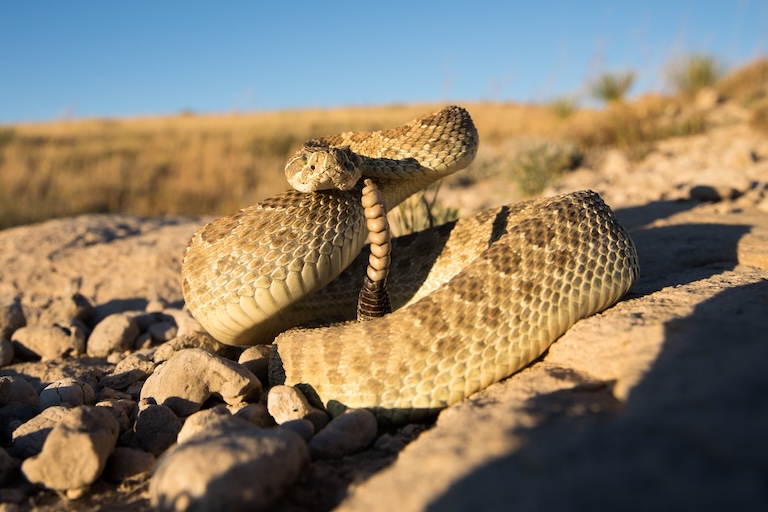
This species is listed by the IUCN as of Least Concern, but in Canada, the Committee on the Status of Endangered Wildlife in Canada (COSEWIC) has them listed as “Of Special Concern”, since 2015.
This ranking seems to place the species at a similar attention level as the IUCN’s “Near Threatened” status, and relates to its significant decline within Canada that promises to threaten the species as a whole if it isn’t addressed.
The difference likely relates to the various populations, with the most northerly of them naturally experiencing the most extreme winters, and this will limit the amount of breeding time they have. In North Dakota, this species’ hibernation time is double that of the Texas populations, for example.
Further, the IUCN covers the species globally, while the COSEWIC listing only refers to the populations in Alberta and Saskatchewan.
On both sides of the border, though, habitat loss and hunting are the primary causes for the species’ decline. 2
Prairie Rattlesnake Fact-File Summary
Scientific Classification
| Kingdom | Animalia |
| Phylum | Chordata |
| Class | Reptilia |
| Order | Squamata |
| Family | Viperidae |
| Genus | Crotalus |
| Species | viridis |
Fact Sources & References
- Harry Russell (2022), “Crotalus viridis ”, Animal Diversity Web.
- , “Prairie rattlesnake (Crotalus viridis) COSEWIC assessment and status report 2014”, Government of Canada.