
Prairie Chicken Profile
In the US nowadays, you’re more likely to hear boomers complaining about the carpets in their second homes to their emaciated grandchildren, but it wasn’t always this way! The vast, open expanses of grasslands that span much of the American continent were, not too long ago, sprawling with birds known as boomers.
Also known as Prairie Chickens, these impressive boomers are still hitting it, and while their numbers are greatly reduced, they might be making a comeback.
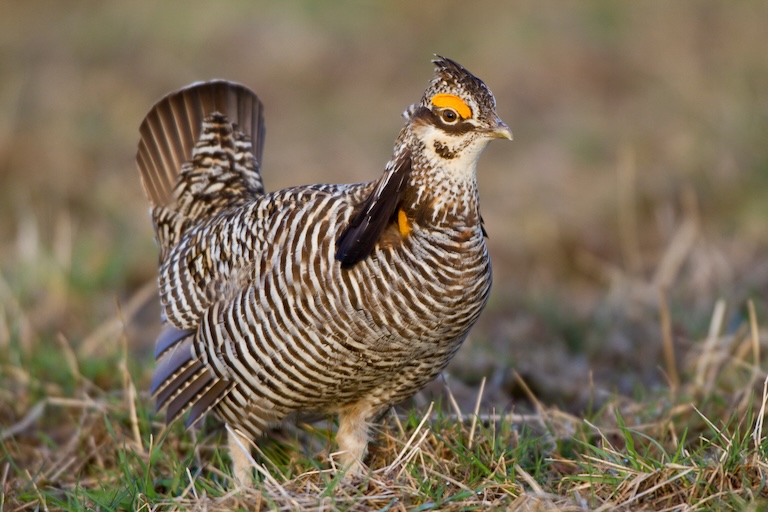
Prairie Chicken Facts Overview
| Habitat: | Prairies, plains |
| Location: | US, up to Canada, through to Alaska |
| Lifespan: | Up to 13 years |
| Size: | Up to 47 cm (19 inches) long |
| Weight: | Up to around 1 kg (35 oz) |
| Colour: | Speckled brown with red neck pouches and orange eyebrows |
| Diet: | Seeds, leaves, fruits, buds, cultivated grains, and insects |
| Predators: | Mostly humans, but also coyotes, foxes, raptors |
| Top Speed: | Nor recorded |
| No. of Species: | 3 |
| Conservation Status: | Greater is listed as Near Threatened, and the Lesser is listed as Vulnerable. Sharp-tailed grouse Least Concern |
Prairie Chickens are three species of almost-chickens, in the grouse tribe of the fowl family. Like most North American fauna, they were once breathtakingly abundant and have since been devastated by human hunting and habitat destruction. But they were also the first animals to inspire Americans to conserve a species, and while there have been some casualties, the lessons learned from this process seem to be working for many of them!
Interesting Prairie Chicken Facts
1. They’re not quite chickens
Prairie chickens are rather chicken-like. They’re in the Galliformes order, which they share with our most abundant livestock, as well as turkeys, pheasants and grouse. All of these are also in the same family, too: the Phasianidae family, all of which are terrestrial, so they are very closely related.
But they diverge from the chickens just below the family level, and while chickens are in the Gallini tribe, prairie chickens are members of the Tetraonini tribe, making them technically a type of grouse!
There are three species in the prairie chicken genus, and its name, Tympanuchus, gives us a little clue as to one of their characteristic behaviours.
2. OK Boomer
The ear drum, as most of us call it, has an anatomical name, too. It’s called the Tympanic membrane. This word shows up again on the side of a frog’s head, where the circular discs of skin, known as tympana, cover its ears.
The word actually comes from the Greek for drum, in the verb form, as in, to hit something, and this is where this genus of birds gets its root, too.
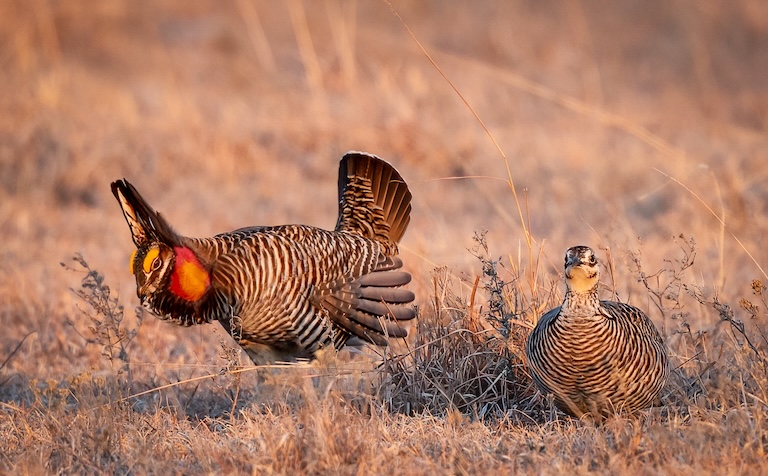
Because these are drumming birds, and alongside the common name Prairie Chicken, they’re also called Boomers. Boomers are named for the sounds they make by inflating air sacs of various types and sending a thudding sound thorough them, which can then be manipulated by muscles on the air sacs into long ascending or descending notes.
Many, many birds in the Galliformes order have some form or another of this communication, for example, turkeys, known for gobble-gobbling, also produce a rising boom from air sacs in their chest.
Prairie chickens have an incredible range of noises they make, and they do so to communicate quite a lot of different messages, usually relating to sex.
3. They lek
When prairie chickens get horny, they gather in their masses for a good lekking.
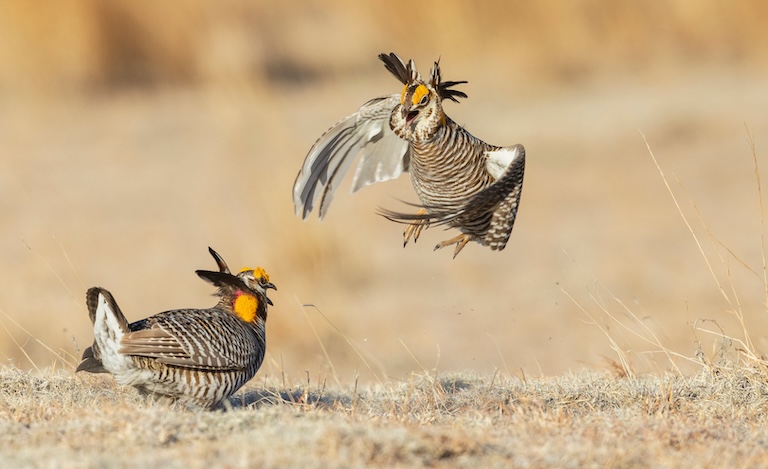
Males gather together in wide open areas and compete with one another for the favour of the females. This involves displays of aggression, dancing, and lots and lots of booming.
Mates are chosen, in large part, for the complexity of their sounds, as well as how active and energetic they are. This is an exhausting process, but since prehistory, it had worked out well for them. 1
4. They were once everywhere
Until not too long ago, prairie chickens were impressively abundant and widespread. They spanned from Northern Mexico all the way up through Canada and into Alaska. They could be found across all of the high plains of Colorado, well into the Texas panhandle, and beyond.
These birds were a staple in much of the terrestrial landscapes across North America, but with the population boom after colonialism, hunting pressures and the expansion of agriculture almost wiped them out. 2
5. They almost went extinct
Today, the boomers are a fraction of their former glory, and for the birds, this has nothing to do with hoarding equity, but all to do with the ravaging of their habitats and the hunting of their members.
In the early ’30s, the heath hen, a subspecies of the greater prairie chicken, went extinct. Martha’s Vineyard held the last 300 for decades after they were wiped out from the mainland, but conservation efforts saw this figure rise significantly, and the subspecies was on track for a remarkable recovery, reaching over 2,000 individuals. But in 1916, a fire wiped out almost all of them, and a particularly frigid winter to follow pretty much finished the job. The dwindling few left were picked off by goshawks, diseases, and more harsh winters.
The rest of this genus have suffered in kind, to varying degrees. Their ranges are now miniscule when compared with their former grandeur, 3
6. But some are on their way back!
Interestingly, this bird was the first animal that Americans tried to save from extinction, and paved the way for conservation as a discipline in the Americas. Of course it didn’t work for the heath hen, and there is a lesson there about keeping all your hens in one basket, but for the remaining species there is some promise.
The greater prairie chicken is on the rise, with the IUCN estimating around 360,000 individuals and counting but still considered Near Threatened. The sharp-tailed grouse is of Least Concern, at 760,000, and the lesser prairie chicken is the exception, with a Vulnerable tag and a decreasing population.
So, there’s room for improvement, but the prairie chickens aren’t done yet. Conservationists are trying to work alongside agriculturalists to create a world that works for both, and projects like the Working Lands for Wildlife are pairing agriculture with conservation and rewilding to this end. With any luck, the lesser prairie chicken will rebound and join its mainland cousins in making a healthy recovery! 4 5
Prairie Chicken Fact-File Summary
Scientific Classification
| Kingdom | Animalia |
| Phylum | Chordata |
| Class | Aves |
| Order | Galliformes |
| Family | Phasianidae |
| Genus | Tympanuchus |
| Species | 3 Species |
Fact Sources & References
- Jeremiah Muldowney (2014), “Tympanuchus pallidicinctus ”, Animal Diversity Web.
- Jamison et al, “The Effects of Management Practices on Grassland Birds—Lesser Prairie-Chicken (Tympanuchus pallidicinctus)”, USGS Science For a Changing World.
- (2020), “Greater Prairie-chicken”,IUCN RedList.
- , “Working Lands for Wildlife (WLFW)”, USDA.
- , “Lesser Prairie-Chicken Initiative”, USDA.