
Potoroo Profile
Kangaroos and their ilk are known to be large, hoppy animals, but throughout their history they have expanded into various other niches, too. Most of these experimental designs have since become extinct, but there are still kangaroos up in the trees, and there are still kangaroos down in the understory, too.
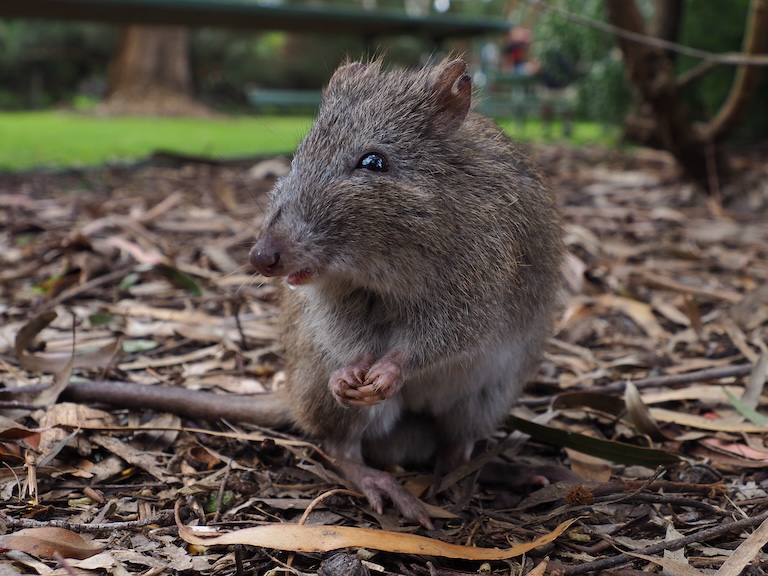
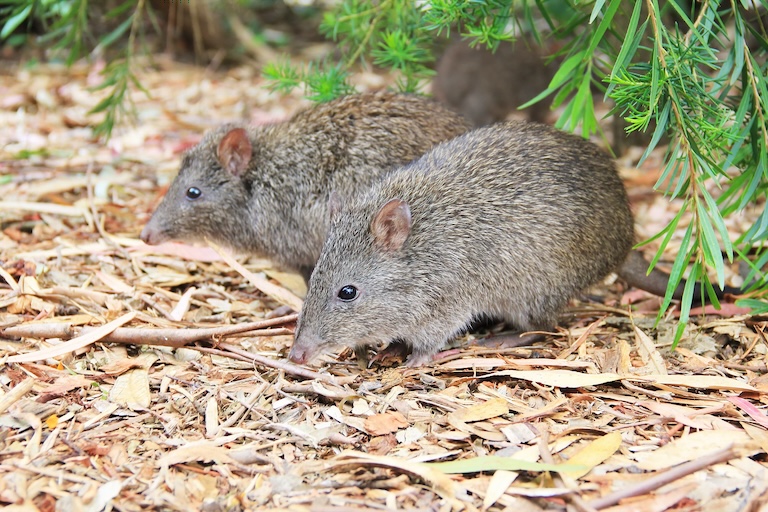
And it’s these small, scurrying examples we’re discussing today. Darwin described them as, “as big as a rabbit, but with the figure of a kangaroo”. And that’s pretty characteristically appropriate. This is the Potoroo, a group of so-called rat kangaroos that remind us there’s more to the clade than just Skippy.

Potoroo Facts Overview
| Habitat: | Forests and woodlands, areas with thick ground cover and lots of rain |
| Location: | Australia |
| Lifespan: | 7 in the wild, 12 in captivity |
| Size: | 40 cm, tail length up to 320 mm additional |
| Weight: | Up to 2.3 kg in males |
| Colour: | Grey-brown |
| Diet: | Some are generalist feeders of plants and insects, and at least one eats primarily fungi |
| Predators: | Foxes and cats |
| Top Speed: | Unknown |
| No. of Species: | 3 extant, one extinct |
| Conservation Status: | Near Threatened, Vulnerable and Critically Endangered. |
Potoroos are small kangaroos. They’re members of the rat-kangaroo family, making up one of three genera within it.
Despite their history of abundance, they weren’t all that well documented, and now that they’re in steep decline, things are getting even harder to figure out. One species is critically endangered and the other two are not all that far behind. And that’s a real shame, as they are all significant custodians of the forest floor ecosystems they inhabit.
Interesting Potoroo Facts
1. They’re Rat-Kangaroos
Australia has almost no native placental species. When it became isolated from the rest of the world, mammals everywhere were mostly marsupials, and while placentals took over in almost all other realms, they didn’t quite make it to Australia. As such, the bats who flew there, the marine mammals who swam there, and a handful of rodents who rafted there from New Guinea 8 million years ago, make up the placental populations. .
Dingos, who are naturalised immigrants, are the descendants of domestic dogs brought over just a few thousand years ago.
So, all other mammal niches are filled by marsupials. And this means that most of the niches rodents would fill are filled by marsupials instead.
Hence: rat-kangaroos, who are members of the kangaroo order, Diprotodontia, but distinctly rat-shaped and rabbit-sized.
These marsupials still jump like kangaroos, but are somewhere between a large rodent and a small wallaby in appearance. They share the family with the bettongs, and are defined as members of the genus Potorous. And it seems as though the more charismatic members of their order get all the attention, as the potoroos aren’t all that well understood.

2. They’re not very well known
The Long-nosed potoroo is still doing the best out of the three species, but is still thought to only number around 75,000 individuals in total. But this group of marsupials was once described as far more widespread and abundant.
These are solitary, nocturnal, relatively small animals that hide very well in the bush, and so they’re not well studied at all, and they’re all in decline. The majority of information on Potoroos comes from the long-nosed species, and lots of inferences are made about the other two from it.
Long-nosed potoroos produce around 2.5 the 3 litters per year on average, dig little holes in the ground to forage, and eat pretty much anything they can find. But this latter point is one key difference between the species. 1
3. Some eat everything
Of the three species of potoroo, it seems that the long-nosed is also the least fussy when it comes to food.
Long-nosed potoroos eat cranberries, fungi, grasses, juicy stems, roots, and tubers on the veggie side, as well as insects for protein. They also eat grass and seeds. This species prefers fungi, though, which is the most common food chosen.
But while it clearly has a preference, this is nowhere near as extreme as is found in its close relative.
4. Some eat only fungi
Plants may look pretty stupid, and they certainly don’t snap back very quickly when you insult them for this, but there’s a lot more going on beneath the surface than there seems to be.
Almost all plants on Earth are connected via chemical communication pathways in the soil, and these pathways are made possible by fungal mycorrhiza. This is almost brand-new information to science, so we’re not about to tell you what it all means, but it’s certainly important and groundbreaking stuff regarding ecological networks and the Gilbert’s Potoroo, then, becomes a custodian of these networks by way of its dietary preference.
Poop from this species of potoroo was made up of around 90% fungus, and it’s thought that the nibbling of little Gilbert stimulates healthier growth of the mycorrhiza, and reinforces the communication networks beneath the soil.
The remaining 10% is mostly sand and root mass, which came along for the ride, and a few insect pieces here and there. This species has now become one of the most fungus-dependent mammal species on record.2 3
5. Settlers considered them a pest
As mentioned, these little guys were once found all over Australia, and when the colonists came over they made note of this. They also noted how much of an annoyance it was that the native potoroos were gnawing away at the roots of their planted crops.
Potoroos were given the hat of shame and marked as a pest species by these farmers, and this might have something to do with why there aren’t many left, now. 4
6. They’re in serious trouble
In 1994, the Gilberts potoroos were rediscovered in a small location in Two People’s Bay in Western Australia. They had previously been considered extinct, and so this now represents perhaps the final stronghold of the species, which is Critically Endangered. IUCN estimates around 49 individuals of this species remain.
Other species are faring somewhat better, but not great, with the Long-footed potoroo listed as Near Threatened and the Long-nosed potoroo thought to be Vulnerable.
Historically, they were persecuted by farmers as pests, but the primary threats now seem to be from invasive predators and competitors such as rats, cats and foxes. Recovery of a population of 49 is a long-shot, especially considering the slow rate of reproduction in the species.5 6
7. They breed slowly
One thing distinctly unrat-like about these rat-kangaroos is their ability to multiply. Potoroos are primarily solitary, and when it comes to reproduction, they seem to have around one offspring at a time, though can do this 4 or 5 times a year.
This, no doubt, contributes to their decline in all extant species, as their recovery is limited by their slow reproductive rates, especially when compared with alien competitors like invasive rats.
Predation comes from natural predators, but far more devastatingly from introduced ones like cats and foxes, which are contributing to their eradication in all species .
So, the plight of the little rabbit-sized kangaroos is a serious and worrying one, and their study is of the utmost importance, as is the continued removal of non-native predators and the protection of their habitats in general. 7
Potoroo Fact-File Summary
Scientific Classification
| Kingdom | Animalia |
| Phylum | Chordata |
| Class | Mammalia |
| Order | Diprotodontia |
| Family | Potoridae |
| Genus | Potorous |
| Species | 3 species |
Fact Sources & References
- Nathan Landesman (1999), “Potorous tridactylus ”, Animal Diversity Web.
- Mark Irwin (2000), “Potorous longipes”, Animal Diversity Web.
- Woinarski et al (2016), “Gilbert’s Potoroo”, IUCN RedList.
- (2018), “Long-nosed potoroo”,NSW Government.
- Jennifer Gumas (2005), “Potorous gilbertii ”, Animal Diversity Web.
- (2016), “Gilbert’s Potoroo”, IUCN RedList.
- Courtenay et al (2022), “Conservation”, Gilbert’s Potoroo Action Group.